Anime Dice Calculator: Cash per Luck and the Next-Dice Wait
Every Anime Dice dice price re-read at native resolution, turned into cash-per-Luck arithmetic from the 42x rung to 5,000,000,000x, plus the wait formula.
Preguntas frecuentes
Does Anime Dice have an official calculator?
How much does one point of Luck cost in Anime Dice?
Which Anime Dice dice should I buy next?
How long do I have to wait for the next dice in Anime Dice?
Is there an Anime Dice rebirth calculator?
Can I calculate my Anime Dice roll odds?
What Can You Actually Calculate in Anime Dice?
Search for an Anime Dice calculator — or an anime dice roller — and you get third-party pages that promise to compute your odds, your rebirth ladder or your next dice. The client itself contains no calculator at all — and the developer has never published a price table, an odds table or a changelog. What the client does contain is one panel that prints two numbers side by side on every unbought dice row: a green Luck value and a green cash price.
Those two numbers support exactly one division, and it turns out to be the division that answers the question people actually have: how much cash one point of Luck costs at that rung, and therefore whether the next rung is worth what it asks. Everything numeric on this page is a frame re-read by us at native 1920x1080 on 2 October 2026, or a division made from two such reads and labelled as ours.
Two things this page deliberately does not do. It does not reprint the rung-by-rung dice catalog — that lives on the dice shop guide, which carries each row with its own provenance. And it does not print a probability table, because the client never prints the pool a roll draws from; the last section explains what it does print.
Sources: every number and both illustrations come from two screen recordings that pass our cleanliness rules — no facecam, no channel branding, no burned-in captions. Cx’s I Went Noob To PRO in Anime Dice Roblox (uploaded 18 September 2026, 24 minutes 47 seconds, no facecam, no burned-in captions) supplies the low rungs and one Rebirth panel; LEK RB’s Thai-language beginner walkthrough and UPD 6 review (uploaded 1 October 2026, 16 minutes 50 seconds, no facecam and no burned-in captions from its second 20 onward) supplies the high rungs, the cash-per-second plates and the second Rebirth panel. Five of its stills carry an incidental Windows
Activate Windowsoverlay in the bottom-right corner of the OS desktop; that overlay is not creator branding and has been removed from those images, and neither recording carries a channel watermark, a lower third or burned-in captions. Every string quoted here was re-read at native resolution or in a magnified crop of it, because numbers read off a thumbnail sheet have been wrong on this site before — including a$50octhat a native frame reads as$5oc.

The UPD 6-window session whose Dice Shop frames carry the top of the ladder, the Rebirth pair and the cash-per-second plates
How Much Cash Does Each Point of Luck Cost?
The Dice Shop panel answers this if you accept one step of arithmetic of your own: price divided by Luck. Both inputs are printed by the game; the division is ours, and we say so on every row below.
| Dice row | Luck printed | Cash price printed | Cash per 1x Luck (our division) | Read from |
|---|---|---|---|---|
| the 42x row — no name printed on it in our frames | 42x | $500k | ≈ $11.9k | Cx 6:14 |
| Ice | 100x | $4m | $40k | Cx 6:14 |
| Magma | 200x | $30m | $150k | Cx 6:14 |
| Blood Moon | 3,000x | $100b | ≈ $33.3m | LEK RB 1:36 |
| Void | 6,000x | $750b | $125m | LEK RB 1:36 |
| Toxic | 150,000,000x | $750sx | $5t | LEK RB 1:52 |
| Ethereal | 375,000,000x | $10sp | ≈ $26.7t | LEK RB 1:46 |
| Frostfire | 950,000,000x | $250sp | ≈ $263t | LEK RB 1:46 |
| Alchemy | 2,000,000,000x | $5oc | $2.5qd | LEK RB 1:40 |
| Radiant | 5,000,000,000x | $100oc | $20qd | LEK RB 1:40 |
This is an arithmetic table, not the catalog. It is ordered by the division rather than by the ladder, it carries no rarity labels, and it lists only the rows we re-read. For the ladder in order — every row with its rarity word and the frames behind it — use the dice shop guide. The Read from column doubles as the era of each reading: Cx was uploaded 18 September 2026, before UPD 6, so those three low rows are a pre-UPD 6 reading; LEK RB was uploaded 1 October 2026, inside the UPD 6 window, which is what the rest of the table and both Rebirth panels below come from.
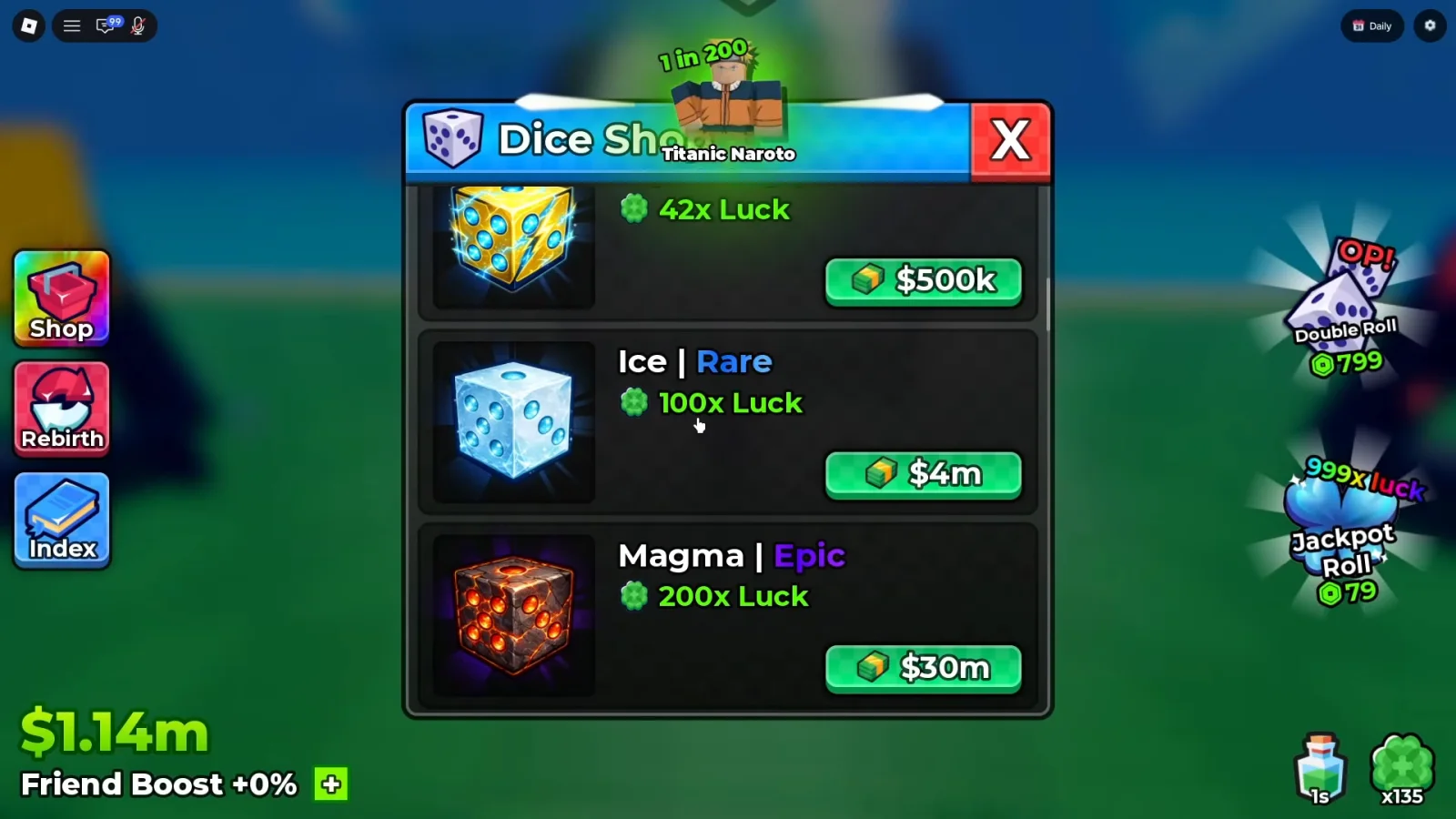
The lowest rungs we could re-read: 42x for $500k, 100x for $4m, 200x for $30m.
The gaps between those rows are just gaps: between Magma at 200x and Blood Moon at 3,000x there are rungs we never saw priced, because the UPD 6 account had already bought them and a bought row shows an Equip button instead of a price.
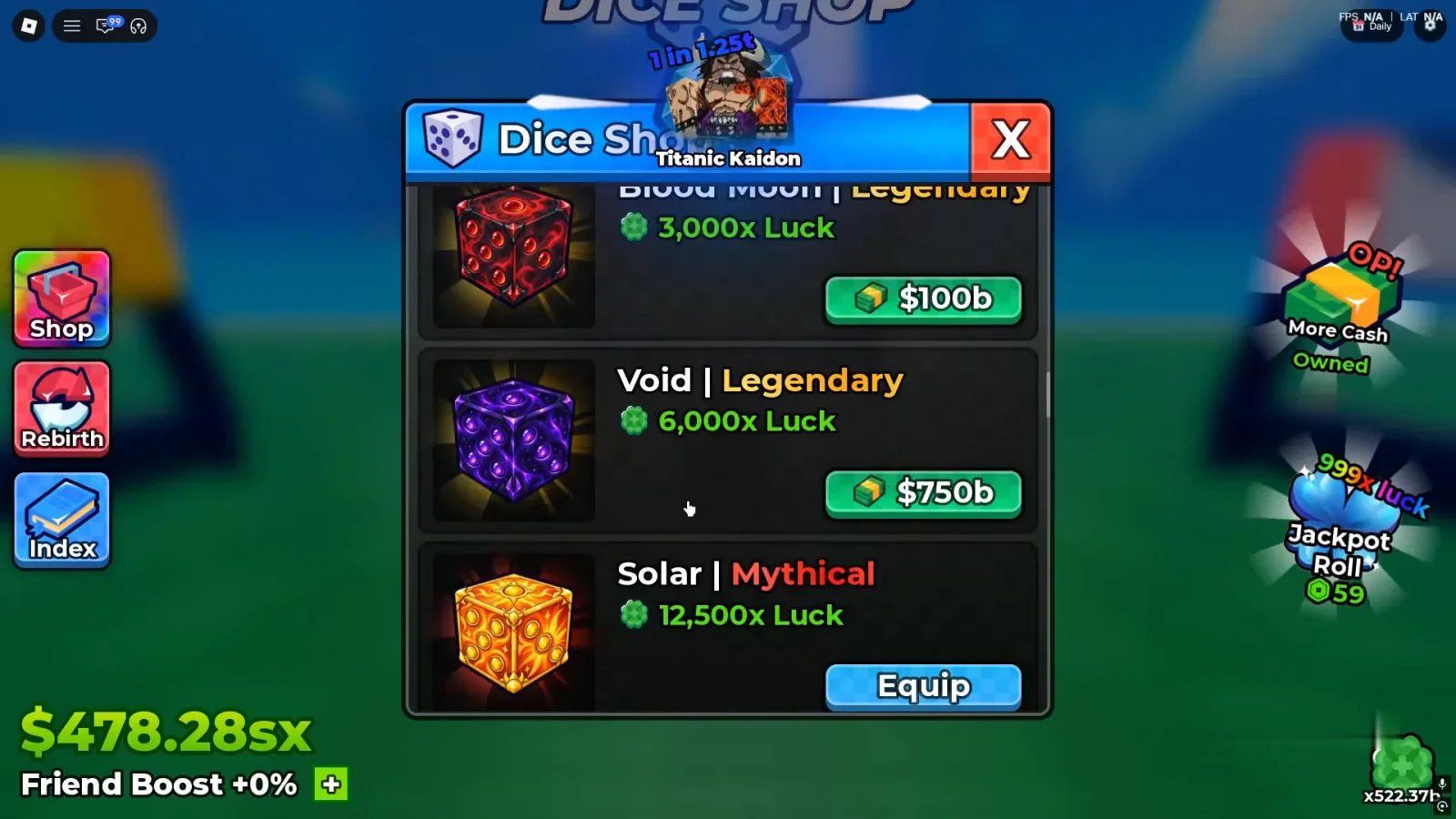
Blood Moon at $100b and Void at $750b — the two readings this page adds to the record.
Watch the Blood Moon, Void and Solar rows at 1:36
Before the division is worth anything, the shorthand has to be stated, because the panel uses letters rather than digits. One convention runs through every figure on this page: k is a thousand, m a million, then each further label — b, t, qd, sx, sp, oc — is a further thousand-fold step. The bottom of the ladder confirms the first two outright (500k, 4m, 30m on one screen); the rest is confirmed by the ladder’s own shape, because the price never drops and every suffix change lands in the same 7.5x–25x band as the steps inside a suffix. If the suffixes were anything other than thousand-fold steps, the ladder’s prices would have to fall at a suffix boundary, and they never do.
Which Dice Rung Is the Better Buy?
Read the table downward and the answer falls out: cash per 1x Luck only ever rises. Take the adjacent pairs we could re-read inside a single frame, and compare what one rung buys over the one below it:
| Adjacent pair | Price multiplies by | Luck multiplies by | Cash per 1x Luck multiplies by |
|---|---|---|---|
| 42x → Ice 100x | 8x | 2.4x | 3.4x |
| Ice 100x → Magma 200x | 7.5x | 2x | 3.75x |
| Blood Moon 3,000x → Void 6,000x | 7.5x | 2x | 3.75x |
| Toxic 150,000,000x → Ethereal 375,000,000x | 13.3x | 2.5x | 5.3x |
| Ethereal → Frostfire 950,000,000x | 25x | 2.5x | 9.9x |
| Frostfire → Alchemy 2,000,000,000x | 20x | 2.1x | 9.5x |
| Alchemy → Radiant 5,000,000,000x | 20x | 2.5x | 8x |
Every row in that table says the same thing: the price of a rung grows several times faster than the Luck it hands you. Across those seven pairs the price multiplies by 7.5x to 25x while the Luck value multiplies by only 2x to 2.5x, which is why the per-Luck cost of a rung is 3.4x to 9.9x worse than the rung below it.
So the practical answer to “which dice is the best buy” is anticlimactic: the next rung you have not bought is the cheapest Luck you will ever be offered again. There is no rung further up the ladder that is more efficient per point of Luck, so saving up to leap over one buys you a worse rate, not a better one. The only reason to climb at all is that a dice rung is a ceiling rather than an addition — one dice is Equipped at a time, so the Luck you own is the one row you are standing on, and the rung above is the only way to raise it.
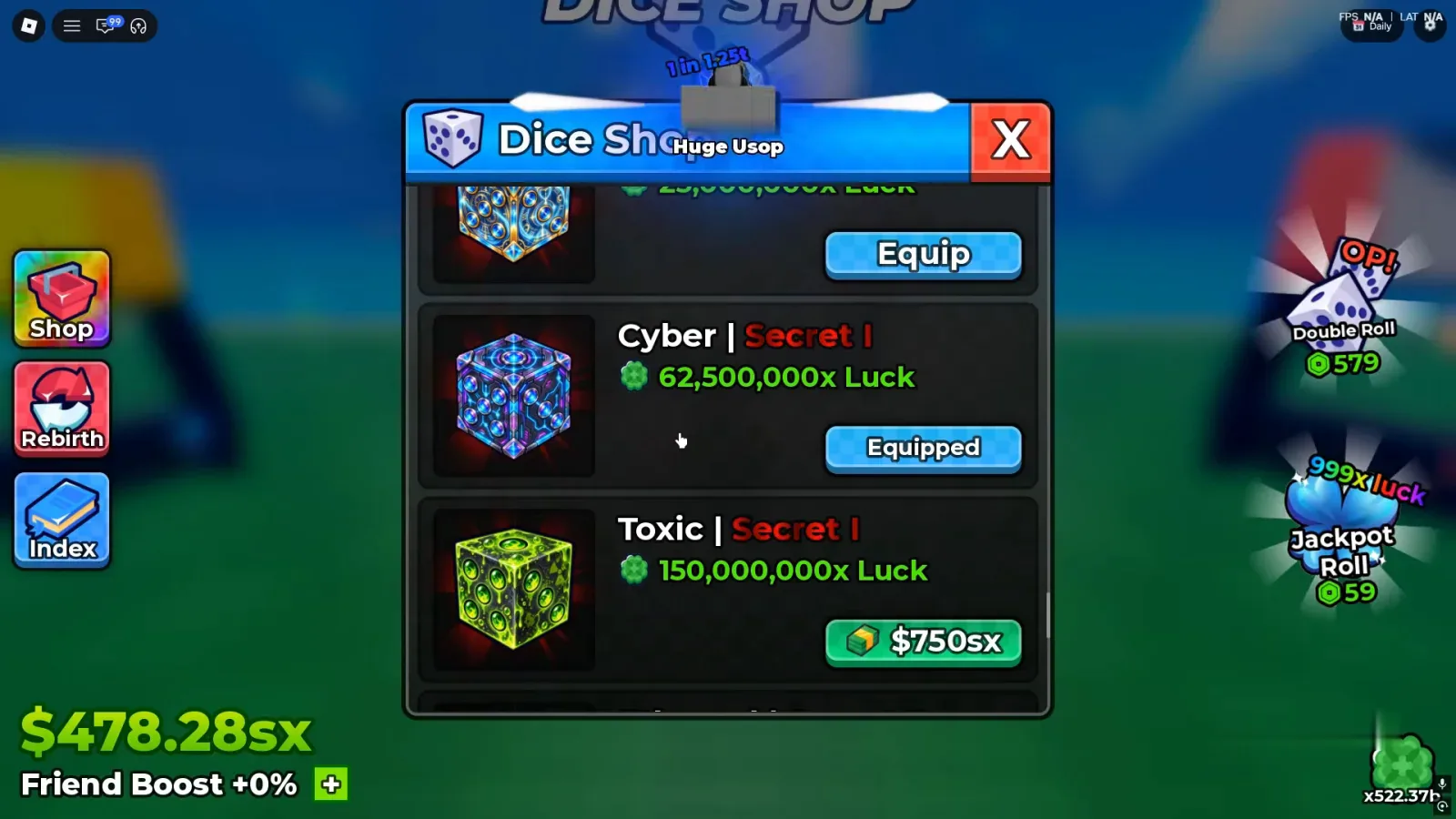
The UPD 6 account’s own position on the ladder: Cyber equipped, Toxic still priced.
Watch the Cyber and Toxic rows at 1:52
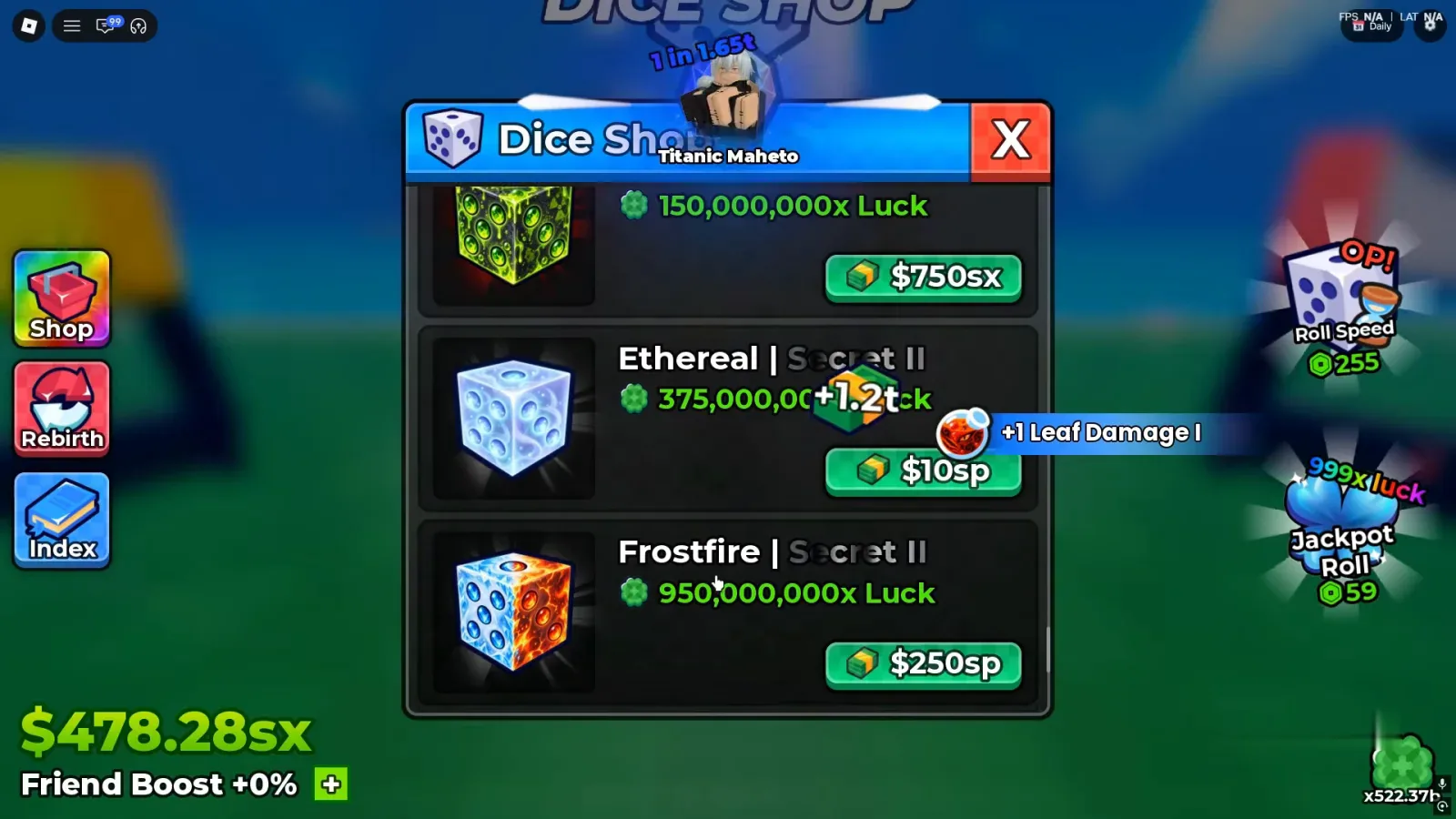
The Secret tier is where the per-Luck cost starts multiplying by roughly ten per rung.
Watch the Ethereal and Frostfire rows at 1:46
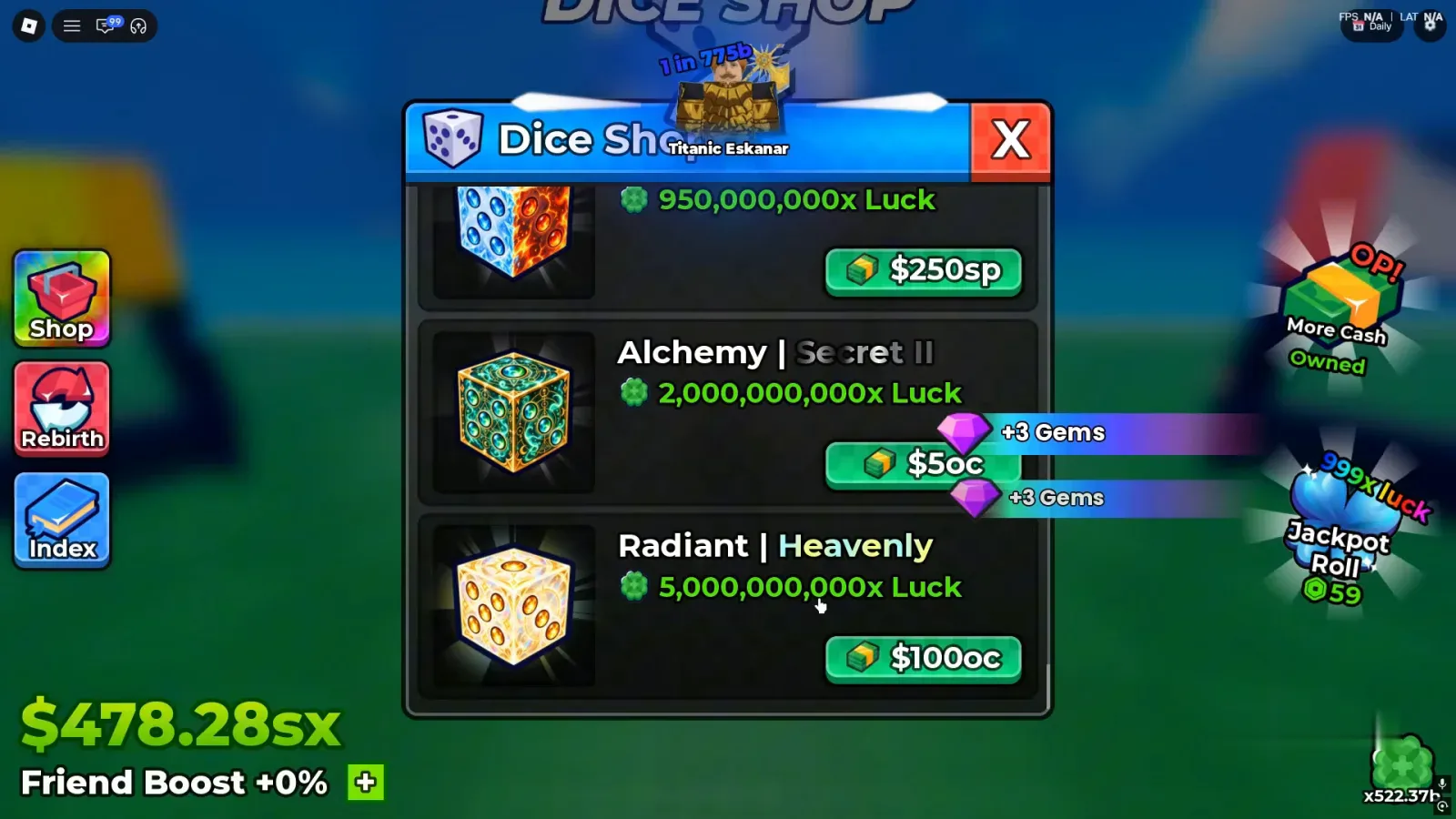
Alchemy at $5oc on the middle row of this frame — we confirmed it against a 4x crop of the price pill. Where another page of ours still prints $50oc, this is the corrected reading.
Watch the Alchemy and Radiant rows at 1:40
How Long Until You Can Afford the Next Dice?
The second calculation the panel supports is a wait, and it needs one number the panel does not give you: your own cash per second. The client prints income per unit, not per account, on the plate under each unit standing on your plot — $1.4k/s, $1.3k/s, $19k/s in the frames we read. Add up the plates you own, and:
wait in seconds ≈ the printed price ÷ your own cash per second
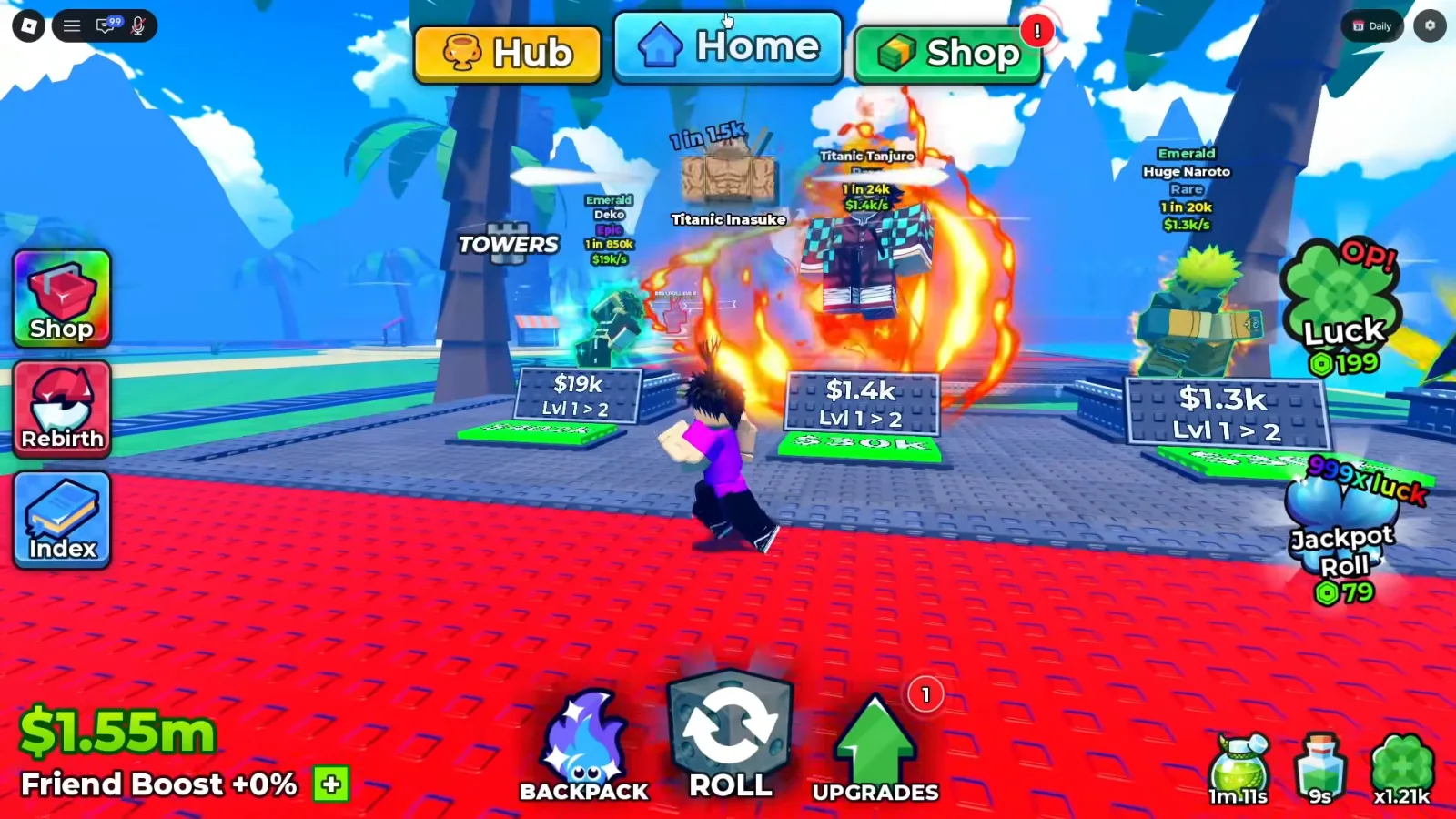
Income is printed per unit, on the nameplate, right under that unit’s own roll odds.
Watch the per-unit income plates at 11:00
No screen in either recording prints an account-wide cash-per-second total. That is why this section hands you a formula rather than a number, and why the two examples below are labelled as arithmetic rather than as screen output.
The same division, run at the top of the ladder, is the argument for why the ladder stops being a cash-saving exercise. Void asks $750b. At the same $2.7k/s, that is roughly 278 million seconds — about 8.8 years. Frostfire asks $250sp and Alchemy $5oc, and at that income the numbers leave the human scale entirely. The gap is not a grind problem; it is the reason the ladder leans on the Cash half of the Rebirth multiplier and on late-tier units, which is the ground the rebirth guide and the unit level guide cover. Free cash from live codes and the hours that accrue while you are away, explained on the offline earnings page, are the other two faucets that move a price tag like that.
Why Doesn’t Anime Dice Have a Working Rebirth Calculator?
The same arithmetic instinct says “if I know my rebirth count, I should be able to compute the next multiplier and its price”. The panel refuses, and our own frames are the reason we can say so rather than shipping the calculator.
The Rebirth panel prints a current Luck multiplier, an arrow, the multiplier the next click buys, and one cash cost under a progress bar. It never prints a count, a ladder position or a table. Two native frames from our two recordings show exactly what it does give you instead:
| Frame | Luck row | Cash row | Cost printed under the bar |
|---|---|---|---|
| LEK RB 2:25 (UPD 6 window) | 14x → 17.5x | 14x → 17.5x | $478.28sx / 1sp |
| Cx 14:10 (18 September 2026) | 2x → 2.5x | 2x → 2.5x | $19.19m / 500m |
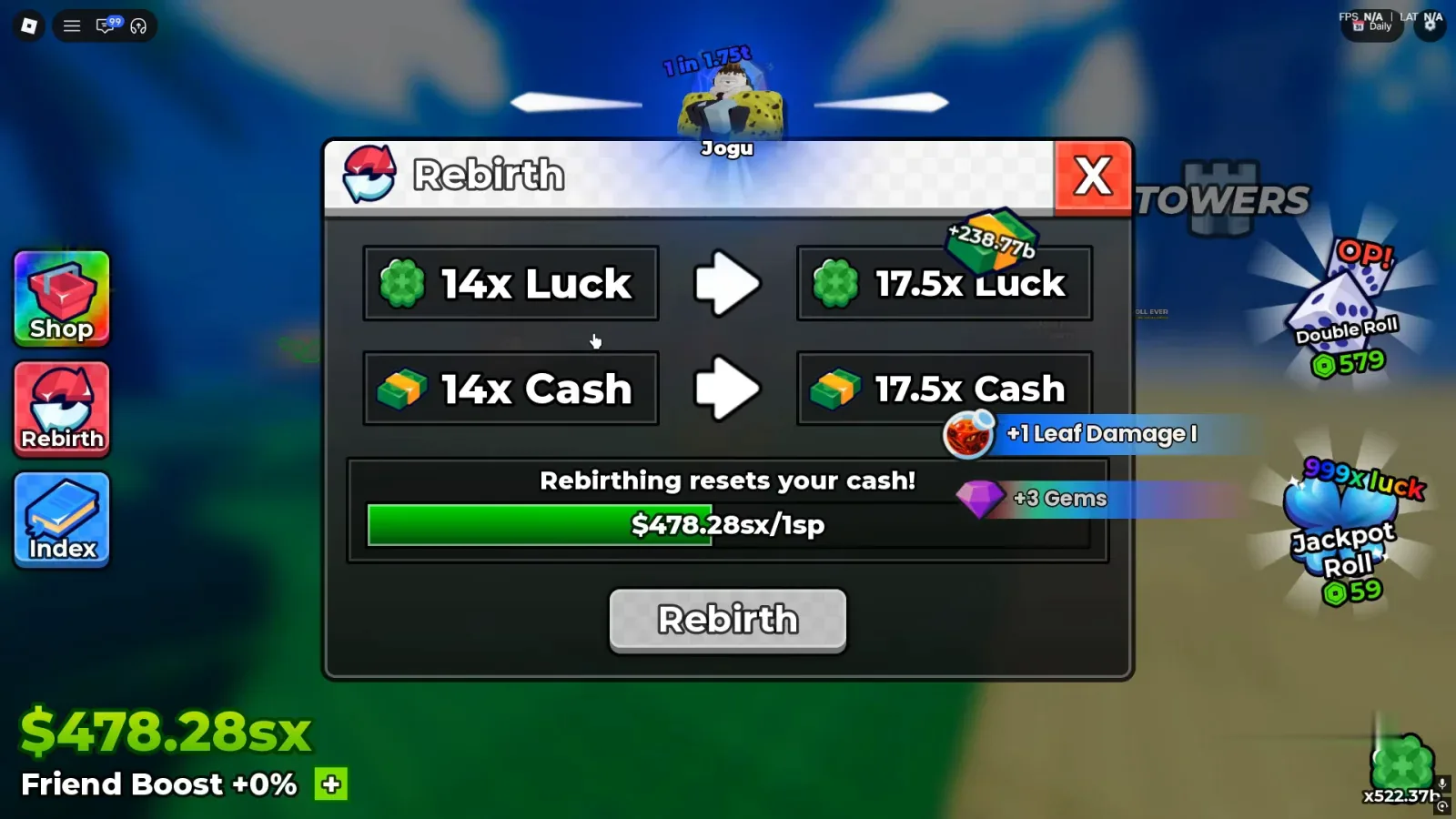
Fourteen to seventeen and a half, for one sextillion-odd — and no printed count that got it there.
Watch the 14x Rebirth panel at 2:25
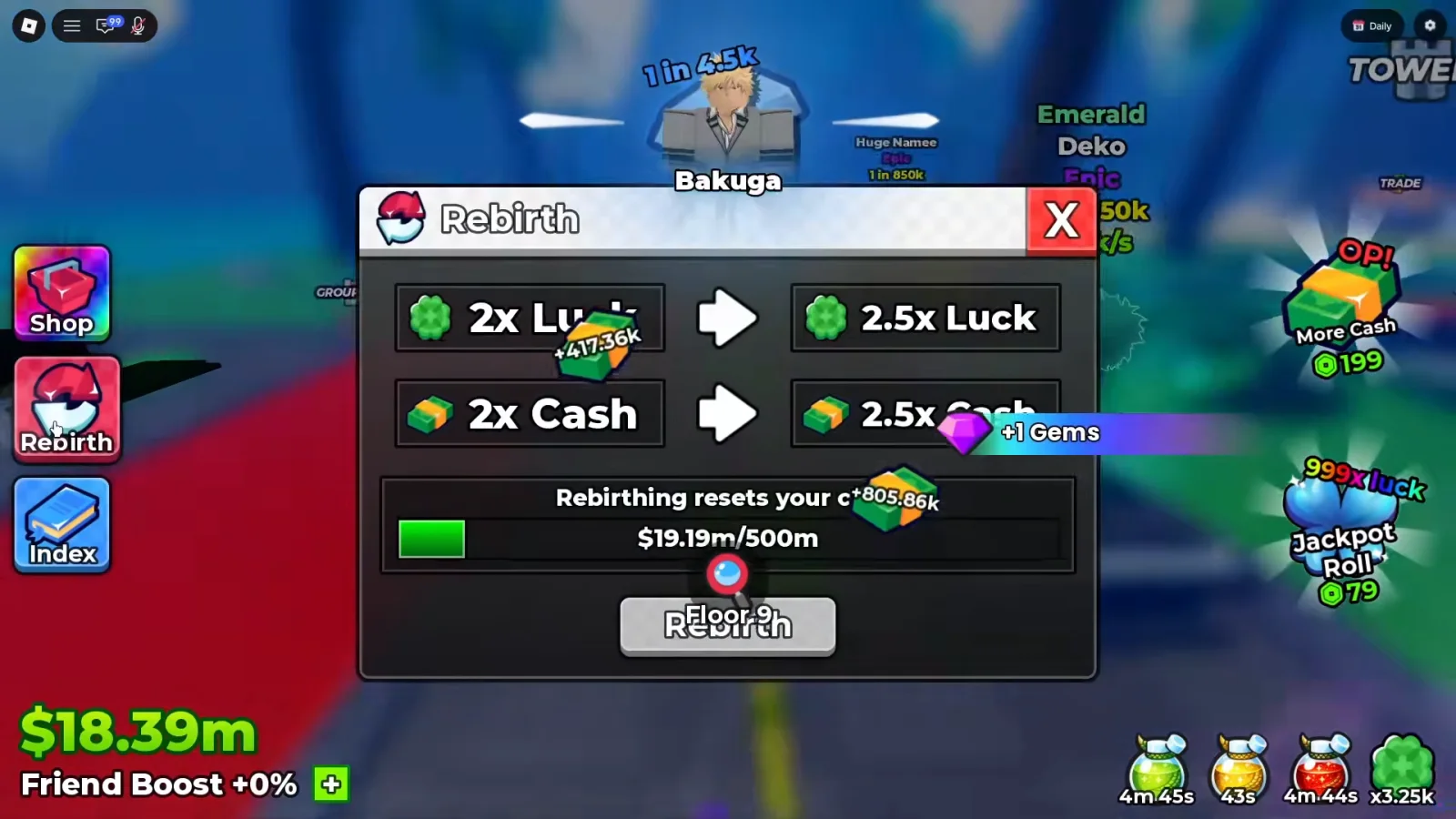
A different account, a different pair, the same panel — 2x to 2.5x at a 500m bar.
Watch the 2x Rebirth panel at 14:10
Now put our two readings next to the pairs and costs our rebirth guide already recorded from other sessions: 1x → 1.5x, 2x → 2.5x, 3x → 4x, 4x → 5x, 14x → 17.5x, and one 30x → MAX, with costs of 50k, 500m, 5t, 500t and 1sp. Two things kill the calculator outright:
- The step size is not a rule.
1x → 1.5xis a 1.5x step,2x → 2.5xis 1.25x,3x → 4xis 1.33x,14x → 17.5xis 1.25x. Four steps, four different ratios, and the30x → MAXrow has no ratio at all because the right-hand box prints a word instead of a number. - The costs are not geometric. From
50kto500mis a ten-thousand-fold jump;5tto500tis a hundred-fold jump;500tto1spis millions-fold. A ladder you could compute would need a constant factor between tiers, and there is none across the tiers we have.
A rebirth calculator has to accept “my rebirth count” and return a pair and a price. To do that it needs the count-to-pair mapping, and no screen in any recording this site has made prints it — the panel shows your pair, not the table behind it. That is why sites that advertise “verified constants” for this ladder are showing you a table the game never displayed. The honest instrument for Rebirth is the panel in front of you, read the same moment you plan to click; the guide linked above is where we keep every pair and price we have actually seen.
Why Is There No Dice Probability Table Either?
The probability half of “anime dice calculator” runs into a different wall. The client does print odds — just never the pool they come from. Roll banners carry a per-result 1 in N over the character (1 in 200 in the low-rung frame, 1 in 4.5k in the 18 September session’s rebirth frame, and 1 in 1.25t, 1 in 1.65t, 1 in 1.75t and 1 in 775b in the UPD 6-window session), and each placed unit’s nameplate repeats that figure under its name (1 in 24k, 1 in 20k, 1 in 850k).
What no panel prints is the denominator behind a roll: how many results a roll can land on, how the weights are distributed, or the probability of a whole rarity tier. Our grades guide has the one ladder the game does print — the per-grade 1 in N and chance percentages on the Grades panel — and that is a grade ladder, not a roll-pool model. Without a printed pool, a “dice probability” table is an assumed model: you would be choosing the pool yourself and then presenting your own assumption as the game’s math. We would rather print the 1 in N figures the client shows you and stop there.
What Could We Not Read on the Dice Ladder?
The list is short and specific:
- Nature’s price, and Solar’s. Neither appears priced in these two recordings. Solar’s row is visible in the UPD 6 frame but shows
Equip, so that account had already bought it. - The name of the 42x row. It is the cheapest priced rung in our frames and no second we captured prints a name for it: the row’s own text area carries only
42x Luck, with a unit-pickup banner card sitting over the panel above it in the seconds the shop was open. We print its numbers and not its name. - Every rung between Magma at 200x and Blood Moon at 3,000x. Those rows are
Equip-state on the UPD 6 account, and they never scrolled into view unpurchased in the other recording. - Every rung between Void at 6,000x and Toxic at 150,000,000x. Same reason, one tier up.
- Whether the ladder enforces in-order purchase. No row is ever marked locked, so the screen does not answer it.
- The total number of rungs, and any price above Radiant’s
$100oc. Higher rows may exist; none appeared in either recording. - How dice Luck combines with rebirths, gamepasses and potions. No screen prints a total, which is the whole reason the luck guide reports sources instead of a formula.
If your own panel shows a rung we cannot, a dated screenshot through the contact page settles it and gets credited here.
What Should You Read Next?
- Dice Shop guide — the full rung-by-rung catalog with each row’s own provenance
- Luck guide — every place the game prints a luck number, and the total it never prints
- Rebirth guide — the pairs and costs behind the section above, frame by frame
- Upgrades tree guide — the other thing your cash can buy while a dice rung waits
- Grades guide — the one odds ladder the client actually prints
- Unit levels guide — the cash sink that raises your income, not your luck
- Offline earnings — what accrues while a big price tag waits
- Live codes — free cash and boosts before you commit to a rung
Artículos relacionados
guides
Anime Dice How to Trade: the Two-Column Trade Window, Frame by Frame
Anime Dice trading read frame by frame: a two-player window with Ready per side, then Accept, Confirming, Saving and a Completed toast. No prices, no value list.
guides
Anime Dice Unit Levels: How to Level Up and What Each Level Costs
Anime Dice unit levels read frame by frame: the level sign on your plot, the cash the next level takes, a seven-step price ladder and the level cap nobody prints.
guides
Anime Dice Gears: Rarities, Bonuses and Where They Drop
Anime Dice gears are UPD 6 tower-drop equipment worn in the Backpack's Gears tab. We read six of them frame by frame: name, rarity word and bonus row.
¿Te resultó útil?
¡Gracias por tu opinión!