Anime Dice Luck: Dice, Potions, Rebirth, Gamepasses and Server Luck
Anime Dice luck sources read off full-resolution frames: dice rows, potion stacks, rebirth, Luck hex nodes and gamepass cards — plus the server luck gap.
FAQ
Where does luck come from in Anime Dice?
Do Anime Dice luck sources stack?
Is there server luck in Anime Dice?
Is there a potion luck percentage in Anime Dice?
How much luck does each dice in the Dice Shop give?
How much do the Upgrades tree's Luck nodes cost?
Are the luck gamepasses worth buying?
Why does the luck card on the HUD show a different Robux price than the shop?
What Counts as Luck in Anime Dice?
Luck is not one system in this game. It is a word printed on five or six unrelated screens, and each screen shows you only its own slice. The Dice Shop prints a Luck line on every row; the Upgrades honeycomb carries a clover branch of Luck I, Luck II, Luck III and upward; a potion tooltip prints a multiplier behind a clover glyph; the Rebirth panel pays a luck multiplier; and the Robux shop sells a Luck and an Ultra Luck gamepass card. Spins are the sixth: a Lucky Spin and a Jackpot Spin each load a multiplier onto one roll.
The important thing about that list is what is missing from it. No screen we found prints a total, a breakdown, or an explanation of how the pieces combine — and none of them prints a server-wide luck figure at all, which is the question this page was written to answer honestly.
Every screen here was read frame by frame from three clean screen recordings:
Sources: the seven frames below come from three sessions, each checked frame by frame at full resolution on 25 September 2026: Cx’s I Went Noob To PRO in Anime Dice Roblox (uploaded 18 September 2026, 24 minutes 47 seconds), Superlex Plays’ MY JOURNEY TO ETERNAL TRAIT! + REBIRTH 10 | Anime Dice! Roblox (uploaded 24 September 2026, 24 minutes 44 seconds) and Plique Games’ ATUALIZAÇÃO ANIME DICE NOVA MÁQUINA, PERSONAGENS E MAIS! ADEUS TOP 1 GLOBAL (uploaded 19 September 2026, 14 minutes 30 seconds, Portuguese narration). None of the three carries burned-in captions or a channel watermark. One thing worth stating about the Plique Games upload, because it can look like creator furniture at a glance: some of its frames show another player’s avatar and name tag hanging in the upper right of the world, which is in-game content rather than an overlay — the corner holds only the client’s Daily button and gear in the frames we shipped. Every image on this page was inspected at full resolution before it was used. The developer publishes no luck documentation, no effect table and no changelog; our update history is the record of how thin that is.

The session whose HUD frames carry the OP! Luck card, the 999x luck Jackpot Roll quick-buy and the +1 Luck I world pickup
Where Does Luck Come From in the Dice Shop?
The Dice Shop is the base of everything else, and it is the one place where luck is printed as a plain property of an object. Walk into the DICE SHOP stall in the hub, and every row of the panel gives you four things: the dice’s name, its rarity in colour-coded text, its Luck value in green behind a clover glyph, and its cash price on a green pill.
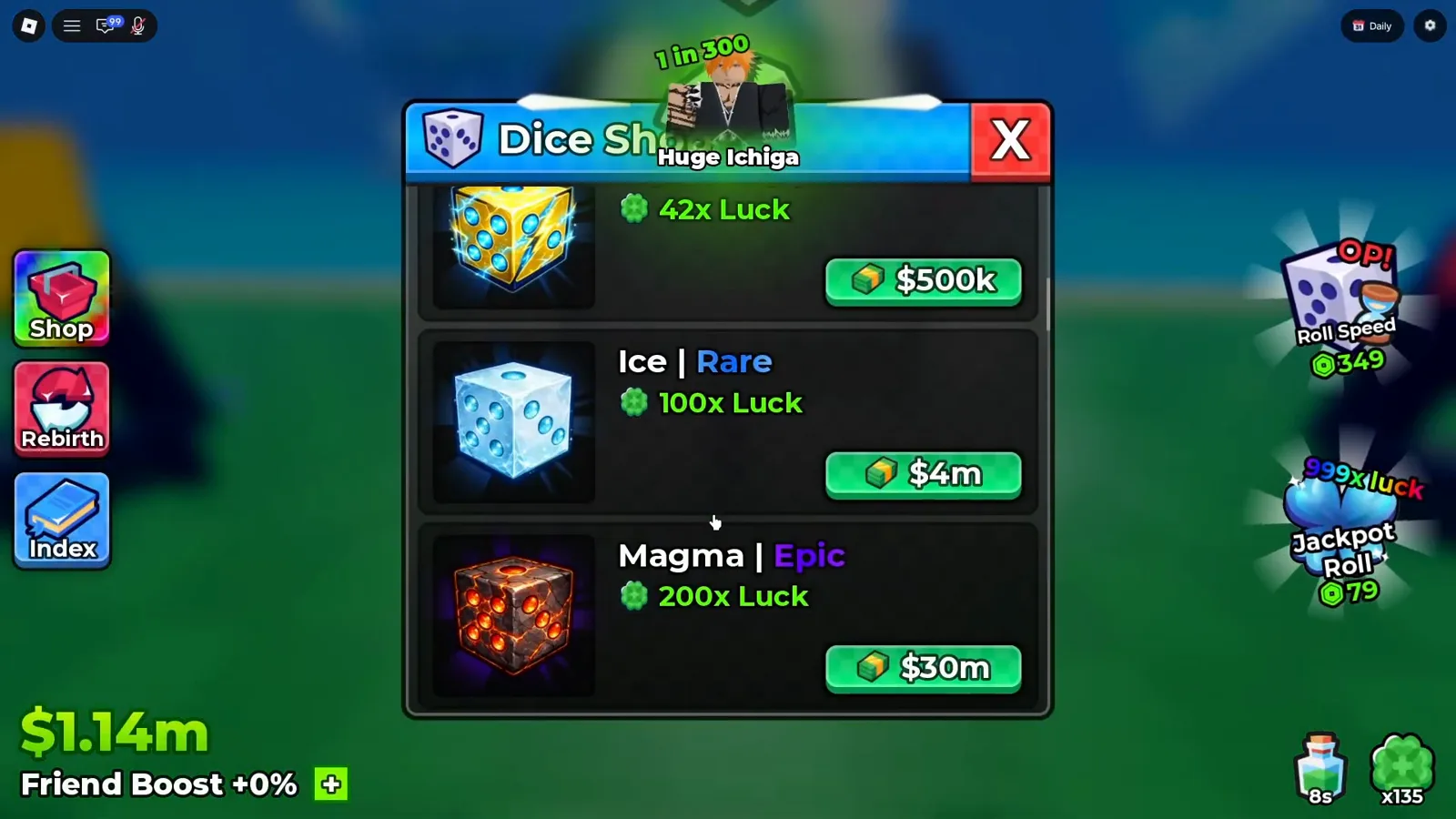
Every row prints a Luck value and a price; the ladder is the base your account readout grows from.
Higher up the same list the numbers get large and the names finally come out from behind the panel edge:
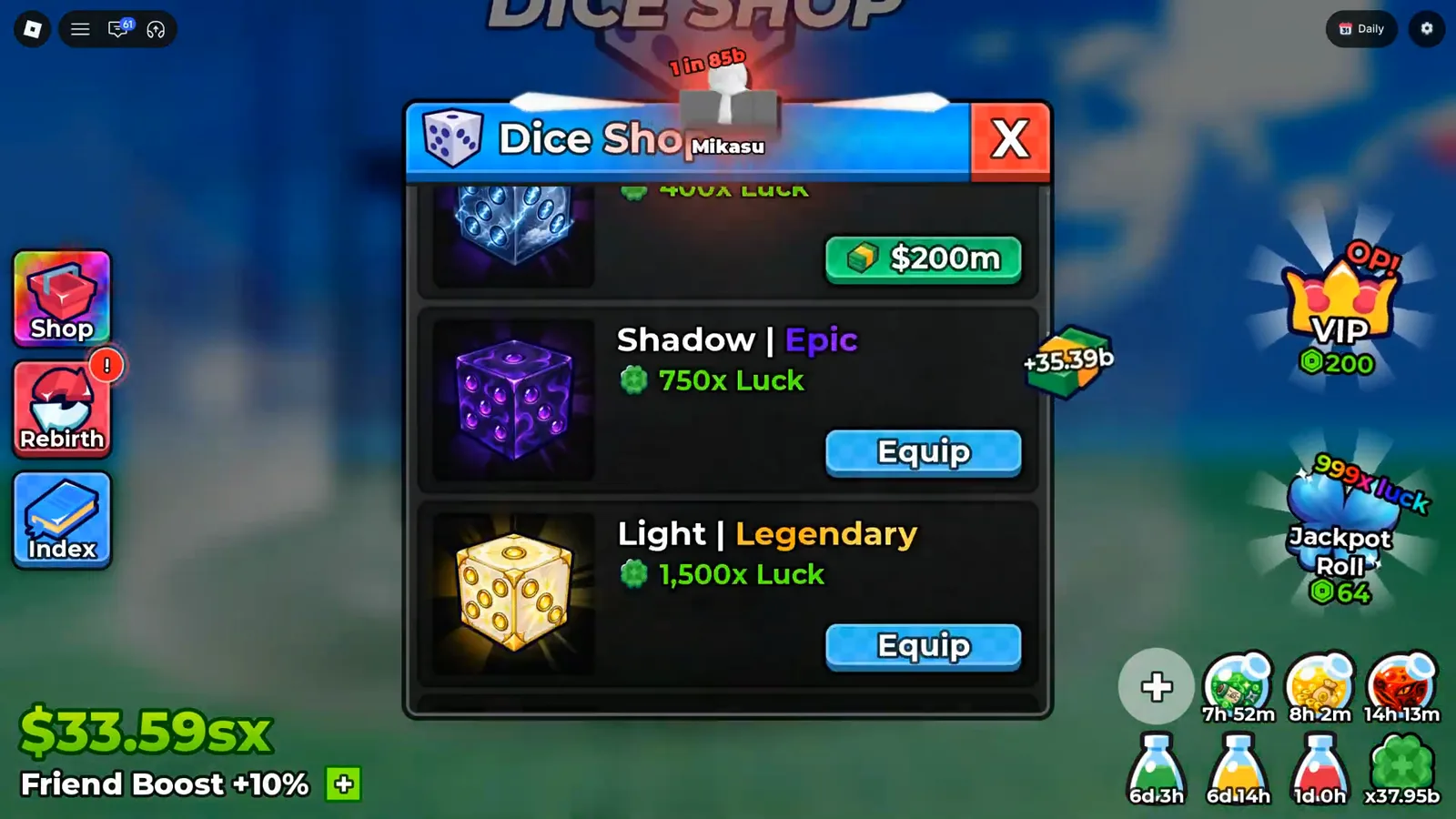
Six hundred seconds into the session the mid-ladder rows are all legible at once.
Watch the Shadow and Light rows at 0:20
Two rules fall straight out of those rows. One dice is Equipped at a time — the rows you already own show Equip or a blue Equipped, not a price, so the ladder is a sequence and not a stack of additions. And the Luck value belongs to the dice, not to you: our dice shop guide found Lunar printing the same 25,000x on a first-run account and on an end-game one, which is how we know the row value is the object’s property.
What the rows do not tell you is where your readout ends up. The creator in our first session says it out loud at 20:40, right after buying the 750x dice: “750 luck from the dice, including the luck event, including everything else.” Ten minutes earlier, at 12:50, he reads his own number twice in one breath — “400 luck, which is now 2.4k luck with the potions and whatever.” That is a player narrating his own screen, not a published formula, and it is the closest thing to an explanation that any of these three recordings contains.

The from-zero session that climbs the dice ladder and opens the Upgrades tree's clover branch on camera
What Do the Upgrades Tree’s Luck Nodes Cost?
The second place luck is printed is the honeycomb behind the green UPGRADES arrow. Its clover branch is named Luck, and each node carries a green cash price underneath it — which makes the tree the only luck system where you can read the price and the name in the same breath.
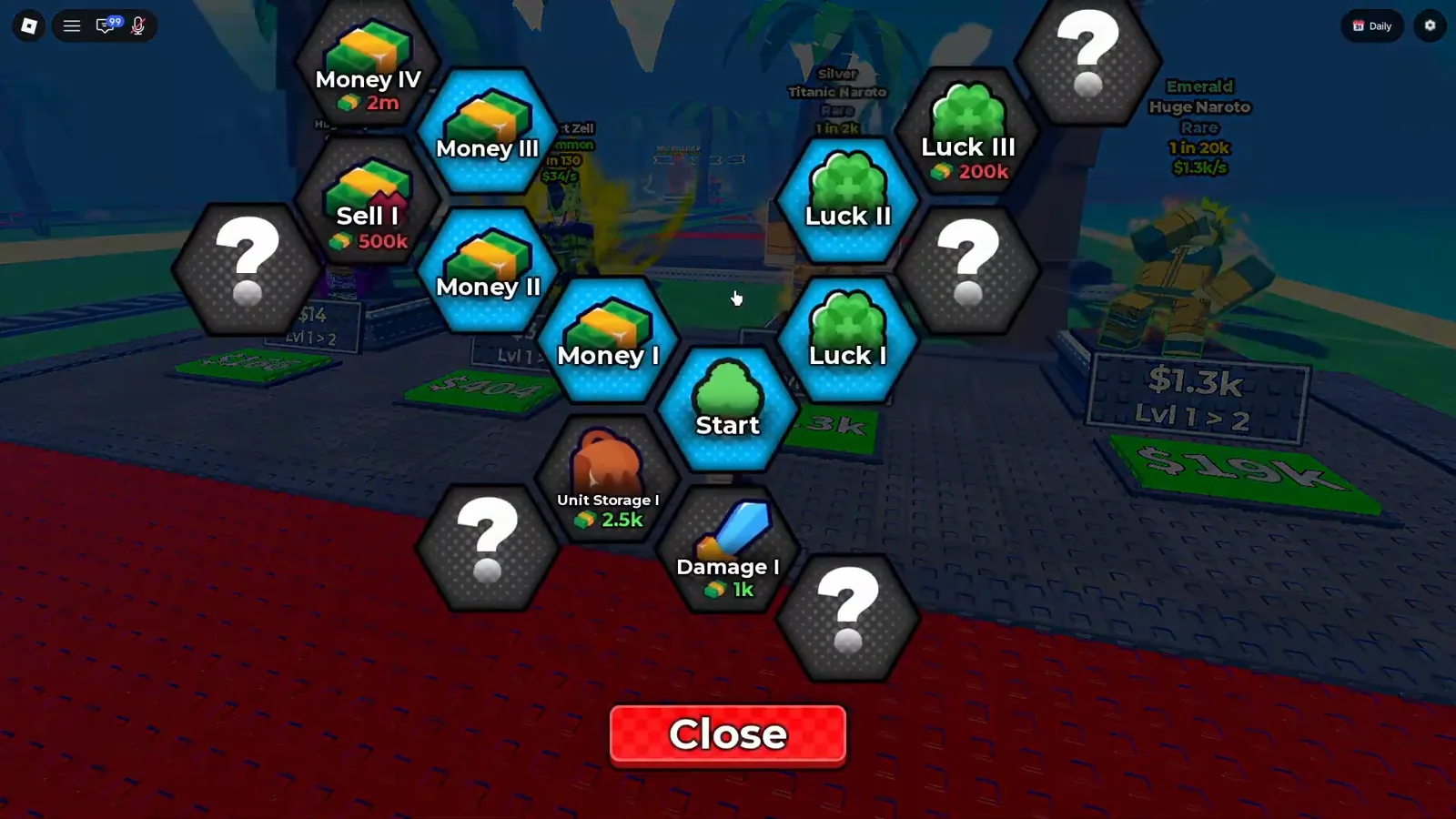
Luck I, II and III in the same honeycomb — only the top of the three prints a readable price here.
Watch the Luck hex nodes at 3:20
Later in that same session, after the branch has grown well past tier III, the chain is long enough to count:
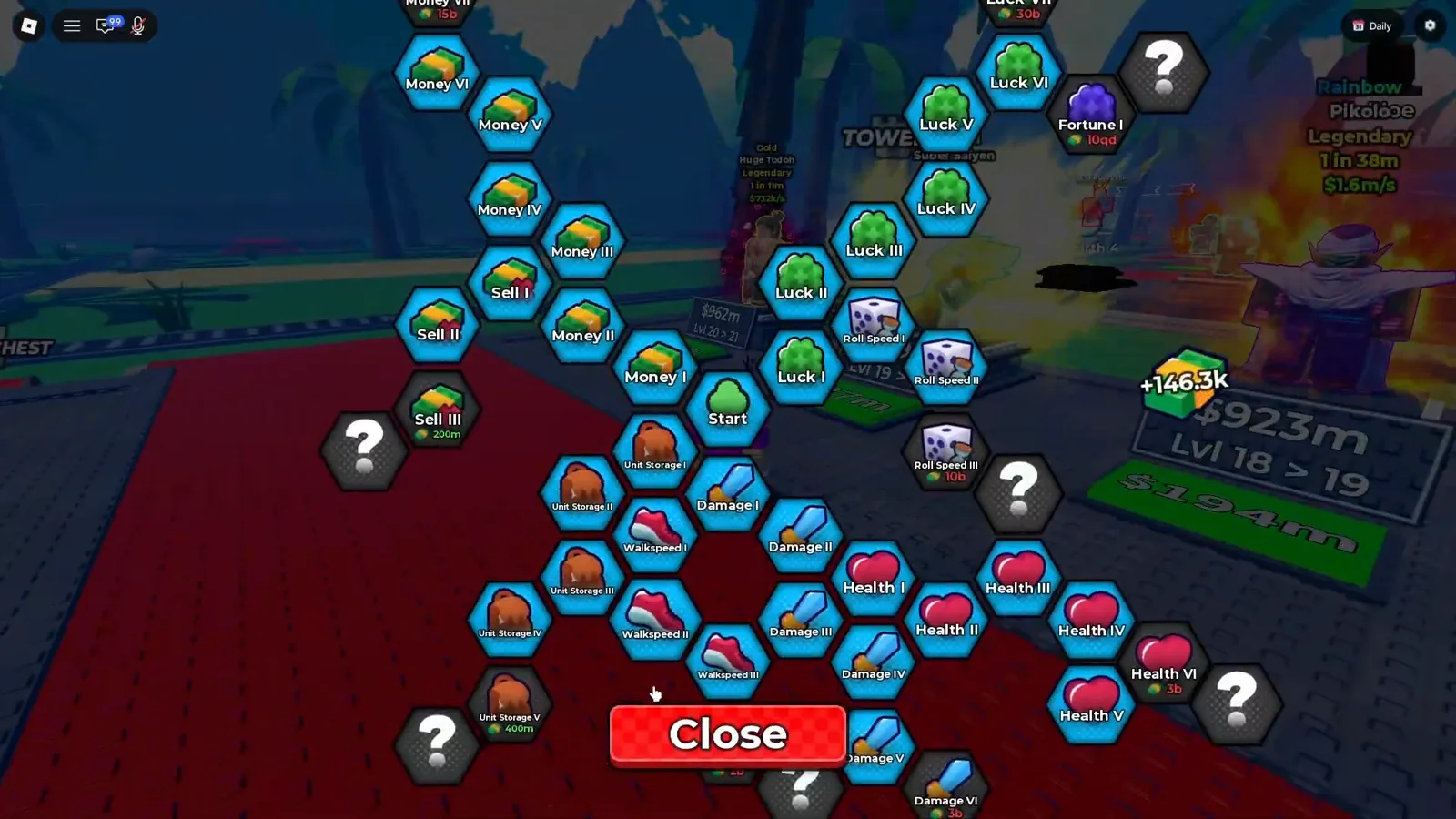
23:43. Two luck-family prices in one frame: Luck VII at 30b and Fortune I at 10qd.
Watch the deep luck chain at 23:43
Read the two frames together and you have the cost curve of the clover branch: from a tier-I node priced in the hundreds of thousands up to Luck VII at 30b, plus a second, purple-clover family called Fortune whose first node is priced 10qd. Our upgrade tree guide owns the rest of that record — its frames give Luck I at $500 and, on the Fortune side, the only luck-family effect tooltip anyone has captured: Fortune IX, +6x. That tooltip is the one number in this whole system that says what a node does, and even it does not say what the +6x multiplies.
What the tree never prints is a percentage under a Luck node. Every price is there, every name is there, and the effect is blank. That is why this page gives you costs and refuses to give you per-node values.
What Do Luck Potions Actually Add?
Potions are the third source, and they are the one where the game states a multiplier outright — on the item’s own tooltip. Our potions guide has the readings in full; the short version is four lines and nothing else: a name such as Pirate Luck III, a rarity, a multiplier such as x3 behind a clover glyph, and a duration line such as Lasts for 4m 0s. Luck IV printed x4.25 over 5m 0s, Cursed Luck III printed x2 over 3m 0s.
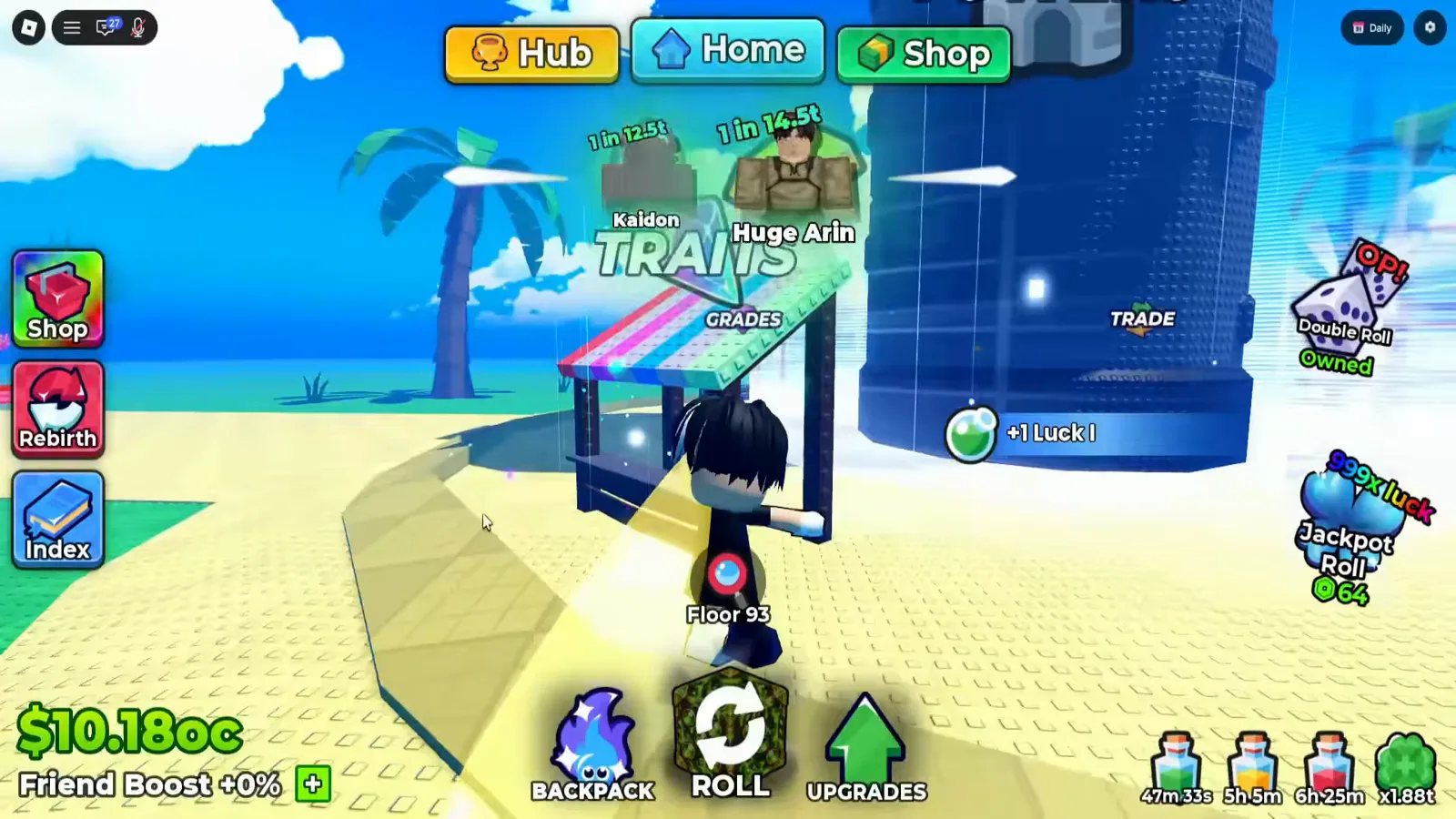
The pickup is one item; the strip is the stack. Neither prints a percentage.
Watch the +1 Luck I pickup at 3:30
Two things are worth separating here, because players blur them. A world pickup reading +1 Luck I is an item being handed to you — the same toast style our potions page records for +1 Dragon Luck II and +1 Damage I — and the item it adds is a named potion, not a server-wide effect. A potion tooltip is that item explaining itself, and its multiplier is the item’s own printed claim. The corner strip of the HUD, meanwhile, is where the game shows you how many timed boosts are running at once; in the frames above it holds a row of hour-long timers (47m 33s, 5h 1m, 6h 21s) ending in a clover tile that carries a figure instead of a clock. No screen in either recording attaches a percentage to any of them.
The creator in our second session treats the two as one habit and says so at 9:37: “I also had a bunch of mythic potions that I um equipped. Like that’s why our luck is so high.” That is his account of his own screen. What the screen itself supports is narrower, and it is the sentence this section exists to make: potions print a multiplier, and nothing prints what that multiplier is applied to.
What Do the Luck Gamepasses Change?
The Robux shop is the fourth source, and it is the only one where the luck upgrade is permanent. Under the Shop button’s gamepass grid sit six cards, and four of them touch a number we care about:
| Card | Effect text on the card | What our frames read |
|---|---|---|
| Double Roll | Roll two dice at once! | more rolls, no luck line |
| VIP | Chat Tag, Trail, 1.5x Cash, 1.5x Luck | bundles both 1.5x multipliers |
| Luck | 1.5x Luck | the standalone luck pass |
| Ultra Luck | 3x Luck | the larger luck pass |
| More Cash | 2x Cash Boost | income only |
| Roll Speed | Rolls faster! | no luck line |
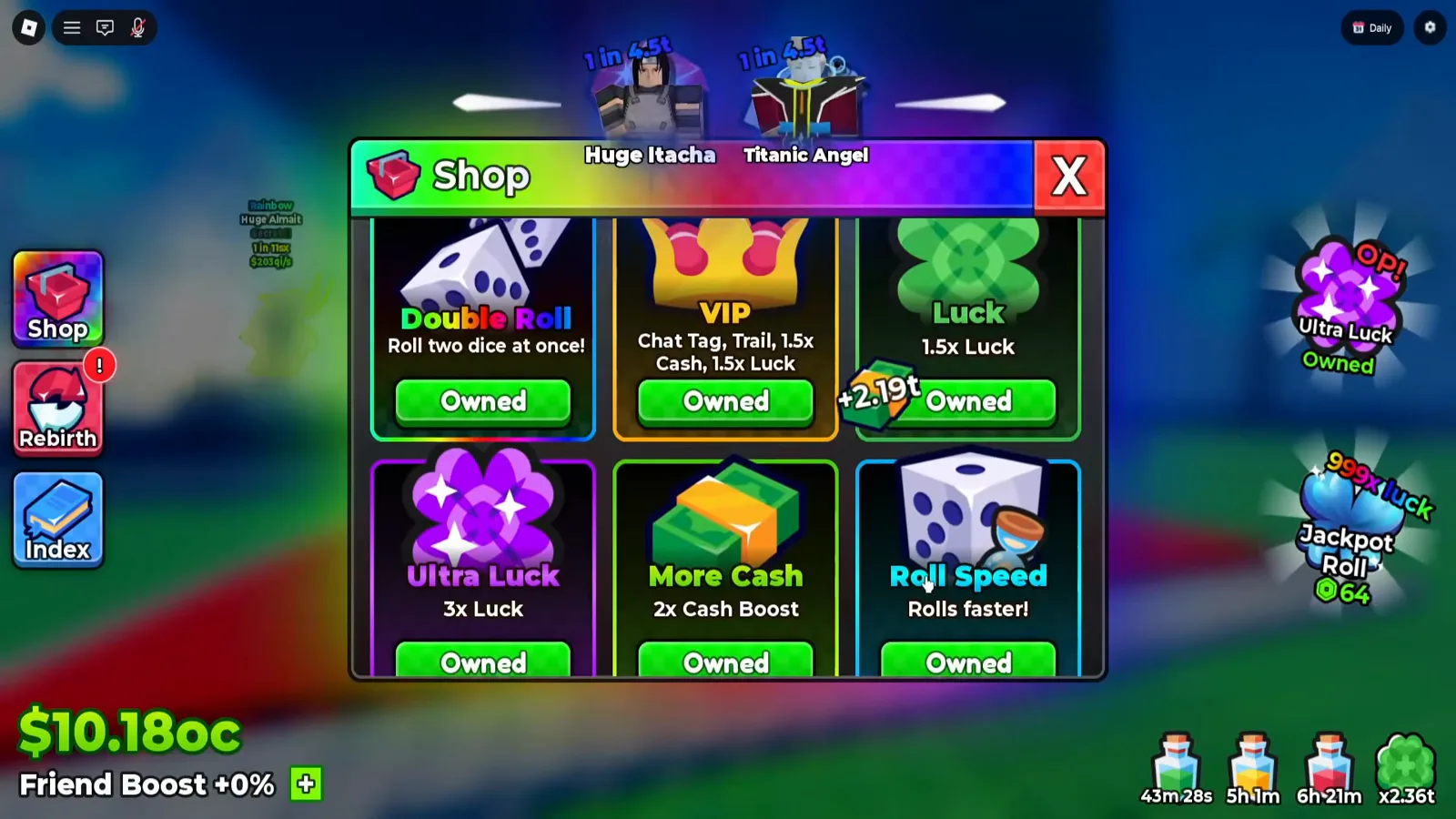
3:58. Every card in the grid, and every price replaced by the word Owned because this account bought them all.
Watch the gamepass grid at 3:58
Note what the frame above does not contain: a single Robux figure. That account already owns all six passes, so each card’s green button reads Owned and the price is gone. The prices this site has verified live on the Robux shop guide, read from a different session’s panel: Double Roll 720, VIP 225, Luck 180, Ultra Luck 450, More Cash 180, Roll Speed 315.
The luck cards also live a second life on the right edge of the HUD, as a floating card under a red OP! badge, and there the numbers stop behaving. Across our three sessions that badge pointed at Luck (green 160 on one account, 199 on another), VIP (200 and 249), Double Roll (799), and Roll Speed (349) — while the same passes list at 180, 225, 720 and 315 on our Robux shop page. The 999x luck Jackpot Roll quick-buy underneath it read 64 in two sessions and 79 in the third. We cannot tell you why. The frames do not say whether that is regional pricing, a rotating offer or something else, so this page prints each number with the session it came from and does not average them into one answer.
Because those displays differ account to account, everything else on this page stays on the cash side of the game, where the numbers repeated. And if you want the consumable side of the same question — what a Lucky Spin and a Jackpot Spin each load onto one roll, and the Auto Roll trap that burns a spin the second it arrives — that is the whole subject of our Lucky Spin versus Jackpot Spin guide.
Is There a Server Luck or Potion Luck Percentage?
This is the section the page exists for, and it is a negative result. We went looking for two readouts in particular — a Server Luck percentage and a Potion Luck percentage — across all three recordings, and neither exists on any frame we extracted.
Where we looked, so you can check the same places:
- The HUD’s boost strip, bottom-right, in both row layouts we captured (a three-timer row and a four-slot row ending in a clover tile). It prints countdowns and one clover figure. No percentage, no “server” label.
- The Boosts panel, whose eleven tiles our potions guide reads one by one. Each tile is an icon and a clock or count. No percentage.
- Every potion tooltip we could open at full resolution. Four lines: name, rarity, multiplier, duration.
- The Quests Shop tab’s fourth card, which is labelled Luck and carries the same clover the Luck potions use. Its price sits below the panel’s visible area in every frame either recording gives us, and no frame shows it being bought, described or applied.
- The hub and the world, for any sign, banner or event label carrying a luck percentage. None appears.
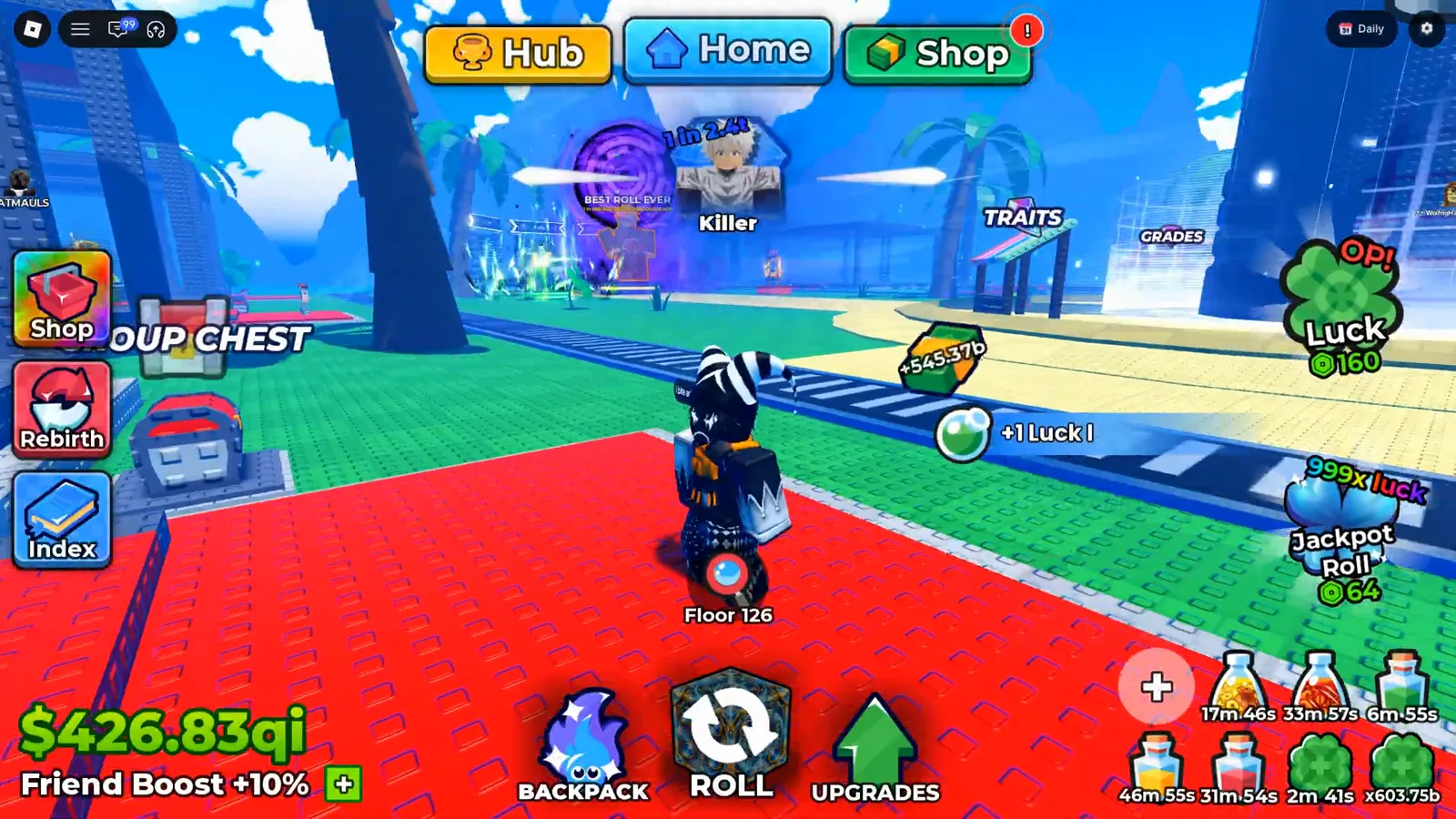
11:08. Four different luck surfaces in a single frame, and the only numbers on them are a Robux price, a multiplier label and some clocks.
Watch the luck widgets at 11:08
What does exist is the idea of a luck event. One creator buys a dice “while there’s a luck event” running (Cx, 8:11), and another says he rolls something good “every time a luck event happens” (Superlex Plays, 6:35). Both are players describing their own sessions, and no frame from either recording prints the event’s multiplier, its duration, or whether it is applied per-server or per-player. So the honest answer to “does Anime Dice have server luck” is that a luck event is talked about on camera and never quantified on screen, and that the client we filmed carries no server luck percentage anywhere we could reach.
What Could We Not Read?
The list of real gaps, not oversights:
- How the sources combine. Whether the dice base, the clover nodes, the potion multipliers, the rebirth multiplier and the gamepasses add, multiply or overwrite each other. No screen prints two of them in one calculation.
- A total luck figure for any account. We deliberately print none. The clover tile at the end of the boost row does carry an account-level figure on an end-game screen, but no frame states how it was produced, so quoting it would be quoting a number without a meaning.
- The numeric effect of any Luck node. The tree prints a price under every clover and a percentage under nothing. Even the Fortune IX tooltip our upgrade tree guide captured prints a bare
+6xwith no object. - The luck event. Its multiplier, its duration and whether it is shared across a server or applied per player. It is mentioned by two creators and quantified by none.
- The Quests Shop’s Luck card. What it sells, and what it costs. Its price is below the fold in every frame either recording gives us — the fuller account of that dead end is on our potions guide.
- Whether the two luck gamepasses stack with each other. Luck reads 1.5x and Ultra Luck reads 3x, but no frame shows a roll with one and then with both, so 3x-over-1.5x is arithmetic we would be doing ourselves.
- Rebirth’s exact contribution. The rebirth guide owns the multiplier ladder; here it matters only that the panel is a luck source and that no frame ties its multiplier to the dice base in a printed total.
- The Robux prices on the OP! HUD cards. They differ between accounts in our own footage, and nothing on screen explains the difference.
If your client closes one of these — an event banner, a node tooltip with a percentage, the Luck card’s price — a dated screenshot through the contact page settles it and gets credited here.
What Should You Read Next?
- Dice Shop guide — the full rung-by-rung ladder these frames come from
- Upgrades tree guide — the clover branch, the Fortune chain and the one
+6xtooltip - Potions guide — the four tooltip lines, the Boosts panel and every drop faucet
- Robux shop guide — the verified gamepass and Jackpot Spin prices
- Lucky spins versus jackpot spins — the one-roll multipliers and the Auto Roll trap
- Rebirth guide — the account-wide luck multiplier and the cash reset that comes with it
- Live codes — free spins and boosts before you spend Robux on any of the above
Related Articles
guides
Anime Dice Friend Boost: The HUD Bonus That Reads +10%, Then +0%
Frame-verified Anime Dice Friend Boost readout: where it sits in the bottom-left HUD, the +10% and +0% frames, and what no screen ever explains.
guides
Anime Dice Plot Slots: Level Signs, Storage and Backpack Counter
Anime Dice plot slots read off frames: the Lvl line and cash figure on a plot sign, the green pad under a unit, the Backpack counter and the Unit Storage node.
guides
Anime Dice Group Rewards: What the Panel Pays and What It Asks For
Anime Dice's Group Rewards panel read off frames: two requirements, a claim that pays 5 Trait Reroll, 5 Gems and 2 Lucky Spin, and the hub's GROUP CHEST.
Was this helpful?
Thanks for the feedback!