Anime Dice Fusion: How the Fusing Machine Works, Frame by Frame
What the Fusing machine does in Anime Dice, frame by frame from UPD 5 day-one footage: three slots, a cash-priced Fuse button, a rolled result, a Celestial tooltip.
Preguntas frecuentes
What is the Fusing machine in Anime Dice?
Where is the Fusing machine in Anime Dice?
How much does fusing cost in Anime Dice?
Does fusing guarantee a better unit in Anime Dice?
What is the Celestial label in Anime Dice?
Can fusing leave you worse off in Anime Dice?
What could we not read about the Fusing machine?
What Is the Fusing Machine in Anime Dice?
The Fusing machine is a dark, purple-signed building in the hub that turns three of your units into one rolled result. It is new on the UPD 5 client we filmed on launch day. You load three slots, pay a cash fee, watch a roll — and the mechanic’s own instruction line admits the outcome is not guaranteed.
Nobody hands you a manual for it. The developer publishes no changelog — our update history page tracks UPD 5 exactly as far as the screens can carry it — and no in-game page explains the machine. What exists is the panel, one instruction line printed on it, and a launch-day recording. This page reads all three, and refuses to guess past them. For everything else the update changed — two new Secret II dice and a 30x rebirth tier among them — the Update 5 roundup keeps the running list.
Every screen here is a frame from one recording, opened and checked at full resolution:
Sources: the captures below are frames from a no-facecam, no-burned-caption screen recording, checked frame by frame at full resolution on 2026-09-19, the day UPD 5 went live: Plique Games’ UPD 5 day-one session (about 14½ minutes, Portuguese narration with auto-translated English captions — the Fusing machine’s launch-day debut, met on camera for the first time). Spoken lines are quoted from those auto-generated captions with timestamps, so treat the wording as approximate; wherever a caption and the screen disagree, we print the screen. The developer publishes no changelog and no Fusing documentation — everything below is what a frame showed.

Plique Games' UPD 5 day-one session — the walk to the Fusing machine, the first fusion and its roll all land inside the first six minutes
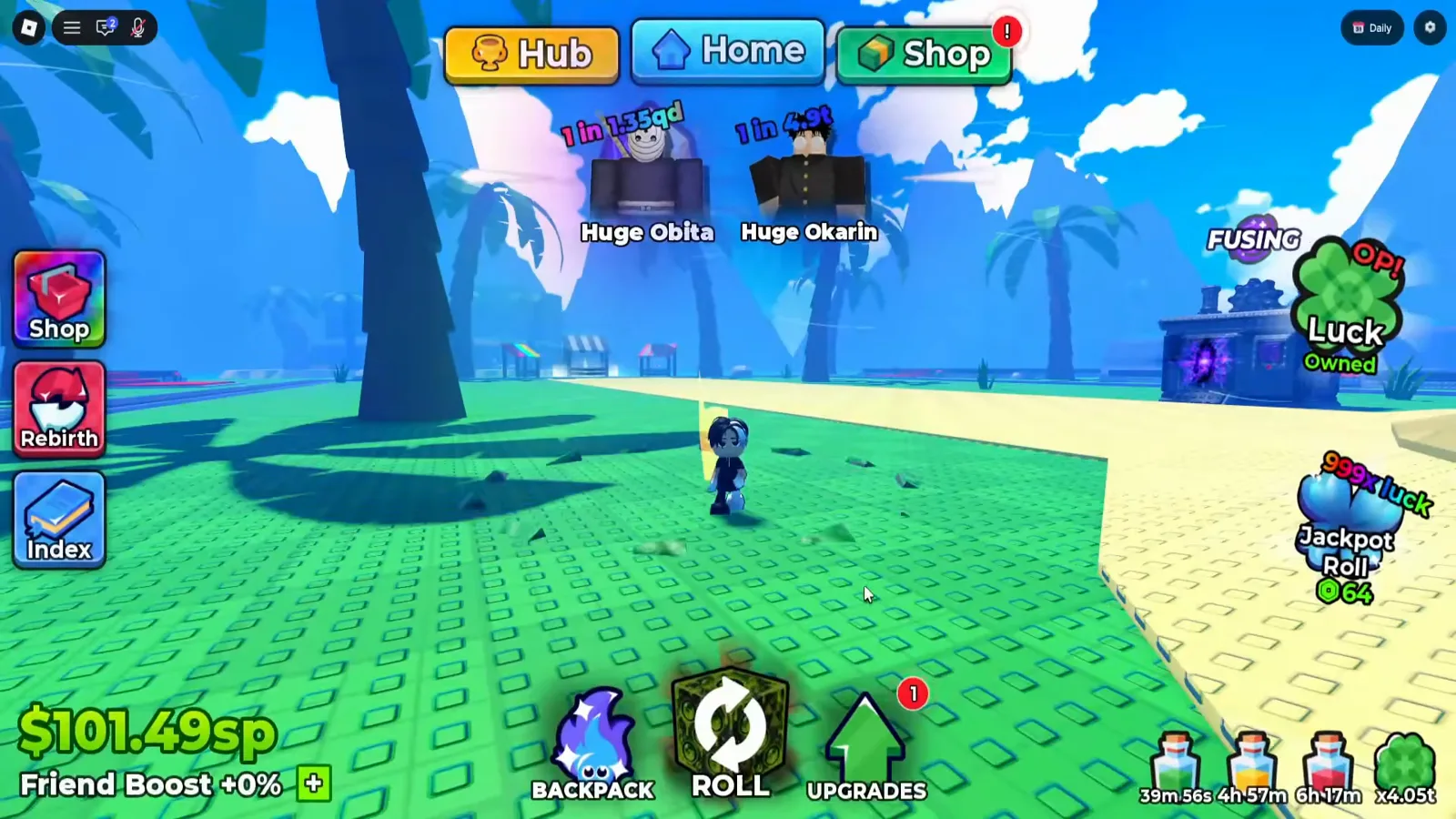
The purple FUSING sign hangs over a glowing purple doorway — the whole building is the machine.
Watch the walk to the Fusing machine at 5:20
The building stands in the same hub plaza the game’s other fixtures live in — the stalls our Dice Shop and quests and tickets guides were read from. Nothing announces it as new except the moment itself: at 5:09 the creator stops mid-sentence — “Wow, what’s this, man? Merger. Oh, no way” — and walks in.
How Do You Fill the Three Fusing Slots?
You fill the machine from its own panel: three input slots on the left, a core that counts them, one output slot on the right. The empty panel reads 0/3 and shows no price; with three units loaded it reads 3/3 and the button becomes the fee.
The panel opens with a title bar — a purple gem icon, the word Fusing, a red X — over a simple left-to-right diagram. Three square slots, each showing a grey silhouette and a plus sign, feed glowing blue pipes into a purple circular core; one more pipe carries out to a single output slot on the right. Below the diagram sits a wide light-blue button reading just Fuse, and at the bottom of the panel an info icon introduces the machine’s only documented rule:
Fuse units with similar chances for the best results!
That sentence is the whole tutorial. Note what the empty frame does not show: no price on the button, no odds, no preview. (The button is the same light blue as when loaded — a still frame cannot prove whether it was clickable at 0/3, so we do not claim it either way.)
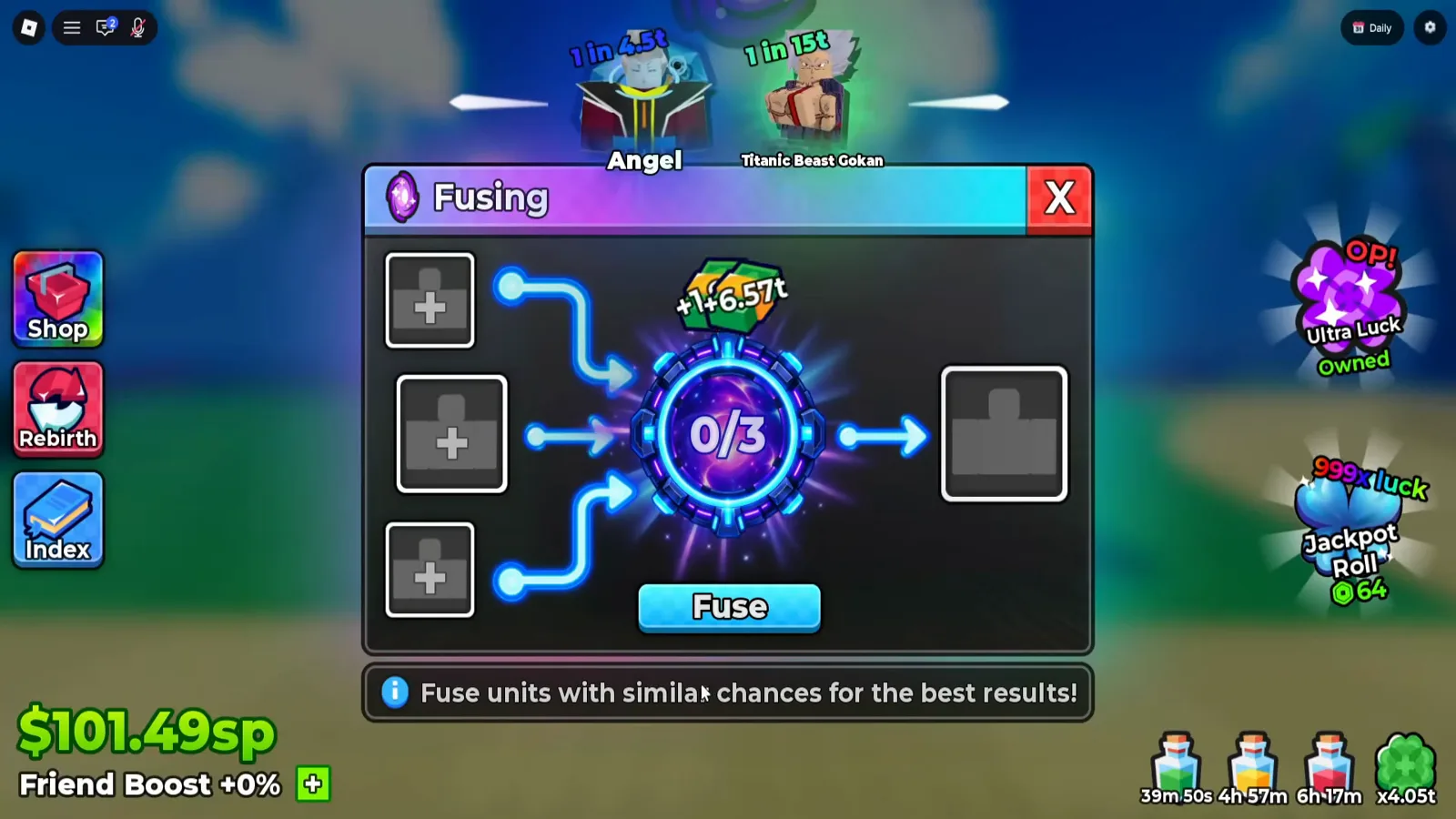
Nothing loaded, nothing priced — the panel at 0/3 is just three plus signs, a core and the rule of the road.
Filled, the same diagram tells you much more. Our loaded frame holds three unit portraits in the input slots — printed with the odds 1 in 47qd, 1 in 2.9 (its suffix hides behind a green +7.03t badge, so we print the question mark with it) and 1 in 1.4qd — the core reads 3/3, and the output slot shows a black silhouette labelled 1 in 25qd. The button has changed from Fuse to a green $4.4sx. Hovering the silhouette pops a tooltip:
| Tooltip line | As printed |
|---|---|
| Name | Titanic Jin-woo |
| Rarity tag | Celestial (purple) |
| Level | Level 1 |
| Income | $773b/s |
| Odds | 1 in 25qd |
The Celestial tag is the detail worth pausing on. It is purple, it sits where other tooltips print their rarity, and it appears on no frame we had catalogued before this video. One frame cannot tell us whether the label is new in UPD 5, nor where it ranks — so we report the tag and stop there.
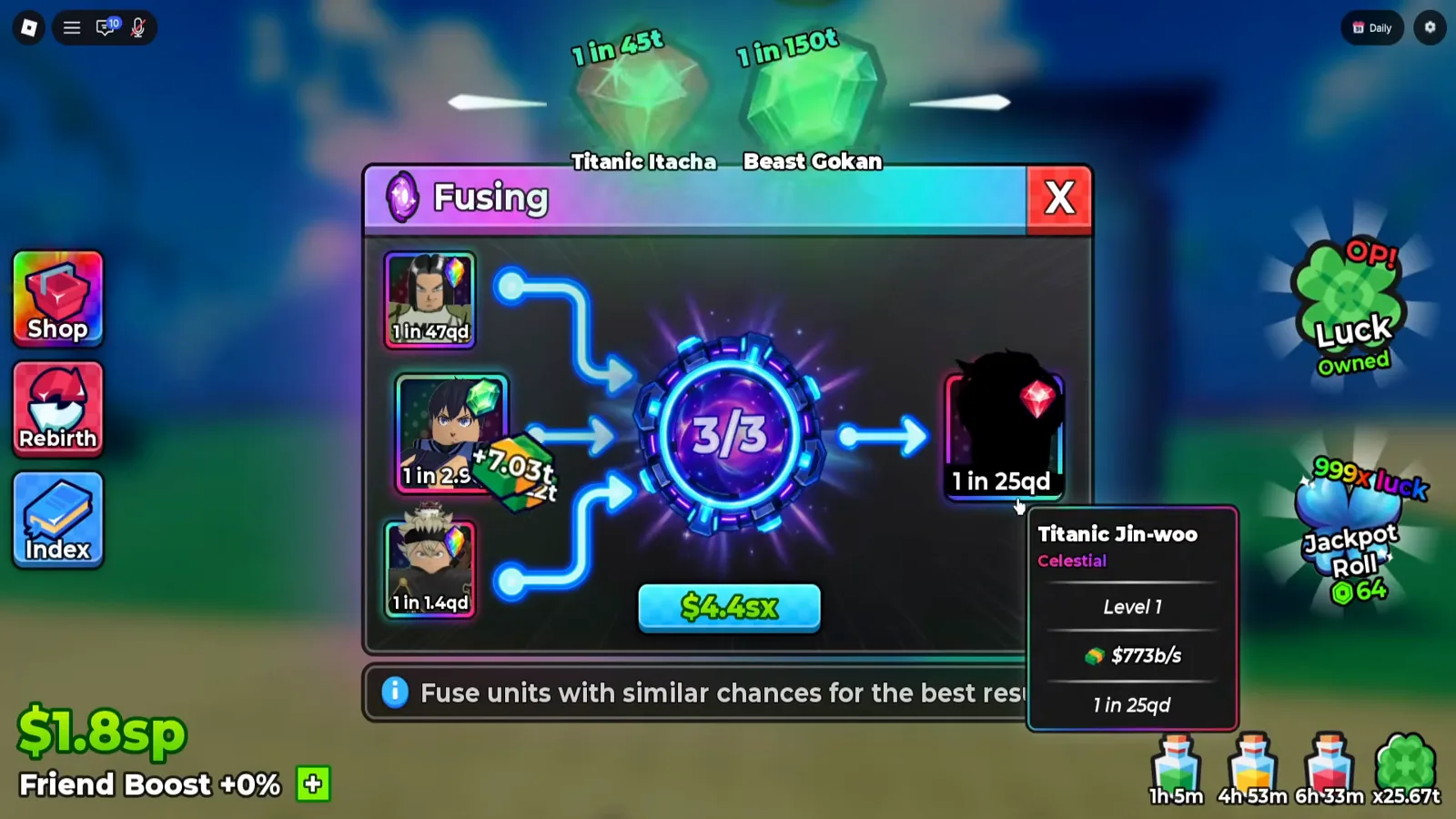
Seconds later the same panel is full: three odds in, one silhouette out, and the fee printed where the word Fuse used to be.
Watch the loaded panel and tooltip at 8:50
What Does Fusing Cost?
Fusing is priced in cash, and the price lives on the button itself: the one loaded fuse we captured printed $4.4sx in green where the empty panel printed nothing but the word Fuse. That single number is an observation — the screen shows no formula and no scaling rule.
Everything else about the fee is unread. We do not know whether $4.4sx was driven by the three units’ odds, their levels, their income, or none of the above — the panel prints no breakdown, and one observation cannot be turned into a rule. We never watched the button refuse a fuse, and we never watched a second fuse priced differently with its inputs visible, so even the direction of the scaling is unknown. If your client shows two loaded panels with different fees, a dated screenshot through the contact page settles it and gets credited here.
What Comes Out of a Fuse?
The outcome arrives as a full-screen roll — a FUSING animation printing the result’s odds to the last digit — and it is not guaranteed to be an upgrade. Our result frame printed 1 in 30,774,162,769,317,628, and the creator’s own fuses in this session disappoint him twice.
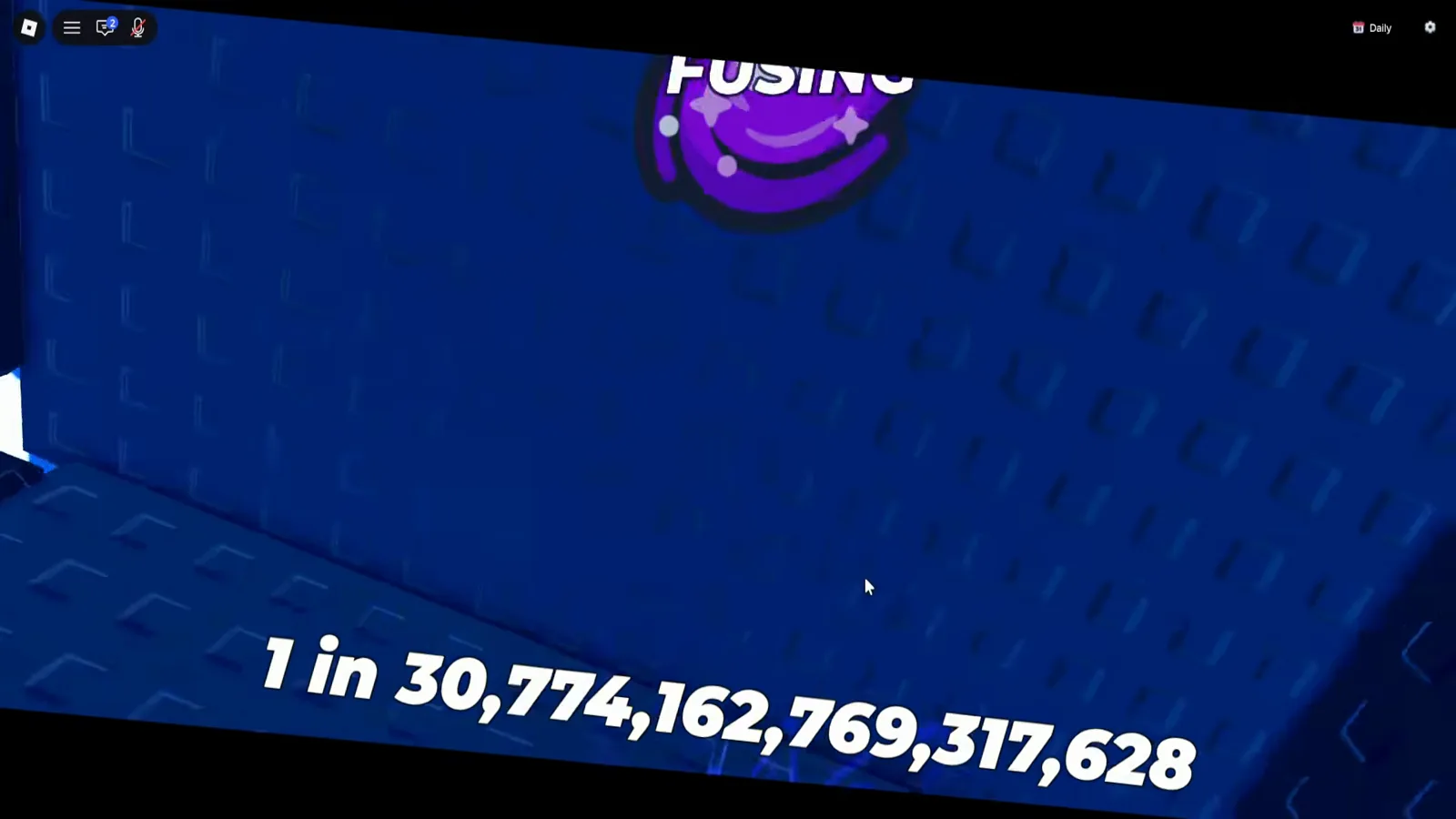
Whatever you fed in, the outcome arrives as a roll — and the game prints the odds to the last digit.
Watch the first fusion’s roll at 5:40
That full-digit number — roughly 30.77qd — belongs to the creator’s first fusion, and the roll is the verdict mechanism: the screen sweeps to a stop on the odds, then reveals the unit. His reaction at 5:39 is the honest summary of that first attempt: “I did the merger… One in 47 sqd… The rainbow came… it wasn’t good” — by his own reading, a downgrade from what he had put in. (The 47 sqd there is the auto-translated caption’s rendering; the frame prints 1 in 30,774,162,769,317,628, and the screen wins.)
The session keeps supplying the same lesson. At 8:43, loading another set of three, he states the mechanic as he understands it: “there’s a chance… it’s not guaranteed.” At 13:18, with much rarer units in his inventory, he hesitates over whether to risk them — “I’m scared, man… I’m afraid of losing here” — and runs the fusion on cheaper units instead. At 13:48 the gamble he did take comes back flat: “the same thing came up… I lost for nothing.”
One honest gap sits between the loaded panel and the roll. The output silhouette we captured carried a printed chance — 1 in 25qd — and a tooltip naming Titanic Jin-woo. No screen tells us whether that printed chance is a fixed promise of the fuse’s outcome or one of several candidates the machine can land on, and the preview and the roll come from two different fuses in the session, so they neither confirm nor contradict each other. We leave the question open rather than pick a side.
Artículos relacionados
guides
Anime Dice Daily Rewards: The Full 7-Day Board, Frame-Read
Anime Dice's Daily Rewards board read off frames: all seven tiles, how claiming works, the one reward the screen names, and why it is not the daily quest board.
guides
Anime Dice Update 5: Every New Feature We Could Verify on Screen
What Anime Dice's Update 5 added, verified frame by frame: two new Secret II dice, a 30x MAX rebirth tier, a Fusing machine, and which codes remain unverified.
traits
Anime Dice Best Traits Ranked: Every Panel Value We Could Verify
Every trait our frames could read on the Anime Dice Traits panel, ranked by printed value: Transcendent 15x at 0.006% down to Money I 1.2x at 25.4%.
¿Te resultó útil?
¡Gracias por tu opinión!