Anime Dice Tier List: What The Cards Actually Print
Anime Dice publishes no per-unit multiplier table. What each card really prints — rarity, 1 in N odds, cash per second — read frame by frame off the screen.
FAQ
Is there an official character tier list in Anime Dice?
What do Anime Dice unit cards actually print?
Why does the same unit show different numbers?
Which rarity tiers exist for units and for dice?
Do higher blocks change the roll odds?
Is There An Official Character Tier List In Anime Dice?
No — and knowing that saves you from spending gems on a number the game never showed you. Anime Dice has no ranking screen and no developer-published multiplier table. It does now have one per-character stat screen — the Index panel prints five lines for any unit you hover, owned or not — but it ranks nothing, so every “S+ 55x” table you have seen on this topic is still somebody else’s estimate wearing a screenshot’s clothes.

The Anime Dice progression session most card readings on this page were transcribed from
What the client does print, on the floating nameplate above every unit standing on your plot, is three separate fields:
- a rarity word — Uncommon, Rare, Epic, Legendary, Mythical;
- that card’s own “1 in …” odds, which belong to the specific card and not to its rarity tier;
- a cash-per-second figure for that unit at its current level.
Three live fields, no fixed stats. So this page does two honest things instead of inventing a ranking: it transcribes the cards we could read frame by frame, and it points at the one ladder the game really does publish — the Grades menu, which multiplies a unit’s income directly.
What Do Anime Dice Unit Cards Actually Print?
Every row below is a transcription, not an estimate. The readings come from the Shensu session at 1:58, 4:20 and 8:36, and from the Superlex Plays session at 13:13 and 25:33, all checked on 13 September 2026 under UPD 3.
| Card as printed | Rarity | “1 in …” | Cash/sec shown | Timecode |
|---|---|---|---|---|
| Silver Tien | Uncommon | 1 in 200 | $46/s | 1:58 |
| Gold Ginyou | Uncommon | 1 in 400 | $77/s | 1:58 |
| Gold Huge Ichiga | Rare | 1 in 3k | $331/s | 1:58 |
| Gold Titanic Aizan | Rare | 1 in 60k | $13k/s | 4:20 |
| Silver Cujo | Epic | 1 in 575k | $14k/s | 4:20 |
| Emerald Deko | Epic | 1 in 850k | $84k/s | 4:20 |
| Maheto | (not visible in frame) | 1 in 16.5k | (not visible) | 4:20 |
| Ruby Friza | Epic | 1 in 5.2m | $0.2m/s | 8:36 |
| Diamond Hasoka | Legendary | 1 in 12m | $5.1m/s | 25:33 |
| Loffy | Legendary | 1 in 22m | $5.7m/s | 25:33 |
| Huge Itacha | Legendary | 1 in 45m | $8.2m/s | 8:36 |
| Rainbow Huge Inasuke | Legendary | 1 in 150m | $8.2m/s | 8:36 |
| Titanic Friza | Legendary | 1 in 520m | $166m/s | 13:13 |
| Rainbow Huge Perfect Zell | Mythical | 1 in 1.3b | $4m/s at Lvl 1 | 25:33 |
| Angel | Mythical | 1 in 4.5b | $325m/s | 8:36 |
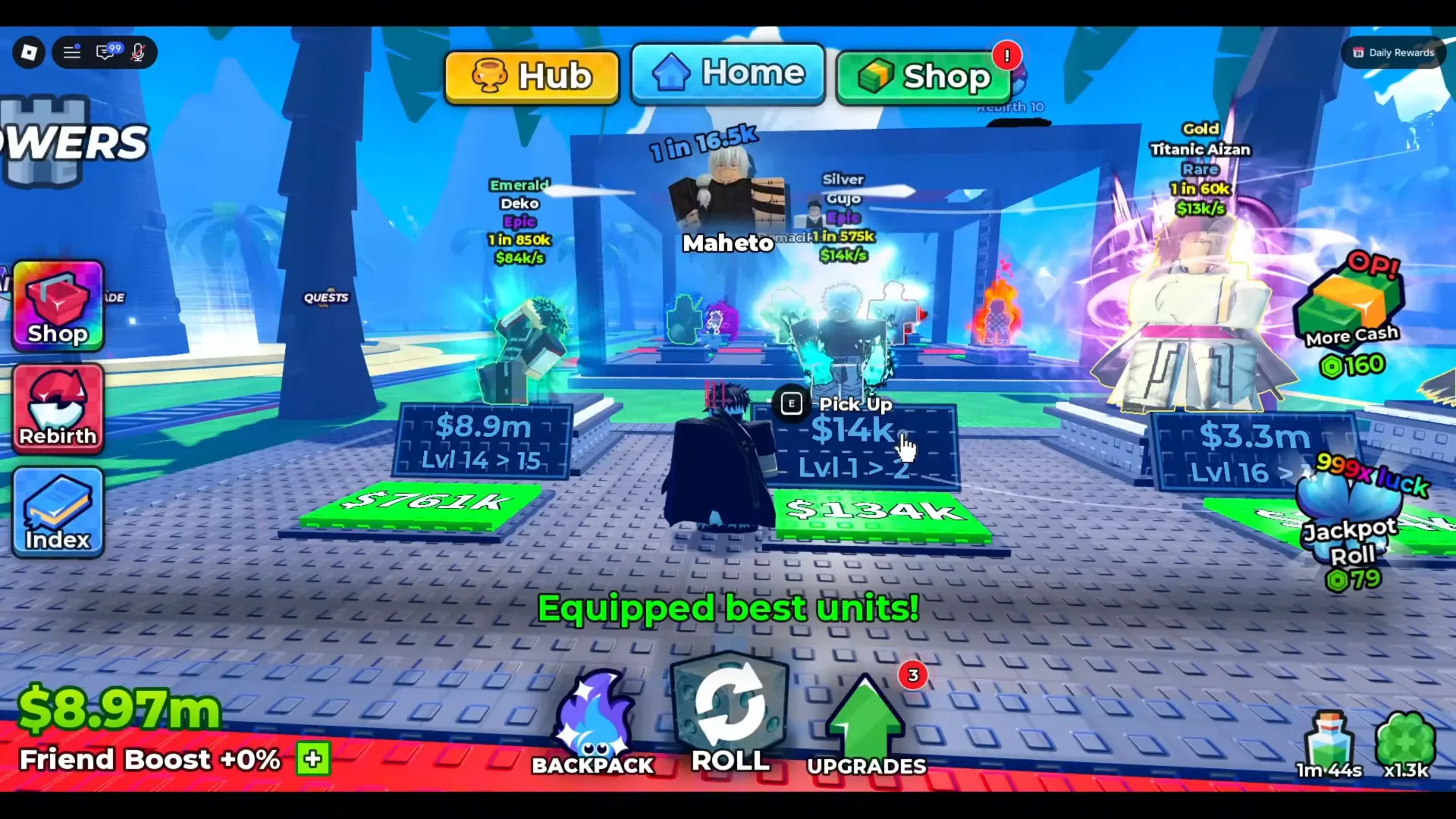
Read top to bottom on each card: mutation or size label, name, rarity, odds, income.
Three things fall out of that table, and they are the reason a fixed tier list cannot exist here.
“1 in …” is per card, not per rarity. Two Legendary cards sit at 1 in 12m and 1 in 520m — a forty-three-fold gap inside one tier. Two Rares sit at 1 in 3k and 1 in 60k, and Huge Itacha at 1 in 45m prints the same $8.2m/s as Rainbow Huge Inasuke at 1 in 150m. Any table that says “Legendary = 1 in 5,000” is describing a tier that does not behave like a tier. One reading we still cannot explain: a card printed Maheto shows 1 in 16.5k at 4:20 and 1 in 1.65m at 8:36, with no size or mutation prefix visible on either plate. We are reporting the two numbers rather than smoothing them into one entry.
Income is a live value, not a stat line. The Mythical Huge Perfect Zell prints $4m/s while it is Level 1 in one frame, and the same card prints $808m/s at Level 35 in another. A ranking built on “base multipliers” is ranking a number the game never freezes.
The names are parodies, and they are the only names in the client. Loffy, Ginyou, Krillan, Tien, Ichiga, Friza, Tanjuro, Deko, Cujo, Maheto, Aizan, Zenitsa, Nameee, Inasuke, Angel, Pikolo, Naroto, Zell, Todoh, Yuju, Hasoka, Todoraki. There is no “Six Paths Naruto”, no “Sun God Luffy”, no “Ultra Instinct Goku” and no “Sukuna Vessel” card anywhere in the footage we read — those are the real franchise names, and this game does not use them.
Why Does The Same Unit Show Different Numbers?
Because four systems stack on one card, and only one of them is the character itself. Rarity sets the base tier; the unit’s level scales the income you see on the pad; a rolled Grade multiplies it; a trait adds a passive bonus; a coloured mutation label marks a collectible version. The tooltip below is the clearest single view of that stack — a Level 35 Mythical Huge Perfect Zell carrying trait Samurai, Grade S, its own “1 in 1.3b” line and $808m/s.
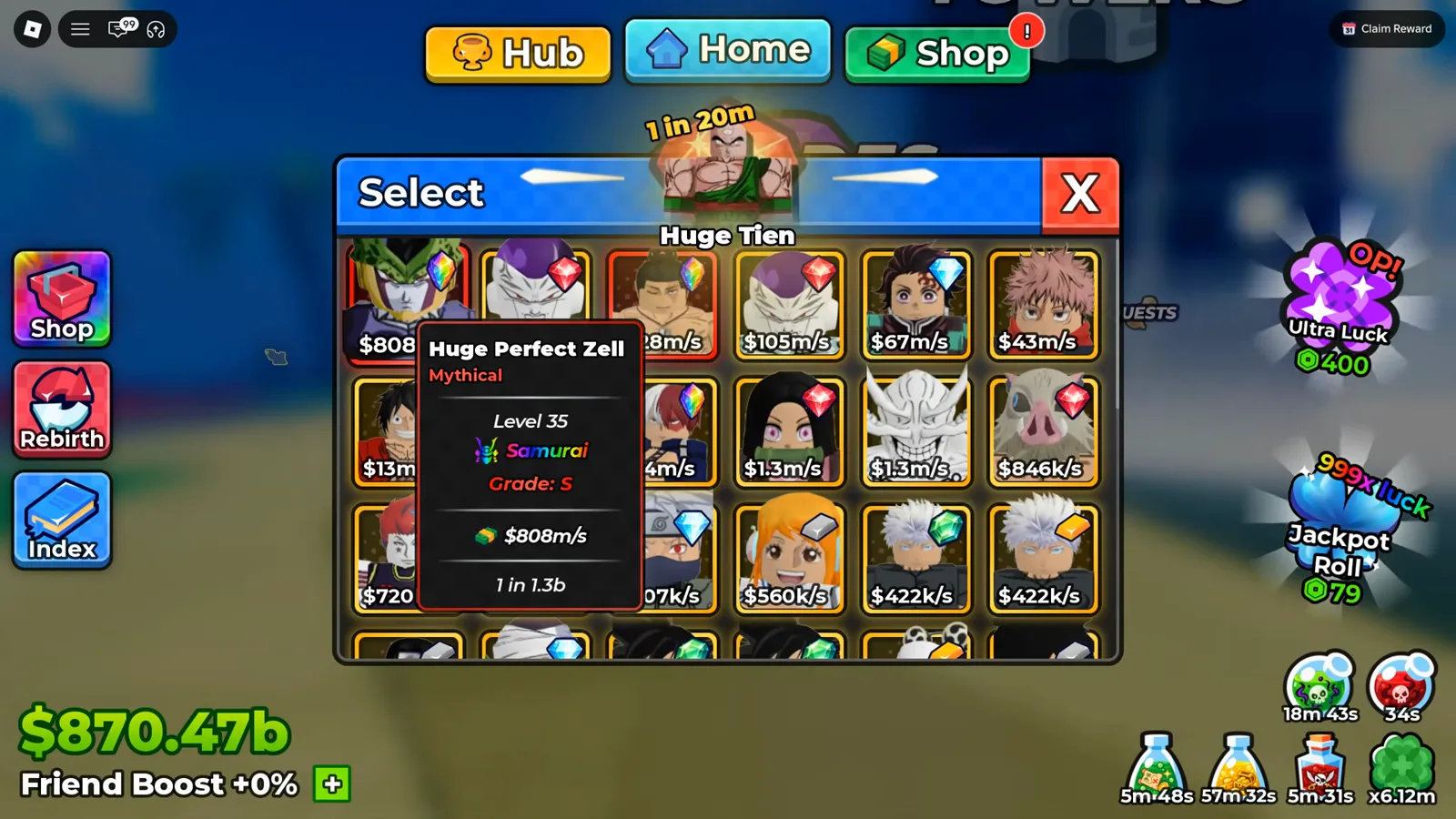
That card is the “1 in 1.3b” Mythical from the table above, twenty-odd levels later.
The four systems are unpacked field by field on the mutations guide; the passive layer is on the traits guide.
Which Rarity Tiers Exist For Units And For Dice?
For units, the placed cards we could read run Uncommon → Rare → Epic → Legendary → Mythical. That is not the ceiling. The in-game Index prints Exotic on a unit tooltip at 1 in 100t and Celestial on four units from 1 in 1.1qd up to 1 in 22qd, and a Backpack copy reads Secret I — so the word list above Mythical exists, the client just never sorts it. We still do not rank those words against each other, because no screen does.
For dice, the Dice Shop panel uses the same style of rarity word — and this is where most of the internet’s “Divine” and “Mythic” confusion comes from.
| Dice entry as printed | Rarity | Luck |
|---|---|---|
| Ice | Rare | 100x Luck |
| Magma | Epic | 200x Luck |
| Storm | Epic | (cut off in frame) |
| (name covered by a nameplate) | Mythical | 12,500x Luck |
| Lunar | Mythical | 25,000x Luck |
| Galaxy | Divine | 50,000x Luck |

Two dice both labelled Mythical print different luck values, so even here the number belongs to the item, not the tier.
Say it plainly: Divine is a Dice Shop rarity, and it is not a trait. What we can no longer say is that the word never touches a unit: our own Grades guide reproduces a Select-roster tooltip for Titanic Kaidon that prints Divine, Level 36, a Samurai label, Grade: S, $22b/s and 1 in 125b. So a page ranking a “Divine tier” of characters is still inventing a ladder the client never publishes — but the client does stamp the word on at least one unit card, and 1 in 125b puts it above the 1 in 4.5b Mythical reading at the top of our own table.
Do Higher Blocks Change The Roll Odds?
The direction is obvious on screen; the numbers are not on screen at all. Compare two frames from the same session: at 1:58 the plot holds Uncommon and Rare cards and the balance reads $42.35k; at 8:36 the same plot positions hold Legendary and Mythical cards and the balance reads $208.44b. Progression clearly shifts what you pull.
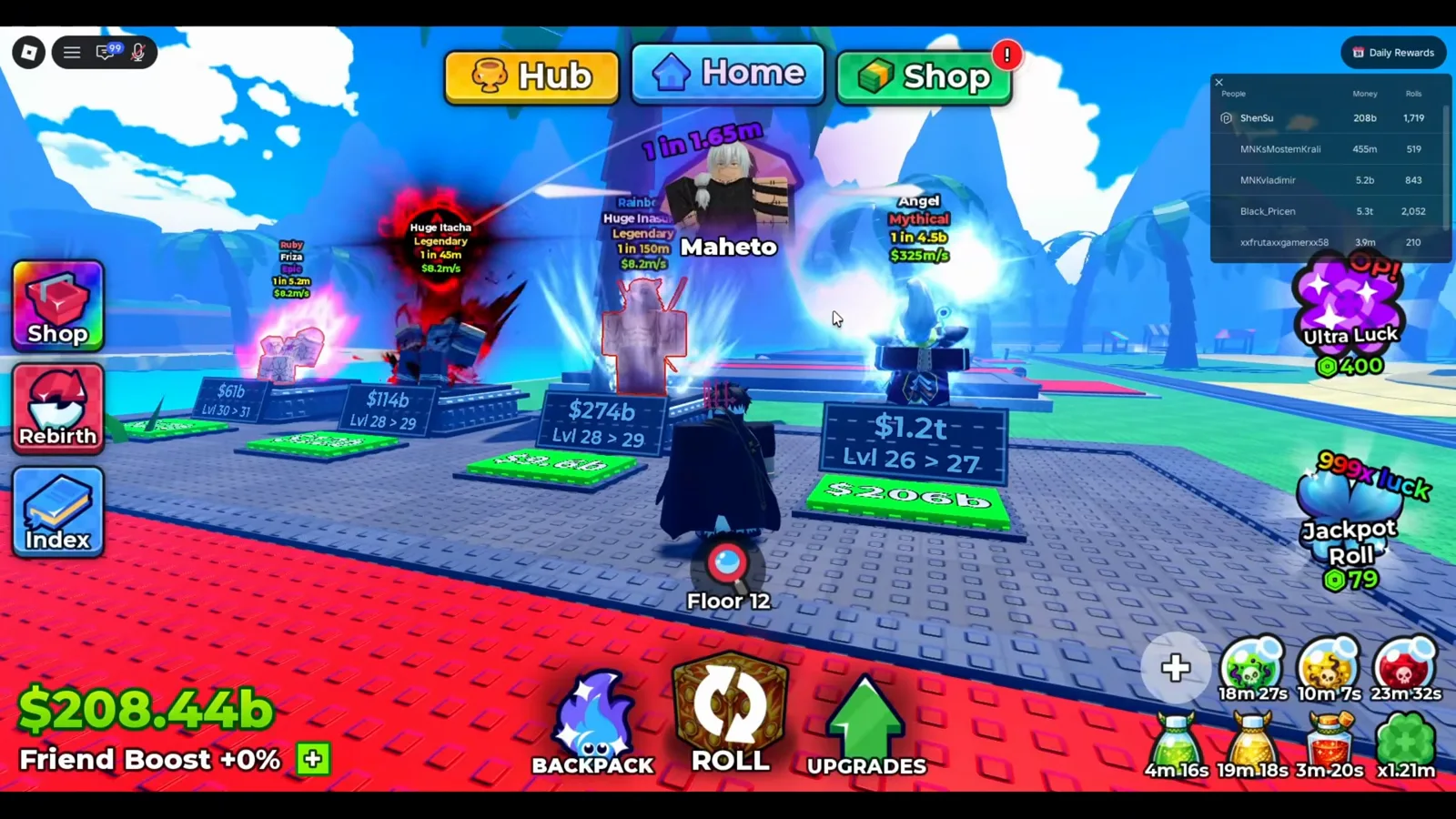
Four cards, four different odds, and not one percentage sign anywhere on screen.
What no frame, menu or official page we checked ever shows is a per-block percentage breakdown — the “Block 3: Rare 60%, Epic 30%…” tables that circulate elsewhere. The client expresses odds per card as “1 in …” and never as a block-level pie. So this page publishes none, and the block upgrade guide is where the cost-versus-recovery question actually belongs.
One honest caveat, now closed: the left rail carries an Index button that we never saw opened in any session we reviewed. A UPD 5 recording finally opened it inside its first minute, and we have transcribed what is behind it — Anime Dice Unit List: What the In-Game Index Actually Prints. It does hold a unit list with rates. It does not supersede this page: the Index sorts by ascending odds and prints no score, no multiplier and no recommendation, so the census lives there and the strength judgement lives here.
What Is The Only Multiplier Ladder The Game Publishes?
The Grades menu. It spends purple gems to roll a lettered income multiplier onto a unit you already own, and it prints both the multiplier and the chance for every tier — which makes it the closest thing Anime Dice has to an official ranking.
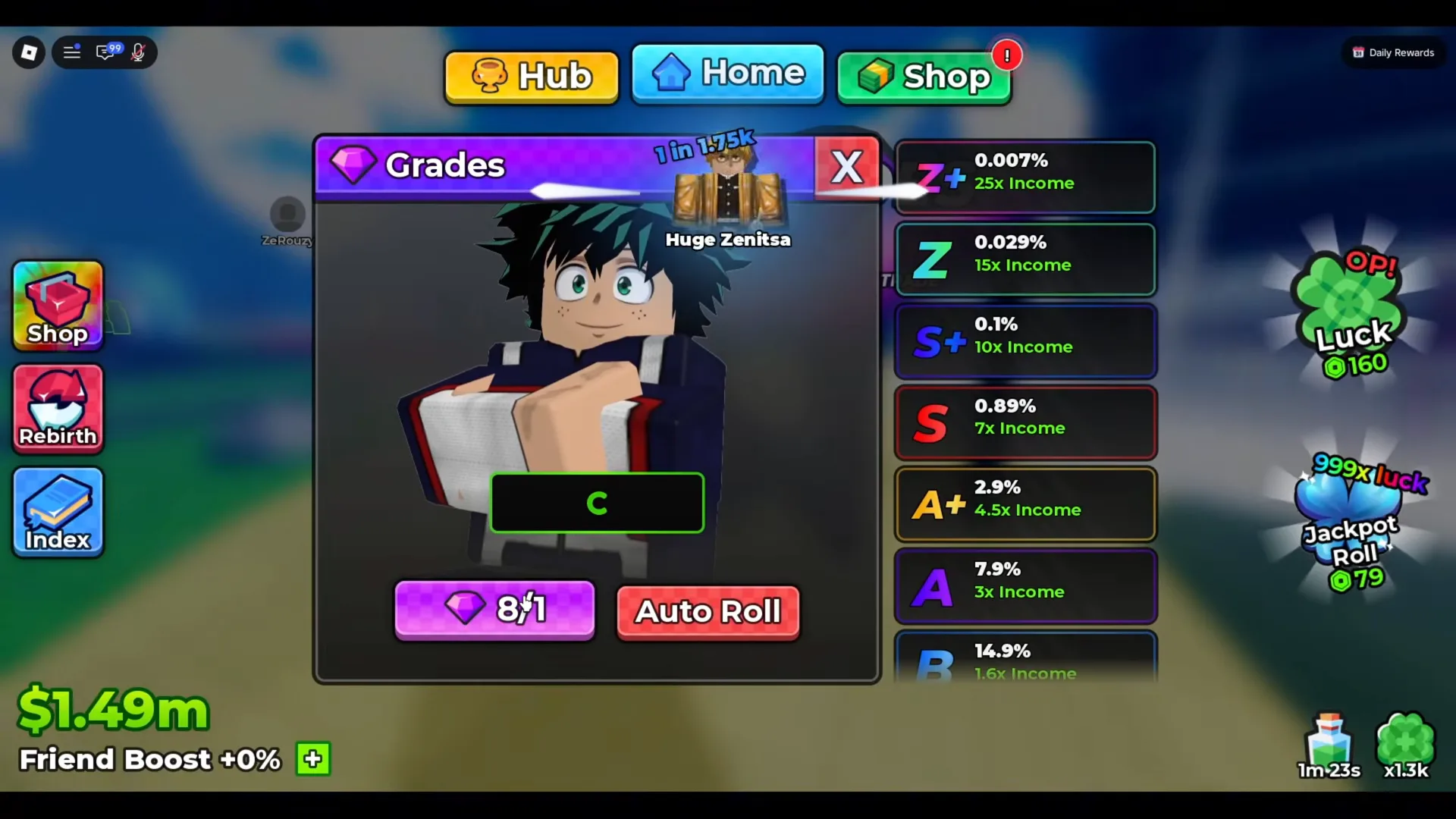
| Grade | Income multiplier | Chance as printed |
|---|---|---|
| Z+ | 25x Income | 0.007% |
| Z | 15x Income | 0.029% |
| S+ | 10x Income | 0.1% |
| S | 7x Income | 0.89% |
| A+ | 4.5x Income | 2.9% |
| A | 3x Income | 7.9% |
| B | 1.6x Income | 14.9% |
The ladder continues below B — the selected unit in that frame sits at C, whose row was scrolled off — and the panel shows the roll cost as 8/1 gems with an Auto Roll toggle. How gems get spent on this ladder is the subject of the Gems guide.
Which Units Should You Actually Chase?
With no multiplier table to rank by, the decision order that survives contact with the client is:
- Rarity tier, then level. A higher tier earns more at the same level, and levelling what you already placed is the cheapest big number on screen — the 4:20 frame shows a Lvl 14→15 pad costing $761k against a plot producing $8.9m.
- Grade next, because it is the published multiplier. A B on a strong unit beats a Z+ roll wasted on a card you will replace.
- Trait on keepers only. Rerolling overwrites, so spend on units you will not sell — the ordering is on the reroll priority page.
- Damage and Health matter only for towers. If you are not running floors, an income trait beats a combat one; the Infinity Tower guide covers which stats the floors actually check.
- Fill the plot before you optimise it. Slot-versus-block ordering is on the beginner guide.
- Claim the free currency first. Codes hand out Lucky Spins, Trait Rerolls and Gems — take them before spending anything, from the verified codes list.
Related Articles
guides
Anime Dice Update 7: Rebirth Upgrade Points, Third Base Floor and New Dice
Anime Dice UPD 7 read off frames: the developer's own patch notes, the 6-path Rebirth Stats panel, and a purchase confirmation. Checked 7 October 2026.
guides
Anime Dice Money: Where Cash Comes From, Read Frame by Frame
Anime Dice money read frame by frame: the cash counter's k-to-oc suffix ladder, the $/s income every unit card prints, and the breakdown no screen ever shows.
guides
Anime Dice Probability and Roll Odds: The 1 in N Screens
Anime Dice prints unit odds as 1 in N and trait odds as percentages, never as one drop table. Frame-by-frame readings plus the arithmetic the game leaves out.
Was this helpful?
Thanks for the feedback!