Anime Dice Probability and Roll Odds: The 1 in N Screens
Anime Dice prints unit odds as 1 in N and trait odds as percentages, never as one drop table. Frame-by-frame readings plus the arithmetic the game leaves out.
Perguntas frequentes
What are the odds of getting a Shogun in Anime Dice?
Does Anime Dice have a drop rate table for every unit?
How many rolls does 1 in N actually take?
What do the None, Huge and Titanic buttons in the Index change?
Does Luck change the odds printed on a card?
What are the unlabelled icons down the Index panel's right edge?
What Does Anime Dice Actually Print About Probability?
Two notations, and no third one. Anime Dice prints roll odds as a 1 in N figure on the thing you are rolling for — the card in the Index panel, the nameplate over a unit standing in the hub, the two-unit banner at the top of the screen, and the reveal that plays over the roll itself — and it prints trait odds as a percentage inside the Traits panel. What it does not have anywhere we could look is a table.
That absence is the answer to most of the searches this page exists for. anime dice roll odds and anime dice probability both read as requests for a published list, and the client does not ship one: the odds live on each card, one figure at a time, and the only screen that arranges them is a panel you have to scroll. This page prints what those screens actually say, marks every derived number as our arithmetic, and leaves the rest as gaps.
Every figure below was read at native 1920×1080 off the two recordings named in the source block, and each published frame was inspected at full resolution before it was used:
Sources: the pictures on this page come from two no-facecam screen recordings, both checked frame by frame at native resolution on 4 October 2026. Xou Blox’s FUI ATRÁS do GIRO IMPOSSÍVEL no ANIME DICE!! (1 em 4 Septilhão) (uploaded 20 September 2026, 22 minutes 6 seconds) supplies the Index panel, the Traits panel and a Dice Shop frame; the parts of it we used are free of burned-in text, but the same upload carries the creator’s own caption cards in other seconds —
TODOSat 0:28, a red cross over the panel at 0:34–0:35,CURTIRfrom about 0:38,REVANCHEat 0:40, white?marks through 0:48–0:56 and card overlays from 0:58 — and none of those seconds appears as a picture here. Cx’s I Went Noob To PRO in Anime Dice Roblox (uploaded 18 September 2026 — the UPD 4 window, one day before UPD 5 landed; 24 minutes 47 seconds) supplies the roll reveal and a second Dice Shop frame, and carries no burned captions in the stretches we sampled. Both uploads predate the current UPD 6 build; the newer of the two is the UPD 5 session, which is why this page is badged UPD 5 and states that window rather than implying the screens are current. The pictures are other people’s recordings; every sentence around them is ours. The developer publishes no odds documentation, no drop table and no changelog for this feature.

The session whose Index panel, Traits panel and Dice Shop frames this page is built from — the Index opens at about 0:30 and the Traits panel at 13:00
| Where the game prints it | The notation our frames read | What that screen shows |
|---|---|---|
A unit card in the Index panel | 1 in 18sx, 1 in 33sx, 1 in 650sx … | one figure stamped at the foot of each card |
| The two-unit banner at the top of the screen | 1 in 17.5b and 1 in 4b at 0:36; 1 in 30k and 1 in 40k at 13:00 | the two most recent rolls with their odds |
| A unit standing in the hub | 1 in 575m at 0:25 | floating nameplate text over the unit |
| The roll reveal | 1 in 292 at 1:30 | one white figure over the roll animation |
The Traits panel | 0.006%, 0.025%, 0.12%, 0.5%, 1.2% | one percentage per trait card |
| A global odds or drop table | — | no frame in either recording contains one |
The roll reveal is the same notation used one step further down the loop. When a roll resolves well, the client prints the odds of what you just got over the animation, in the same 1 in N form the cards use:
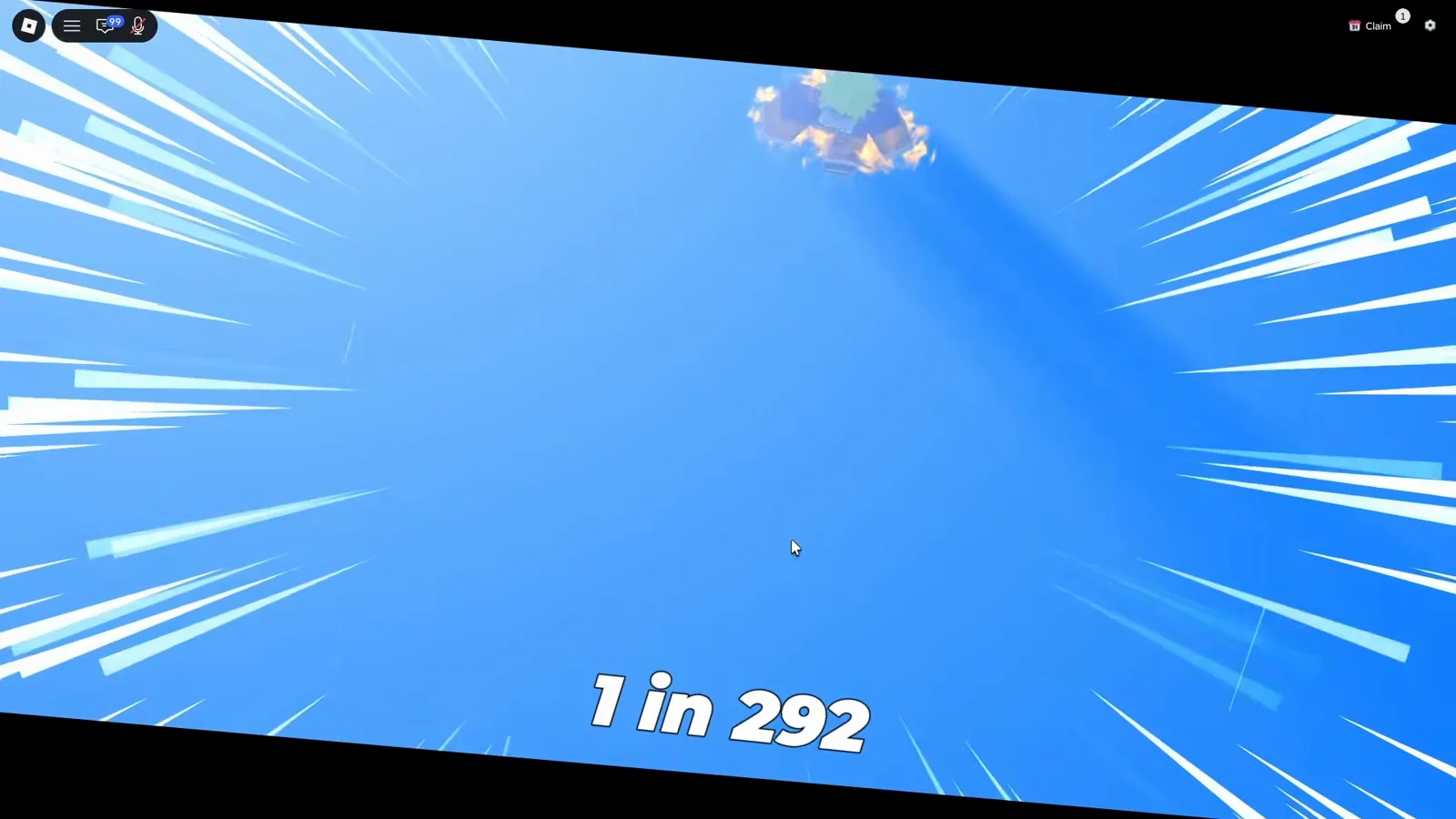
1 in 292 over a roll animation. It is the client’s own figure for the unit that just resolved, printed in the notation the Index cards use — and it is the one place the game tells you the odds of something after the fact rather than before.
What Do the 1 in N Figures Actually Mean?
Read literally, which is how this site reads them: one chance in N per roll. The card says 1 in 650sx, so a single roll has one chance in 650sx of producing it, and the game has now told you everything it is going to tell you.
The rest is arithmetic anyone can check, and it is worth doing because the printed figure misleads people in a predictable direction:
- Average wait. The expected number of rolls to the first copy is exactly N.
1 in 650sxmeans an average of 650sx rolls, not 650 rolls. - Half of players earlier, half later. The median wait is about 0.69 × N rolls, because the geometric distribution’s median is N × ln 2.
- Rolling N times is not a guarantee. It finds at least one copy about 63% of the time, and that 63% is nearly identical for every N — 63.3% at N = 292, 63.2% at N = 4,000. It is a property of the shape, not of that unit.
- Ten times N. Rolling 10N times misses about once in 22,000 attempts: a hit about 99.995% of the time. Still not a guarantee.
- Two cards in one roll. The denominators multiply. Two independent
1 infigures land together at one chance in the product of the two numbers.
The Index panel lets you watch the odds themselves step, and the step is steadier than you would expect. In one frame the grid shows twelve consecutive cards, and every neighbouring pair sits about ×1.8 apart:
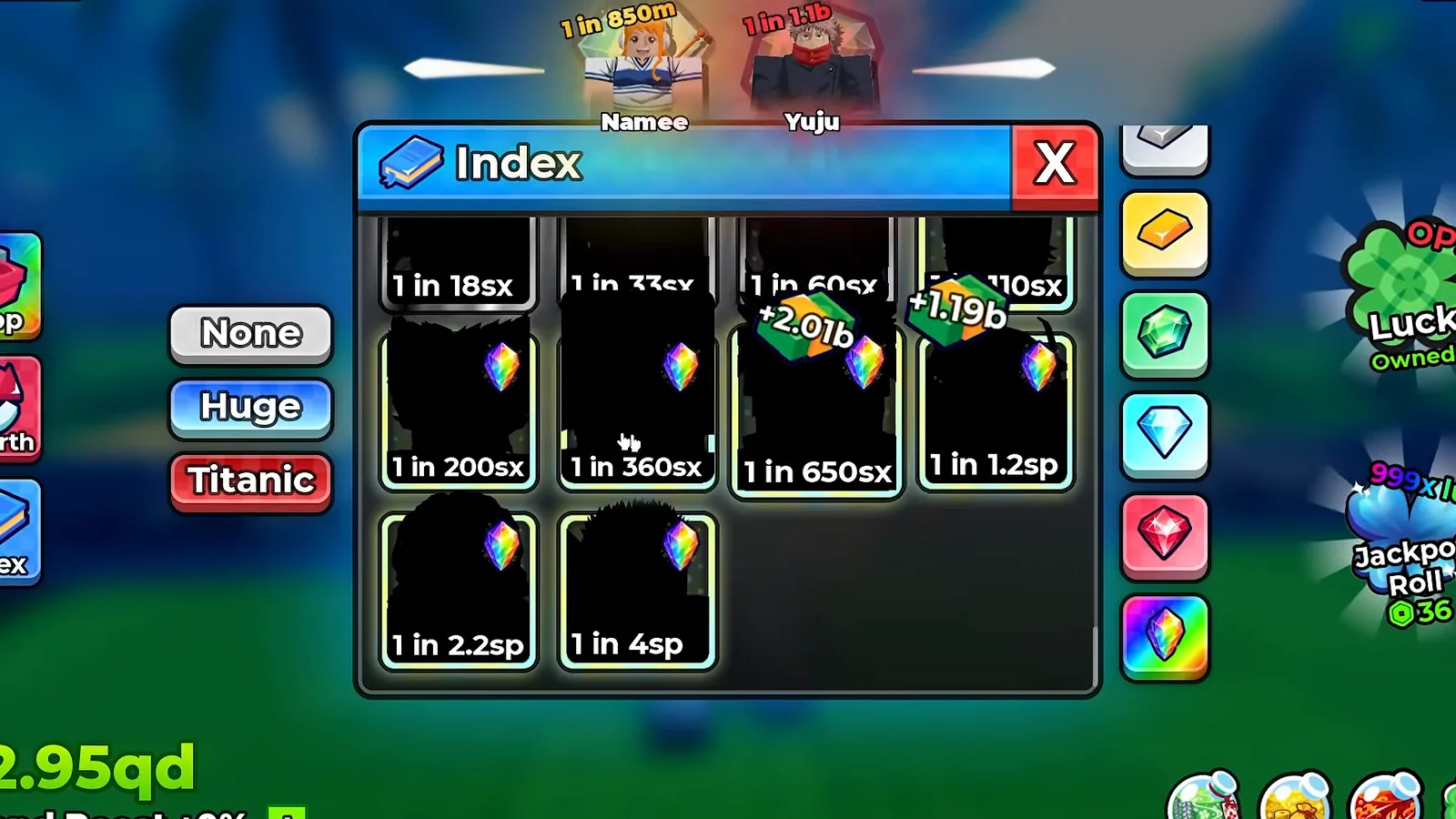
A card’s 1 in figure is printed inside the card’s lower edge, not in a separate column. At this instant no card is enlarged, so all ten figures in the stretch are legible at once — two seconds earlier the enlarged card hid one of them.
Watch the Index grid figures at 0:32
| Card as printed | Our arithmetic: the step from the card before it |
|---|---|
1 in 1.7sx | — (head of the stretch our frames reach) |
1 in 3.1sx | ×1.82 |
1 in 5.6sx | ×1.81 |
1 in 10sx | ×1.79 |
1 in 18sx | ×1.80 |
1 in 33sx | ×1.83 |
1 in 60sx | ×1.82 |
1 in 110sx | ×1.83 |
1 in 200sx | ×1.82 |
1 in 360sx | ×1.80 |
1 in 650sx | ×1.81 |
1 in 1.2sp | ×1.85 (see the suffix note below) |
Twelve consecutive printed figures, read from one scrolled state of the panel at 0:31, stepped by our own division. The average step is ×1.82, and the tightest and loosest are ×1.79 and ×1.85.
One reading to be explicit about, because it is the kind of thing that goes wrong in a screenshot: the head of that table is printed as 1 in 1.7sx, and we read it at 0:31.3, where the decimal point is visible at 7× magnification. In the frame at 0:31.0 the same cell renders as 17sx with the point clipped, because the panel is mid-scroll at that instant. Both readings are of the same card; the value in the table is the one with the point.
Does the Index Panel Print a Global Drop Table?
No, and the panel’s own behaviour is the proof. The Index is a scrollable grid of unit cards, four across, each card carrying its own 1 in figure — and what is visible in that grid changes as it scrolls. Two frames three seconds apart show the same stretch of the list with a different card enlarged, and the second between them shows a longer stretch of it:
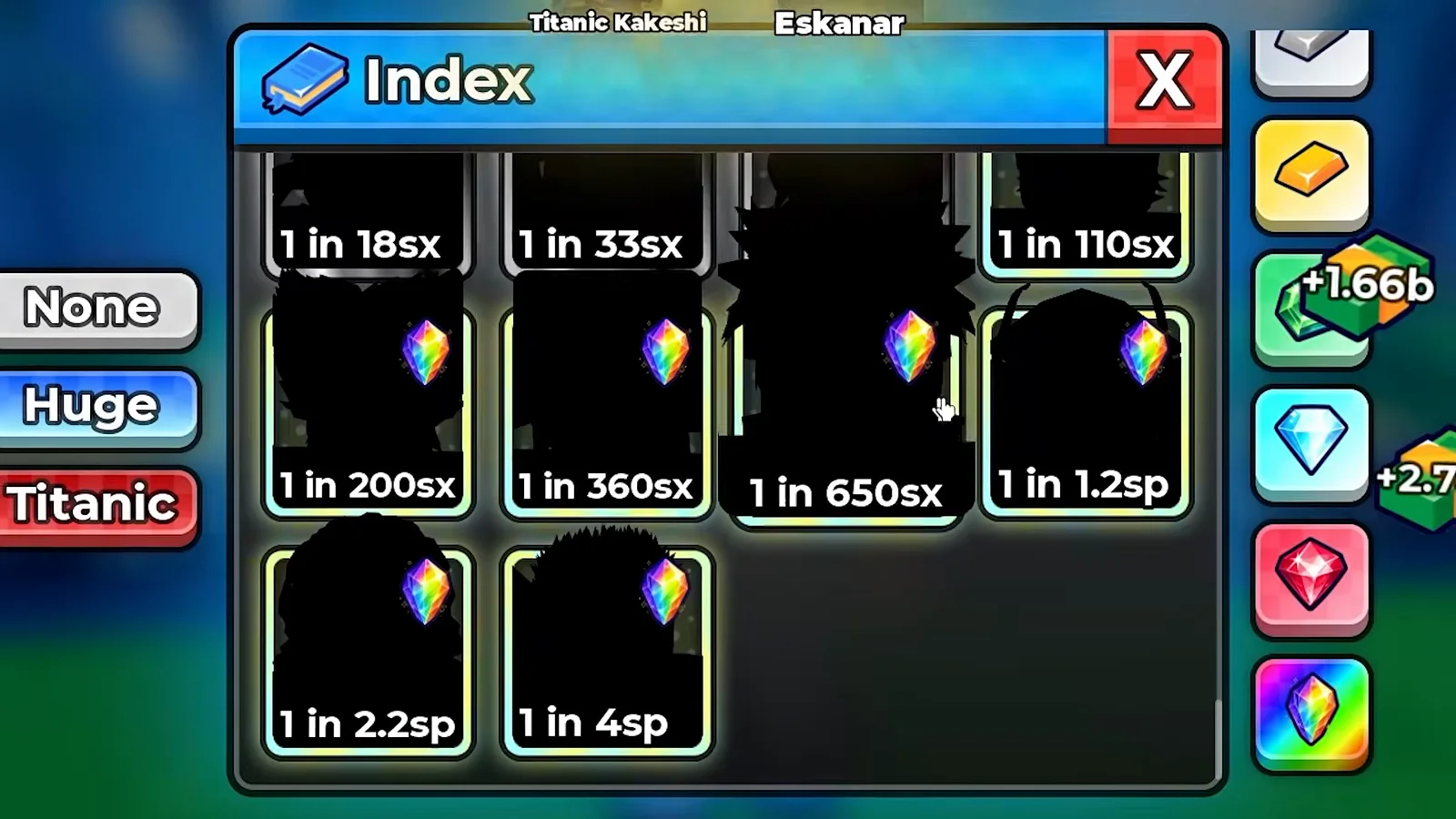
The Index title bar, the red X, the three size buttons down the left edge and the unlabelled icon column down the right. The grid is four cards wide; the figure printed inside each card is the unit’s roll odds.
Watch the Index panel open at 0:30
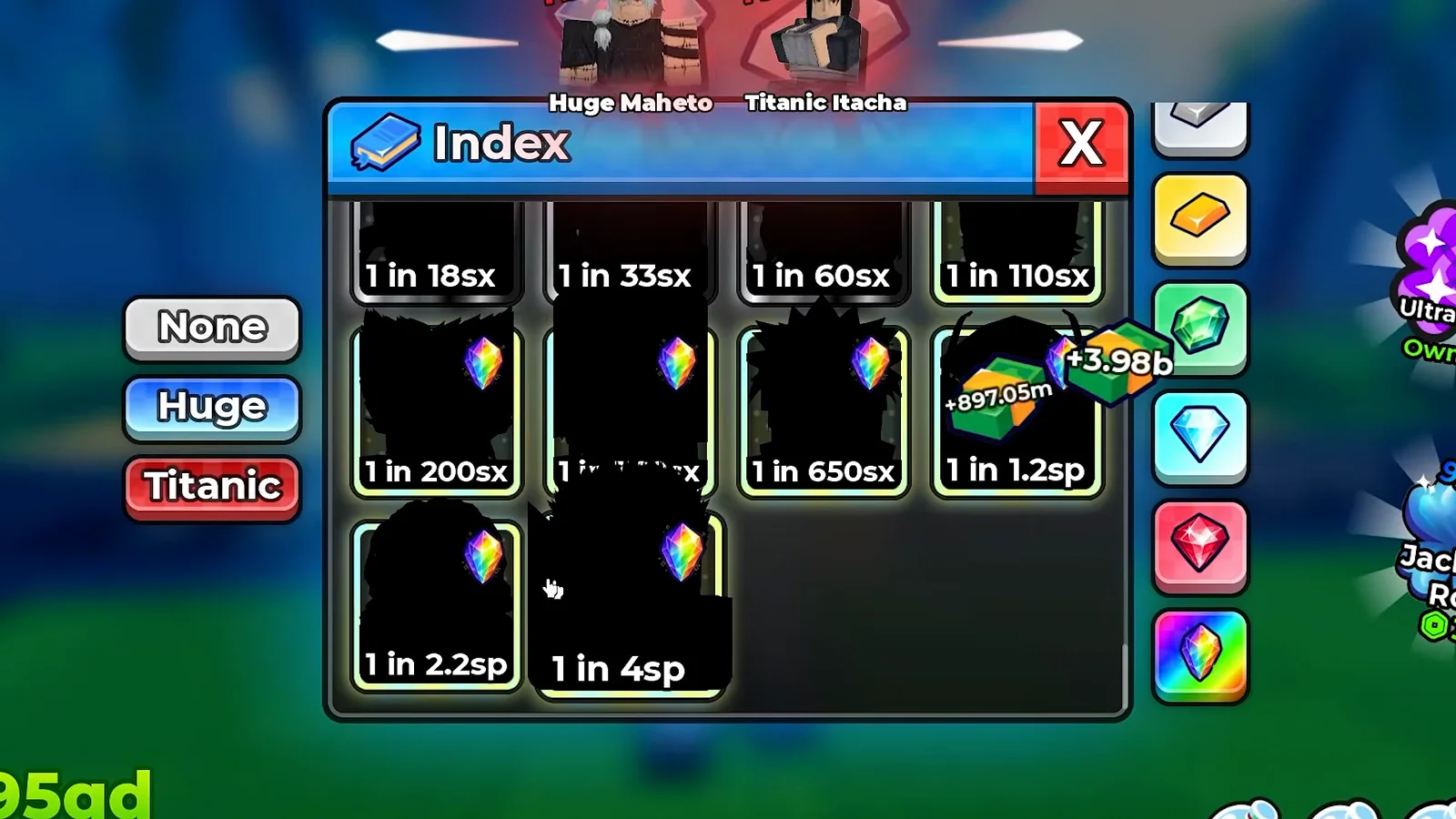
Same panel, same ladder, three seconds later. A different card is now the enlarged one, and the figure it covers has changed — at 0:30 the hidden figure is the one printed 1 in 60sx, and here it is the one printed 1 in 360sx. Reading the two frames together is how all ten figures in this stretch become legible.
Watch the enlarged card move at 0:33
Three things fall out of those two frames, and they are the reason this page does not reprint an odds table:
- The visible stretch moves. At 0:31.3 the grid holds twelve labelled cards and its first card reads
1 in 1.7sx; by 0:32 the bottom row holds1 in 2.2spand1 in 4spwith two empty cells beside them. The list continues past both ends of what fits on screen, so any snapshot of it is a snapshot, not the ladder. - One card at a time is drawn larger. In every frame we read, exactly one card is scaled up, growing upward over the card above it; the enlarged card keeps its own figure at its foot, and the card it covers loses its label. That is a rendering behaviour, not a rule we are inferring from one frame — it happens in each of them.
- The last row of a stretch is short. When the grid is scrolled to what looks like the end of its list, the final row holds two cards and two empty cells. No
Addprompt, no plus button and no counter appears in any frame we captured; the two empty cells are simply empty.
What the panel prints about its own state is much thinner than what it prints about the units. The None, Huge and Titanic buttons down the left edge are grey-, blue- and red-framed respectively, and the red frame on Titanic is present in every frame of the panel we have — including frames whose cards all print the same corner of the ladder, so the red is not a selection marker we can read. Down the right edge sit six unlabelled resource tiles: a silver ingot, a gold ingot, a green gem, a light-blue diamond, a red-pink diamond and a rainbow gem, the last of which is the same gem the cards themselves display. None carries a label and none opens a tooltip in any frame. Green +1.66b and +2.7… badges drift across that column in our frames, but they are the world’s own floating cash labels rendered behind the panel, not part of the icon rail.
Where Does the Game Print a Percentage Instead?
One screen, and it is not about units: the Traits panel. Open it and the right-hand column lists traits as cards, each with multipliers and a percentage underneath the icon.
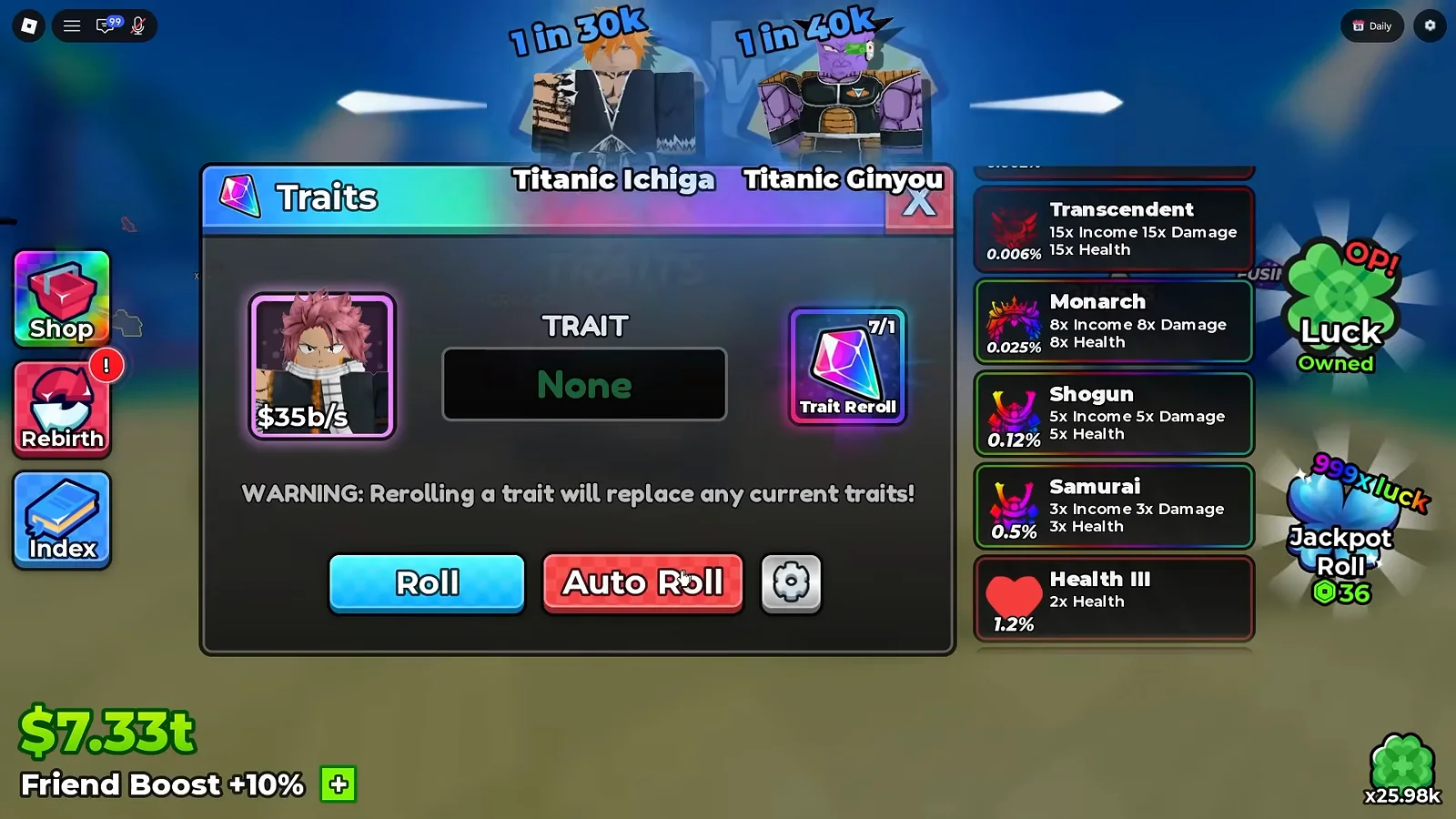
The panel reads Traits, the trait slot reads None, the counter reads 7/1, and the warning line reads WARNING: Rerolling a trait will replace any current traits!. The controls are Roll, Auto Roll and a gear. The percentages are in the right-hand column, printed under each trait’s multipliers.
Watch the Traits panel probabilities at 13:00
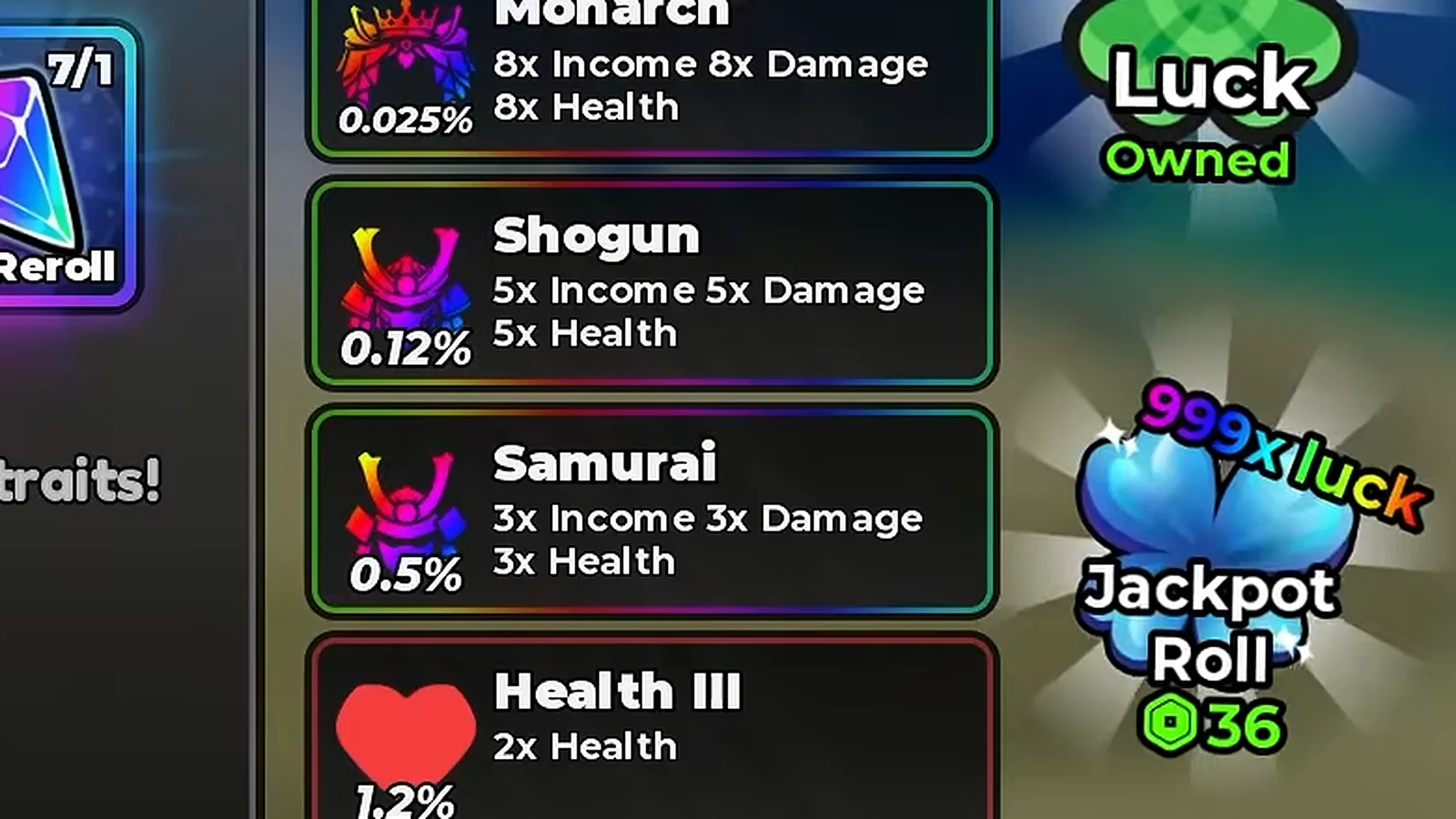
Four of the five trait cards legible in one crop, each printing its own percentage next to its icon; Transcendent’s 0.006% sits one card above this view, on the wider frame above. This is the client’s only percentage notation for probability that we found.
Watch the five trait percentages at 13:00
| Trait as printed | Multipliers as printed | Percentage as printed | Our arithmetic: as a 1 in figure |
|---|---|---|---|
| Transcendent | 15x Income 15x Damage 15x Health | 0.006% | 1 in 16,667 |
| Monarch | 8x Income 8x Damage 8x Health | 0.025% | 1 in 4,000 |
| Shogun | 5x Income 5x Damage 5x Health | 0.12% | 1 in 833 |
| Samurai | 3x Income 3x Damage 3x Health | 0.5% | 1 in 200 |
| Health III | 2x Health | 1.2% | 1 in 83 |
The percentages are the game’s; the last column is ours, and it is nothing more than 100 divided by the printed percentage. It is worth printing because the client itself uses both notations without ever relating them: a unit card says 1 in 650sx, a trait card says 0.12%, and no screen anywhere reconciles the two.
What the trait cards do not say is what the percentage is a percentage of. Each card prints a percentage and each panel carries a Roll and an Auto Roll, so a per-reroll reading is natural — but nothing on screen states it, the way nothing on screen states the sx convention. The trait side of this game — what the multipliers do, which traits are worth chasing, and what a reroll costs — belongs to the traits guide, the reroll priority plan and the grades page; this page only records that the probability is printed.
What Are the Odds of Getting a Shogun in Anime Dice?
The game prints them on the trait card: Shogun, 0.12%. That is the whole of the published figure, and our arithmetic on it is short: 0.12% is one chance in 833 trait rerolls, half of players see one inside about 577 rerolls, and 833 rerolls find at least one about 63% of the time.
Two honest caveats sit on top of that sentence, and both come from the frames rather than from caution:
Shogunin our frames is a trait, not a unit. The card carrying that name sits in the Traits panel’s list with5x Income 5x Damageand5x Healthprinted under it, and it is the trait cards that carry percentages. No unit card or nameplate in either recording prints the nameShogun, so if the question was about rolling a unit, this site has no frame-built answer — the unit roster page records which names this site has actually seen on cards.- The percentage is per something the screen does not name. The panel prints a percentage per trait and a reroll control under it; it prints no line saying “per reroll”, no pity counter and no statement that the odds improve with attempts. We treat
0.12%as the printed per-attempt figure and stop there.
What Does Luck Do to the Printed Odds?
The game prints Luck constantly and never once attaches it to a 1 in N figure. The places it is printed are worth listing, because it explains why the question keeps being asked:
- Dice Shop rows. Each dice row prints its own luck value behind a clover glyph. In two independent recordings the same three luck values come back:
Water | Uncommonwith10x Luck,Nature | Rarewith20x Luck, and a third row at42x Luck. - The HUD. The bottom-left corner prints the account’s cash above a line reading
Friend Boost +0%in most frames andFriend Boost +10%in the later part of the session. - A floating world element. A clover labelled
Luckwith the wordOwnedunder it, and a big blue999x Luckabove aJackpot Rolltile reading36.
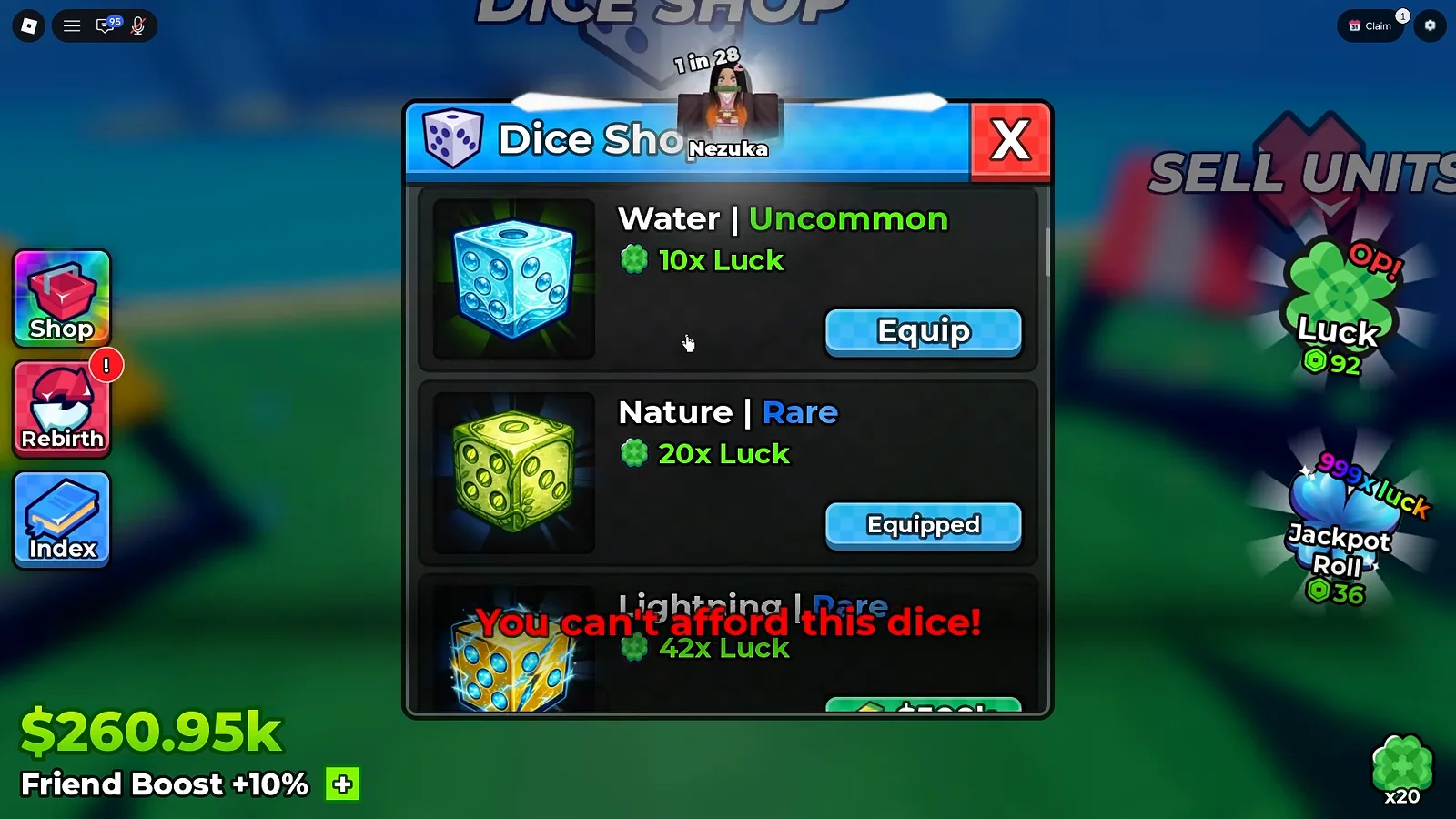
Every row prints its own luck value and nothing about what that value does to a roll. The dice on your account is Equipped one at a time, so these are a ladder of alternatives, not a stack.
Watch the Dice Shop luck rows at 3:48

The same three luck values in a second recording from a different channel. Two independent sessions agreeing is why this page prints 10x, 20x and 42x rather than a single-account reading.
Watch the second session Dice Shop at 4:00
So the honest reading of the whole luck question is a shape, not a number: the client multiplies luck in at least four visible places, prints each one separately, and prints no join between any of them and a card’s odds. Our arithmetic can show what a multiplier would do — a 1 in 650sx card read as if a ×2 luck halved the denominator would behave like 1 in 325sx — but that sentence is arithmetic on an assumption, and no frame in either recording shows a single odds label change after a luck change. The luck page owns what each source prints and what it refuses to say; the dice shop guide owns the rung-by-rung ladder.
What Could Not Be Determined From These Frames?
Every item below is a real gap in the footage, with the sampling boundary stated so you can judge it:
- Whether
None,HugeandTitaniccan be pressed. No click on any of the three appears in any frame we read, and the redTitanicframe is present in all of them, including frames showing the same odds corner, so no frame tells us which one is active or what each one changes. - What the six right-edge icons mean. No label, no tooltip and no pressed state in any frame. They reappear as corner badges on cards elsewhere in the client, which is suggestive rather than explanatory.
- What the empty cells in the Index grid are for. The scrolled-to-end view holds two cards and two empty cells in its last row; no
Addprompt, plus button or counter appears anywhere in our frames. Sampling boundary: our reads of this panel are six moments of one upload — 0:30, 0:31, 0:31.3, 0:32, 0:33 and 0:36. - The conversion from Luck to odds. Never printed, and never demonstrated by a before-and-after frame. See the callout above; this page publishes no converted figures.
- What
sx,spand the other suffixes are numerically worth. Never printed. Our ratios need no convention; any percentage we could print for ansxfigure would, so we print none. - Where this stretch sits in the full list. Our frames reach the
sxandspcorner of the ladder and the two-card tail of one stretch. Whether that tail is the end of the whole Index or the end of a filtered view is not visible on screen, and the grid scrolls in both directions. - Whether the trait percentage is per reroll or per something else. The panel prints a percentage per trait card plus
RollandAuto Roll; it does not print a basis, a pity counter or an improving rate. - What the
Gradespanel’sGrade Chancescolumn contains. The clearest frame of that panel in our set has a browser window open behind it, so this page publishes no picture of it and transcribes nothing from the column. The grades page records what its own frames showed. - Whether the same character’s copy prints different odds than its catalogue card. Our Unit Index page documents an Almait with a catalogue figure and a Backpack figure about ten thousand times apart in the same session. That question needs the Backpack and the Index in one frame; nothing in this page’s frames resolves it.
If your client shows one of the three size buttons being pressed, a tooltip on a right-edge icon, an Add prompt in the grid, or an odds label changing after a luck change, the contact page takes dated screenshots and we will correct this page.
What Should You Read Next?
- Unit Index — the full
1 inladder this page explains the notation of, transcribed from the same panel down to its1 in 40qdtail - Luck — every place the client prints a luck multiplier, and why no screen joins them into a total
- Traits guide — the multipliers behind the percentages in this page’s trait table, and what each trait does to a unit
- Reroll priority — where the reroll currencies come from and which traits are worth spending them on
- Grades — the letter-graded multiplier screen, including the
Grade Chancescolumn this page could not photograph cleanly - Dice Shop — the rung-by-rung luck ladder whose
10x,20xand42xrows appear above - Dice calculator — the other place this site does arithmetic the client leaves out, on income rather than odds
- Update history — which build each screen on this page was captured in, and why every picture here is UPD 5
Artigos relacionados
guides
Anime Dice Update 7: Rebirth Upgrade Points, Third Base Floor and New Dice
Anime Dice UPD 7 read off frames: the developer's own patch notes, the 6-path Rebirth Stats panel, and a purchase confirmation. Checked 7 October 2026.
guides
Anime Dice Money: Where Cash Comes From, Read Frame by Frame
Anime Dice money read frame by frame: the cash counter's k-to-oc suffix ladder, the $/s income every unit card prints, and the breakdown no screen ever shows.
guides
Anime Dice Calculator: Cash per Luck and the Next-Dice Wait
Every Anime Dice dice price re-read at native resolution, turned into cash-per-Luck arithmetic from the 42x rung to 5,000,000,000x, plus the wait formula.
Isso foi útil?
Obrigado pelo feedback!