Anime Dice Trait Reroll Guide: Priority Order and What to Skip
An Anime Dice trait reroll guide: which units deserve Trait Rerolls, how rerolls differ from grade rolls, where the currency comes from, and when to stop.
FAQ
What should I use Trait Rerolls on in Anime Dice?
Are Trait Rerolls the same as rolling Grades?
How do I get more Trait Rerolls?
Is it worth rerolling Rare or Epic units?
Does Anime Dice publish trait values and reroll odds?
Reroll Guide Basics: What Do Trait Rerolls Actually Change?
A Trait Reroll is a currency, not a stat. Spending one re-randomises the trait attached to a single unit — the passive bonus line you see on that character in the trait panel. Two definitions matter because they get mixed constantly in comments and on other sites:
- Lucky Spins roll the dice to pull new units for your team.
- Trait Rerolls change the trait on a unit you already own.
- Gems are the general upgrade currency, spent on improving dice abilities and overall power.
That split comes from the games.gg codes guide (2 September 2026) and matches Pro Game Guides’ coverage the same week; it is also exactly how the three currencies behave in play. A reroll cannot make a weak unit good — it can only make a strong unit’s bonus line fit its job. So the whole strategy question is about where you spend the roll, not how you roll.

Anime Dice session showing the trait and grades panels the priority order below is built on
Trait Rerolls Are Not Grade Rolls
Before the priority list, one distinction that saves more currency than any rule about which unit to pick. Anime Dice has a second “roll” system that looks identical in a screenshot: the Grades menu, where you spend shards to roll a lettered income multiplier onto a card. In the frame below, the grades panel is open with its tier ladder and a per-tier chances column — that is a grade roll, and no amount of Trait Rerolls will move it.
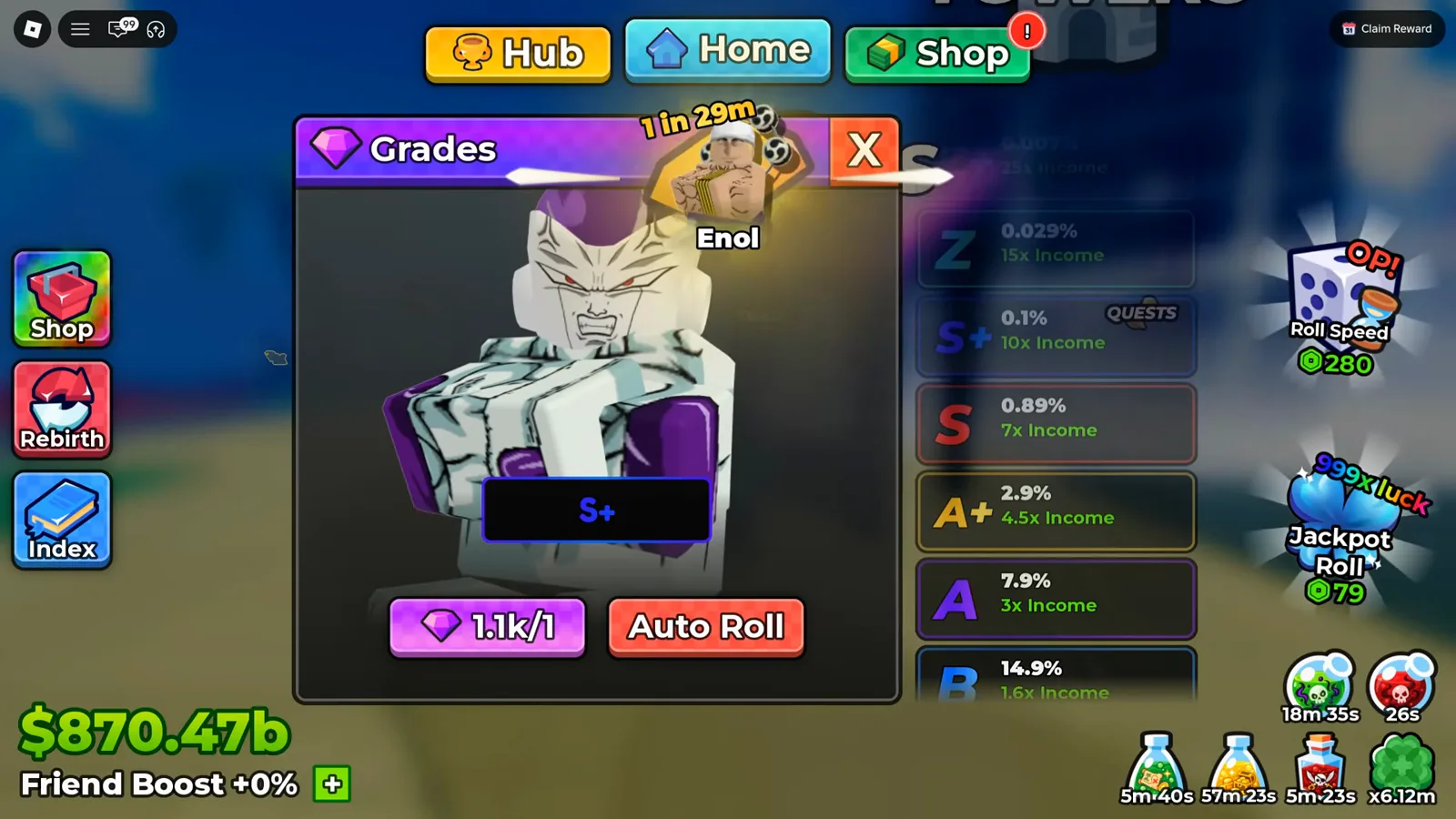
Shards buy grades, rerolls buy traits. Keep the wallets apart.
| Trait Reroll | Grade roll | |
|---|---|---|
| Currency | Trait Rerolls (from codes, quests, gems) | Shards (farmed from rolls and progression) |
| Changes | The unit’s passive trait line | The unit’s lettered income multiplier |
| Lives in | The trait panel on a unit | The Grades menu, with an Auto Roll toggle |
| Best spent on | Units you are keeping long-term | Units whose base income already justifies the tier chase |
Grades, traits, rarity and mutations are four independent fields stacked on one card — the mutations guide walks through how they coexist on a single unit.
The Reroll Priority Order
Work down this list and stop at the first rule that applies. It is ordered by absolute gain per reroll, which is the only thing a limited currency should be optimised for.
- Highest rarity first. A trait is a modifier on top of base income, and base income climbs with the rarity ladder (Uncommon · Rare · Epic · Legendary · Mythical). The same upgrade on a Mythical card is worth several times the same upgrade on a low-tier one. If you own a Legendary or Mythical unit that is still carrying a trait doing nothing for it, that is your first reroll.
- Plot units before tower units. Income traits pay off every second you are on the plot — and every second you are away, because offline earnings ride the same cash-per-second stream. A unit parked in a tower squad does not earn while it fights.
- Match the stat to the job. In the sessions we reviewed, traits appear as named bonuses with levels — the panel runs from tiered income/damage/health traits (for example Health III, Money III) up through the high multipliers we transcribed in the traits guide. Income-style traits belong on earners parked on your plot; Damage and Health traits belong on the units you send into tower floors. Rerolling an earner toward damage is a wasted roll even if the level looks impressive.
- Then the multipliers on top of the base. If your plot layout is still small, a slot upgrade does more for total income than a perfect trait on one unit. The beginner guide sets out the slots-before-blocks order; follow it before polishing traits.
- Skip anything you plan to sell or replace. Rerolling a unit you will overwrite next tier is spending the currency on a temporary. Check the character tier list first so you know which units are keeps.
- Save a bank instead of emptying it. Rerolls arrive in bursts with updates and codes. Ten rolls spent one by one on “pretty good” results lose to ten rolls spent on a single unit you are building around — set a stop-loss before you open the panel.
Where Trait Rerolls Come From
Three reported sources, only one of which is free-and-instant:
- Codes. The most reliable faucet. Live codes in this cycle hand out Lucky Spins, Trait Rerolls and Gems together — check the verified Anime Dice codes list and redeem before a session, since each code is one-time per account and case-sensitive.
- Quests. Daily and weekly boards pay tickets and currency for goals like clearing tower floors; the AFK farming guide shows the quest board and which rewards accumulate while you are away.
- Gems in the shop. Possible, and usually the worst value: gems are the general upgrade currency, and pulling them out of dice power to buy rerolls is a slow leak.
Because codes drop with updates and milestones, the practical habit is: claim first, spend later. New versions land roughly every few weeks here — the update history page tracks what shipped when, which is also when the reroll supply jumps.
Is It Worth Rerolling Early On?
Not yet. Early on, the binding constraint is how many units you can place and how much their base income is, not the fine print on one card. Two rerolls on a mid-tier roster change nothing measurable, while the same two rolls on a Mythical earner you built your plot around are visible in the cash-per-second figure.
The exception: if you already have a high-rarity unit sitting on a good plot slot with a clearly mismatched trait, fix it — that is the one case where an early reroll pays for itself. Everything else can wait until the reroll economy you have makes the decision meaningful.
Related Articles
guides
Anime Dice Update 7: Rebirth Upgrade Points, Third Base Floor and New Dice
Anime Dice UPD 7 read off frames: the developer's own patch notes, the 6-path Rebirth Stats panel, and a purchase confirmation. Checked 7 October 2026.
guides
Anime Dice Money: Where Cash Comes From, Read Frame by Frame
Anime Dice money read frame by frame: the cash counter's k-to-oc suffix ladder, the $/s income every unit card prints, and the breakdown no screen ever shows.
guides
Anime Dice Probability and Roll Odds: The 1 in N Screens
Anime Dice prints unit odds as 1 in N and trait odds as percentages, never as one drop table. Frame-by-frame readings plus the arithmetic the game leaves out.
Was this helpful?
Thanks for the feedback!