Anime Dice Grades: The Income Tier Ladder and Gem Cost
What Grades do in Anime Dice: a per-unit income multiplier you reroll with Gems, read off the on-screen tier ladder frame by frame.
Perguntas frequentes
What are Grades in Anime Dice?
How much does one Grade roll cost?
What is the best Grade shown on the panel?
Does Auto Roll stop on a good Grade?
Can a Grade roll make a unit worse?
What Does the Grades Panel Actually Show?
Grades are one of the two physical stations in the hub — you walk your character up to the GRADES stall and a Grades panel opens over a single unit. It is not a menu buried in a settings screen; it is a place in the world, right next to the TRAITS stall, and it works on one unit at a time.
Read the panel left to right and every part has a job:
- Unit portrait with its name (here Titanic Deko) — the unit you are grading.
- Current-grade box under the portrait — the letter that unit holds right now (
A+in the frame below). - Gem counter in the pink pill (
302/1) — your Gem balance over the cost of one roll. - Auto Roll button — fires the rolls for you.
- Tier ladder down the right edge — every grade letter with its income multiplier and its odds.
Every screen on this page was opened and read frame by frame from two sessions:
Source: the captures and timestamps below are frames from two clean screen-capture sessions by Superlex Plays — the ~41-minute GRADES station run, which reads the whole ladder on camera, and the later base session, which corroborates the gem cost and the Auto Roll behaviour. Neither video carries a facecam or burned-in captions, so we screenshot freely from both. The ladder numbers are a single-account snapshot at UPD 3; the developer publishes no official grade table.

The Superlex Plays session that opens the Grades panel and reads the full tier ladder on camera
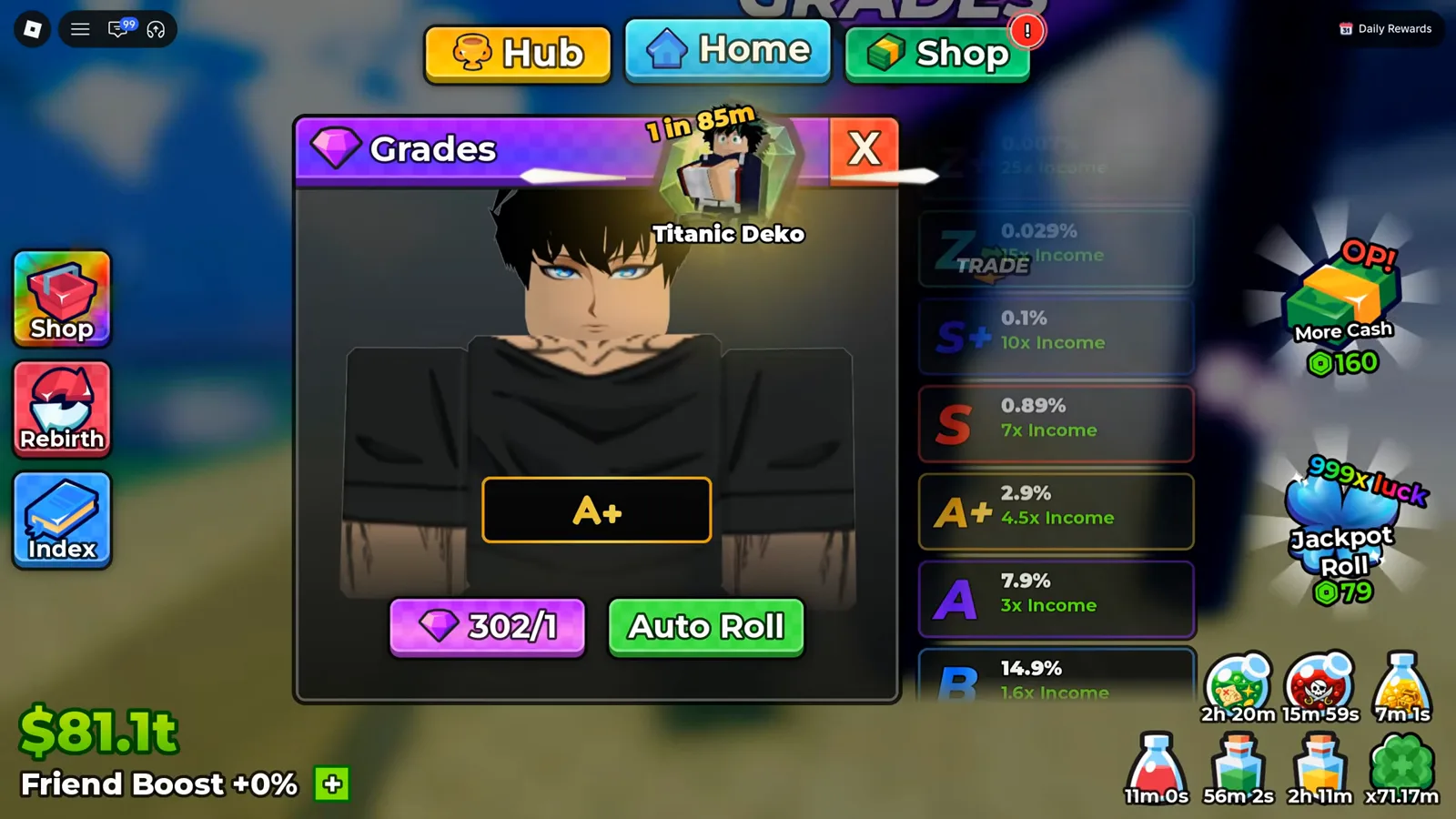
This is the reference frame — the current grade box, the gem cost and the ladder all in one shot.
Watch the Grades panel at 6:25
What Is the Grade Ladder and What Does Each Letter Pay?
The ladder on the right of the panel is the whole system in one column: a letter, an income multiplier, and an odds percentage. Higher letters pay more and are far rarer. Transcribed straight off the screen:
| Grade | Income multiplier | Odds (per roll) |
|---|---|---|
| Z+ | 25x income | 0.007% |
| Z | 15x income | 0.029% |
| S+ | 10x income | 0.1% |
| S | 7x income | 0.89% |
| A+ | 4.5x income | 2.9% |
| A | 3x income | 7.9% |
| B | 1.6x income | 14.9% |
Two honesty notes about exactly what the frames show. The Z+ row is the top line of the ladder, but its letter badge is clipped at the upper edge of the panel in every frame we captured — the 0.007% and 25x income are legible, and the creator names that row “Z Plus” on camera, but we could not get the “Z+” glyph itself cleanly in shot. The Z row’s “15x income” is partly hidden behind a floating “TRADE” popup in the primary video; we read it cleanly from the secondary video’s frame instead, where nothing covers it.
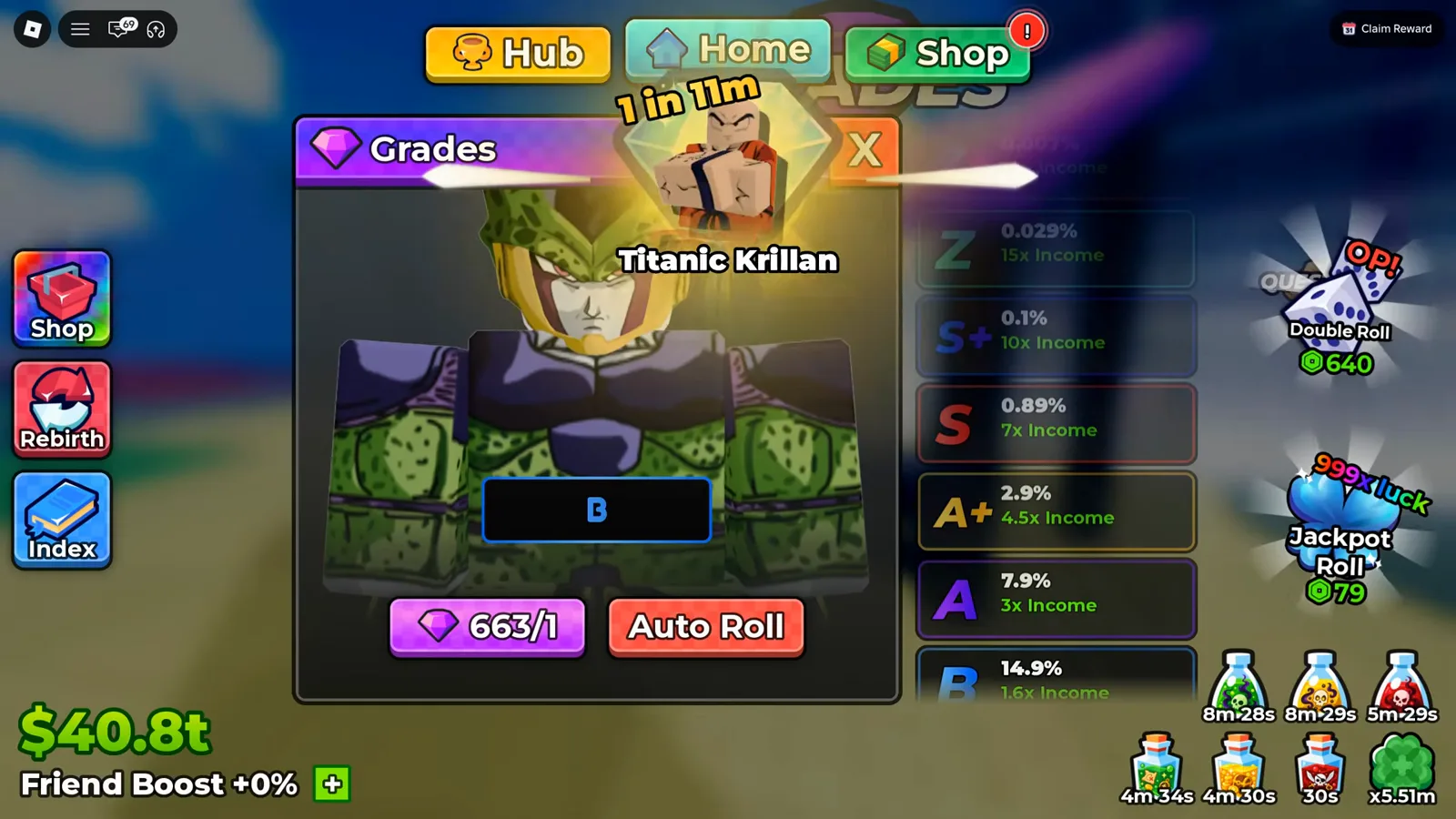
Same ladder, second session — this one lets us read the Z row’s multiplier in the clear.
Watch the grades ladder in the second session at 3:20
How Do Gems Pay for Grade Rolls?
The pink pill at the bottom of the panel is the giveaway: it reads a number over 1 — 302/1, then 275/1, then 249/1 as the rolls fired in the primary session, and 663/1 in the secondary one. The /1 is the price of a single roll; the leading number is your remaining Gem balance. Every attempt spends one Gem, so a Grade reroll is a direct drain on the same gem faucet you spend everywhere else.
That makes Grades the main competitor for your Gems, which is why it is worth reading the Gems usage guide alongside this page — it tracks where Gems come from and what else they buy. If you would rather not burn a stack of Gems one letter at a time, redeeming live Anime Dice codes is the free-to-play way to top the balance back up before you commit.
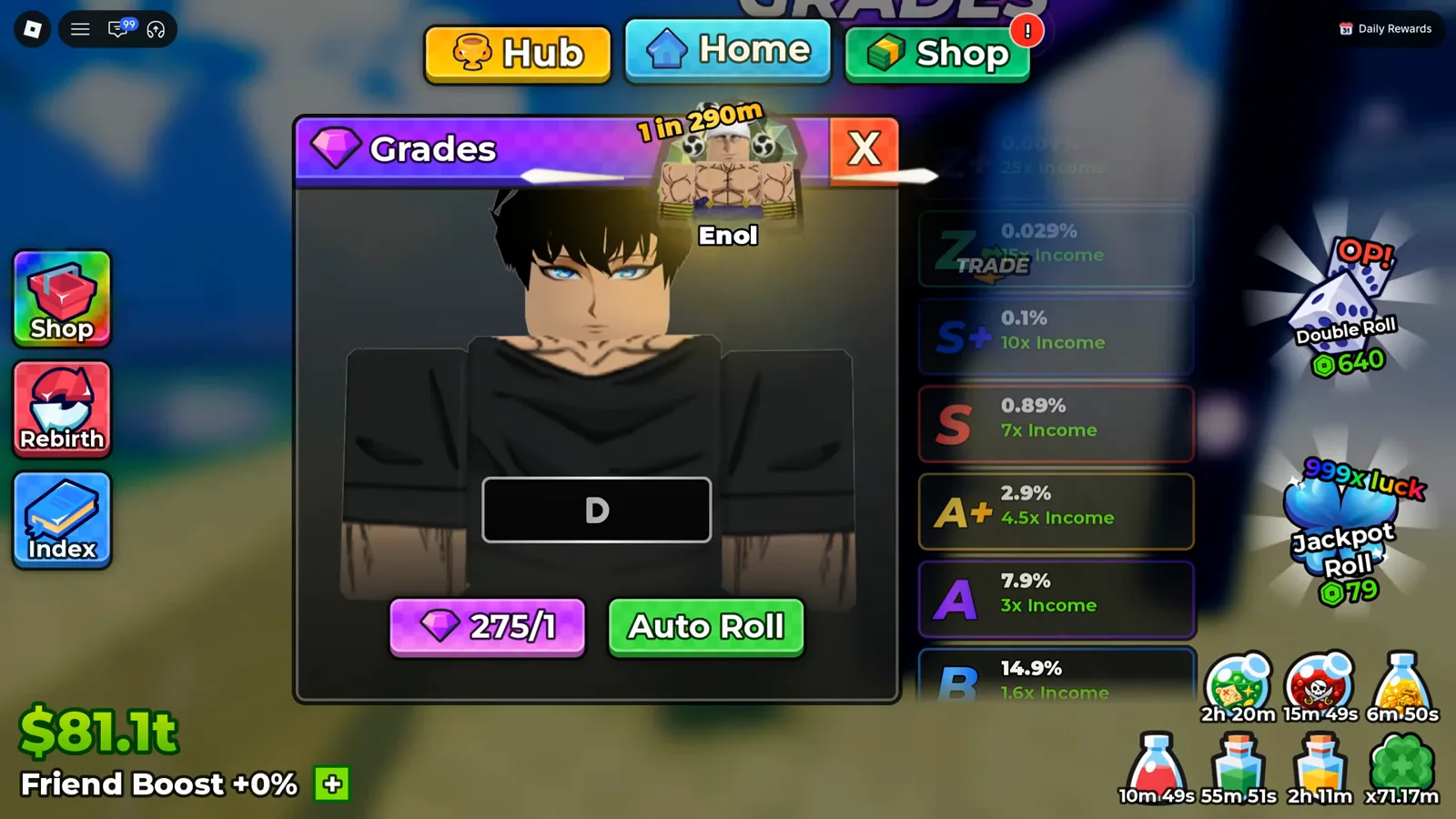
The counter only moves one way while you roll — down, one Gem at a time.
What Does Auto Roll Do?
Auto Roll keeps firing Grade rolls without you tapping each time. The important catch — confirmed independently in both sessions — is that it does not stop on a good result. The creator in the secondary video puts it plainly: he found out “it actually doesn’t skip the really good ones… you had to stop it at the perfect time.” The primary session says the same thing while watching his balance fall.
So Auto Roll is a convenience, not a filter. It spends your Gems at speed until you intervene, and the current-grade box simply reflects whatever the last roll landed on. Nothing on the screen auto-holds an S+ for you.
Can a Grade Roll Downgrade a Unit?
A roll overwrites the unit’s current grade with whatever it lands on — and the low letters are real outcomes. In our frames the current-grade box read D twice and B once, and other rolls across the two sessions landed on C. That is the whole risk: you can spend down to a D on a unit you were trying to push higher.
Both creators handle this by refusing to keep rolling a unit they care about once it reaches a target letter — one says he will not take anything below S+ on a keeper, the other re-rolls to a minimum of S. That is a spending discipline, not a game rule, and the screen supports it: the ladder shows S at 7x income and 0.89%, so S+ and above are rare enough that walking away at the right letter matters.

This is what “landing low” looks like — a D where you were hunting for an S.
Where Does the Grade Show Up on a Unit?
The grade is not only a panel — it is stored as a stat on the unit’s card. Open the Select roster and a unit’s tooltip lists its rarity, level, mutation, income and a Grade line. In the frame below, Titanic Kaidon reads Grade: S right under its Samurai mutation.
That distinction matters for search: Grade is the letter you roll with Gems; mutation is a separate roll-based quality you see on the same card. They are different systems, and our mutations guide covers the other one.
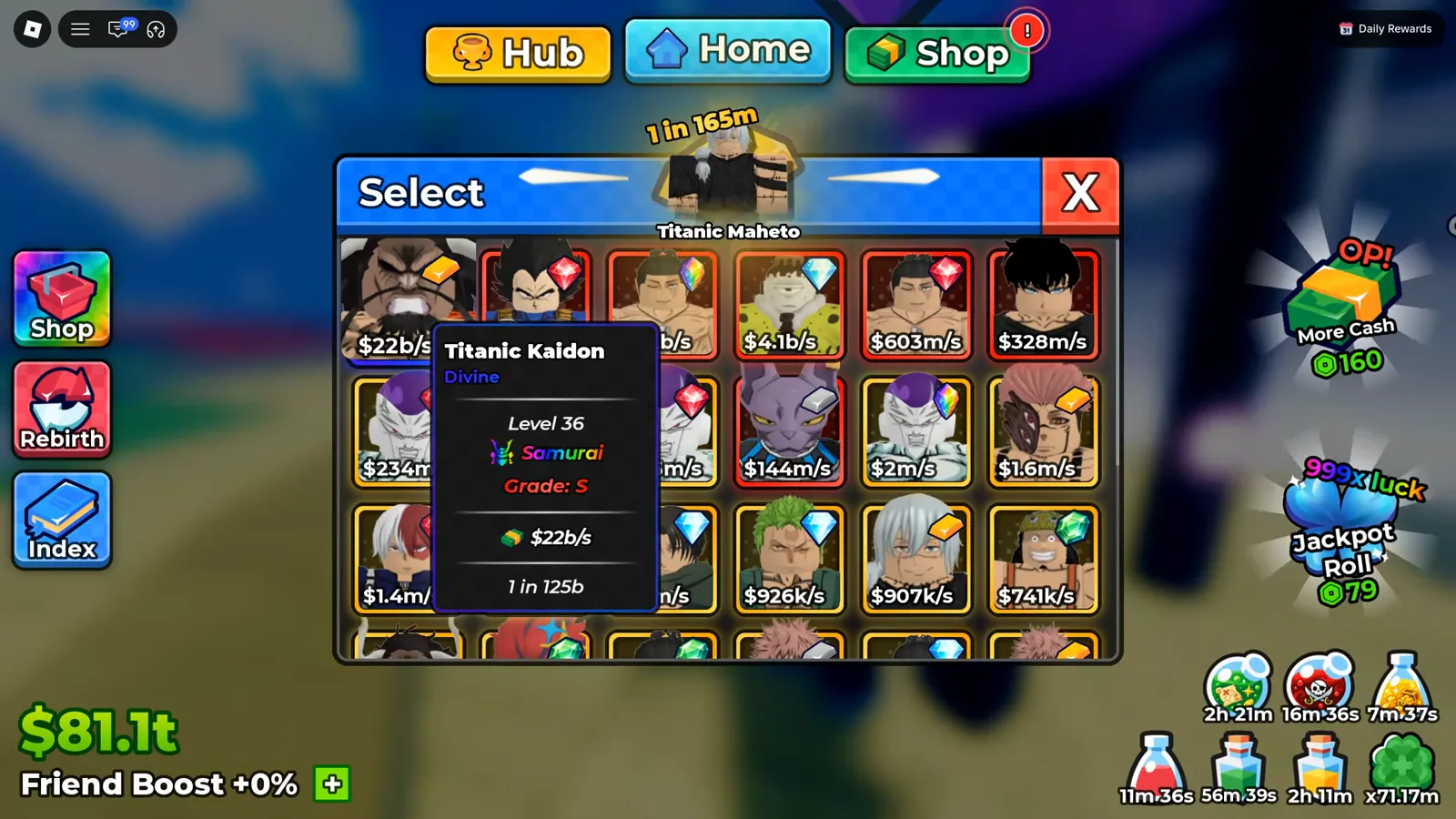
Grade is a stat that lives on the unit, not just a moment on the panel.
Watch the unit card tooltip at 6:20
Which Units Deserve Your Gems?
Because a Grade multiplies a single unit’s income and each roll costs a Gem you will never get back, the grade is only worth buying on a unit you plan to keep. A replaceable low-rarity unit is a Gem bonfire — you are paying to boost income the next roll will sell anyway. The character tier list is the companion for that call: it ranks which units are worth the levels, traits and grades at all.
The same logic extends to the other reroll currency. Grade rolls spend Gems; Trait rerolls spend Trade Shards, and deciding which to prioritise is its own problem — see the reroll priority plan for how the two currencies compete for the same session.
Artigos relacionados
guides
Anime Dice Quests and Tickets: Daily, Weekly and Shop Tabs
Where the Quests board is in Anime Dice, what the Daily, Weekly and Shop tabs actually pay, and what Tickets buy — read off frames, one screen at a time.
guides
Anime Dice Upgrade Tree: Money, Luck, Damage & What to Buy First
How the Anime Dice Upgrades hex tree works: the Money, Luck, Damage and Unit Storage branches, what nodes cost, and what to buy first — read frame by frame.
guides
Anime Dice Gems: What to Spend Them On and What to Skip
What Gems do in Anime Dice, read off the screen: the Grades roll cost, tower drop tables, the Trait Reroll crystal, and what is actually priced in cash instead.
Isso foi útil?
Obrigado pelo feedback!