Anime Dice Gems: What to Spend Them On and What to Skip
What Gems do in Anime Dice, read off the screen: the Grades roll cost, tower drop tables, the Trait Reroll crystal, and what is actually priced in cash instead.
FAQ
What are Gems in Anime Dice?
What do Gems actually buy?
Where do Gems come from?
What should you spend Gems on first?
How do Gems differ from Lucky Spins and Trait Rerolls?
What Are Gems in Anime Dice?
Gems are the purple faceted jewel that appears on the right-hand counter rail, in tower drop lists, and as a floating pickup on the ground. The naming is not our interpretation: in the frame below the player walks over a drop and the toast prints “+4 Gems” beside that purple jewel icon, which settles what the item is called in-game.
The screens on this page were read frame by frame from two sessions:
Source: captures and timestamps are frames from Shensu’s I Went from NOOB to PRO in Roblox Anime Dice! (September 2026) and Superlex Plays’ How to become OVERPOWERED in Anime Dice — the latter is the session whose narrator says, on mic at 12:08, “so this is what the gems are used for” as he opens the Grades menu. One payout line is quoted from the same creator’s HOW TO GET 100,000x LUCK DICE! + RAINBOW GRADES, which we use for audio only and screenshot nothing from. The currency definition is cross-checked against games.gg’s Anime Dice guide (2 September 2026) and a second write-up published the same week, both retrieved 13 September 2026.

The OVERPOWERED session that identifies the Grades menu as the gem sink
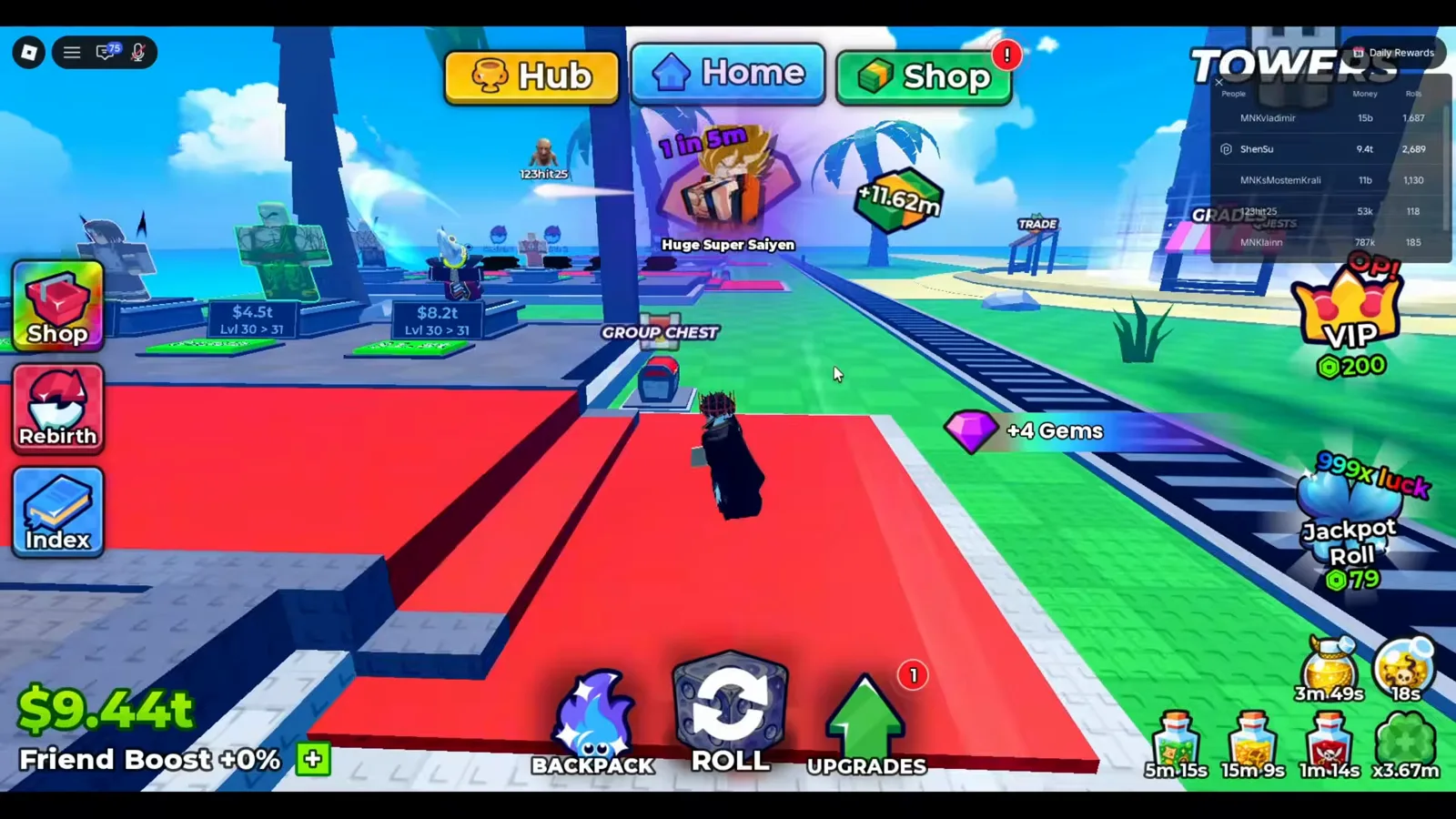
Whatever else guides call it, this is the label the client uses.
Watch the +4 Gems toast at 9:00
Two independent September 2026 write-ups agree on the role: Lucky Spins roll you new units, Trait Rerolls re-roll the traits on a unit you already own, and Gems are the general upgrade currency that lifts your dice capabilities and overall power. Our frames put a concrete screen behind that last phrase — the Grades menu.
What Do Gems Actually Buy In-Game?
The Grades panel. Its header carries the purple gem icon, the big roll button under the unit portrait shows that same icon with an owned / per-roll counter beside it (the frame below reads 9/1 — nine gems held, one spent per attempt), and next to it sits the Auto Roll toggle. Down the right edge is the ladder: every letter tier with its income multiplier and its own probability column.
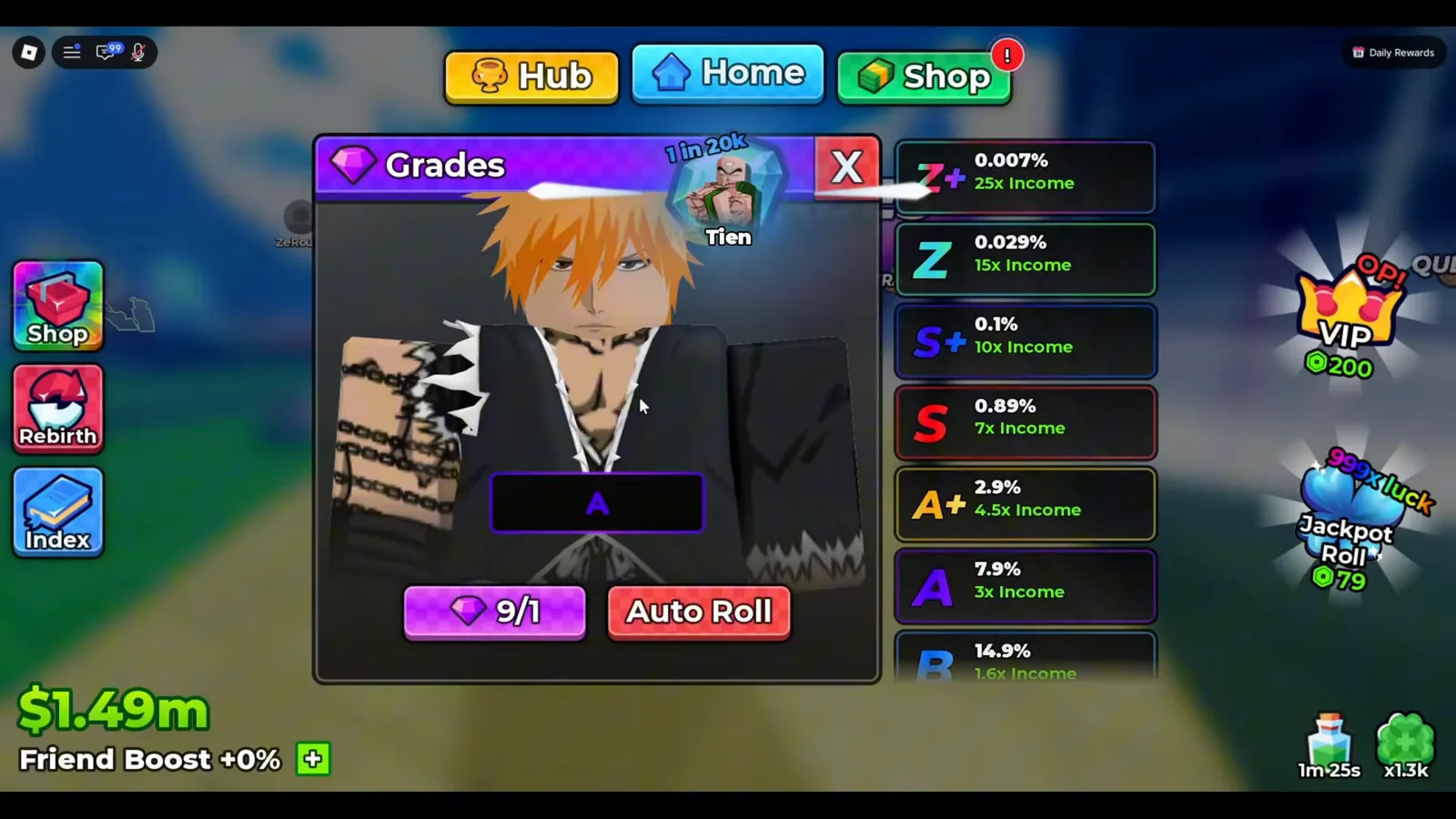
Grade is an income multiplier bolted onto a unit you already own — and gems are what buy the attempts.
Watch the Grades roll cost at 4:30
That is the complete list of confirmed sinks. We are deliberately not extending it: no frame we checked showed gems priced on anything else.
Where Do Gems Come From?
Towers are the faucet, and you can read it three ways on the same screen path.
1 — The drop preview. Every tower panel’s Drops column lists the purple gem, in the base band at the top and again inside the higher band that unlocks past “Floor 50+” or “Floor 60+”. Hovering the neighbouring pink crystal prints the tooltip “Trait Reroll”, filed under Celestial — that is the item people misremember as a gem.
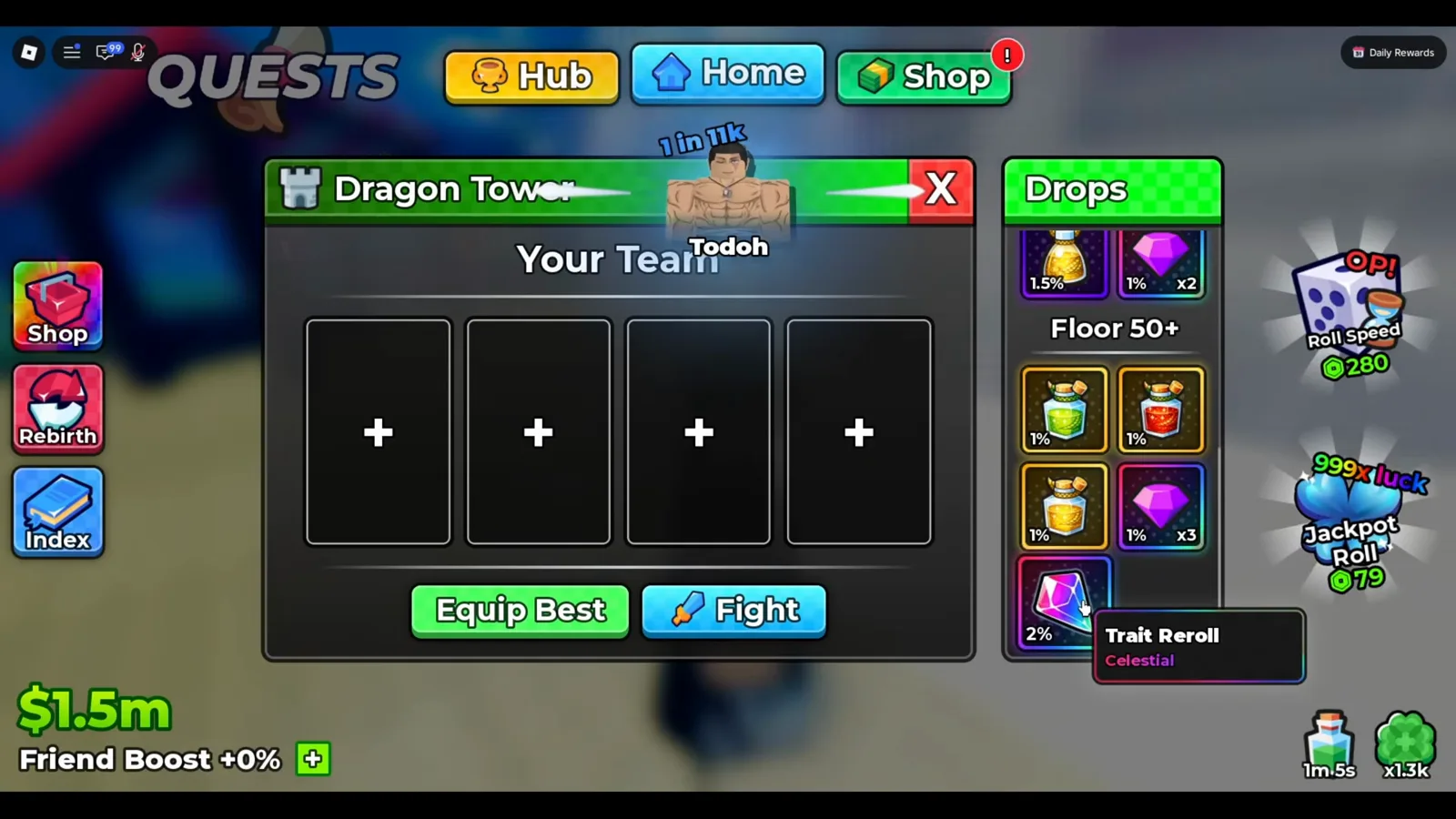
Read the drop list before you spend the entry, and read the tooltip before you assume.
Watch the Dragon Tower drop list at 4:45
2 — The payout screen. When a run ends, the Rewards panel prints what you actually collected, stack counts included — four purple gems on one trip in the frame below, potions alongside.
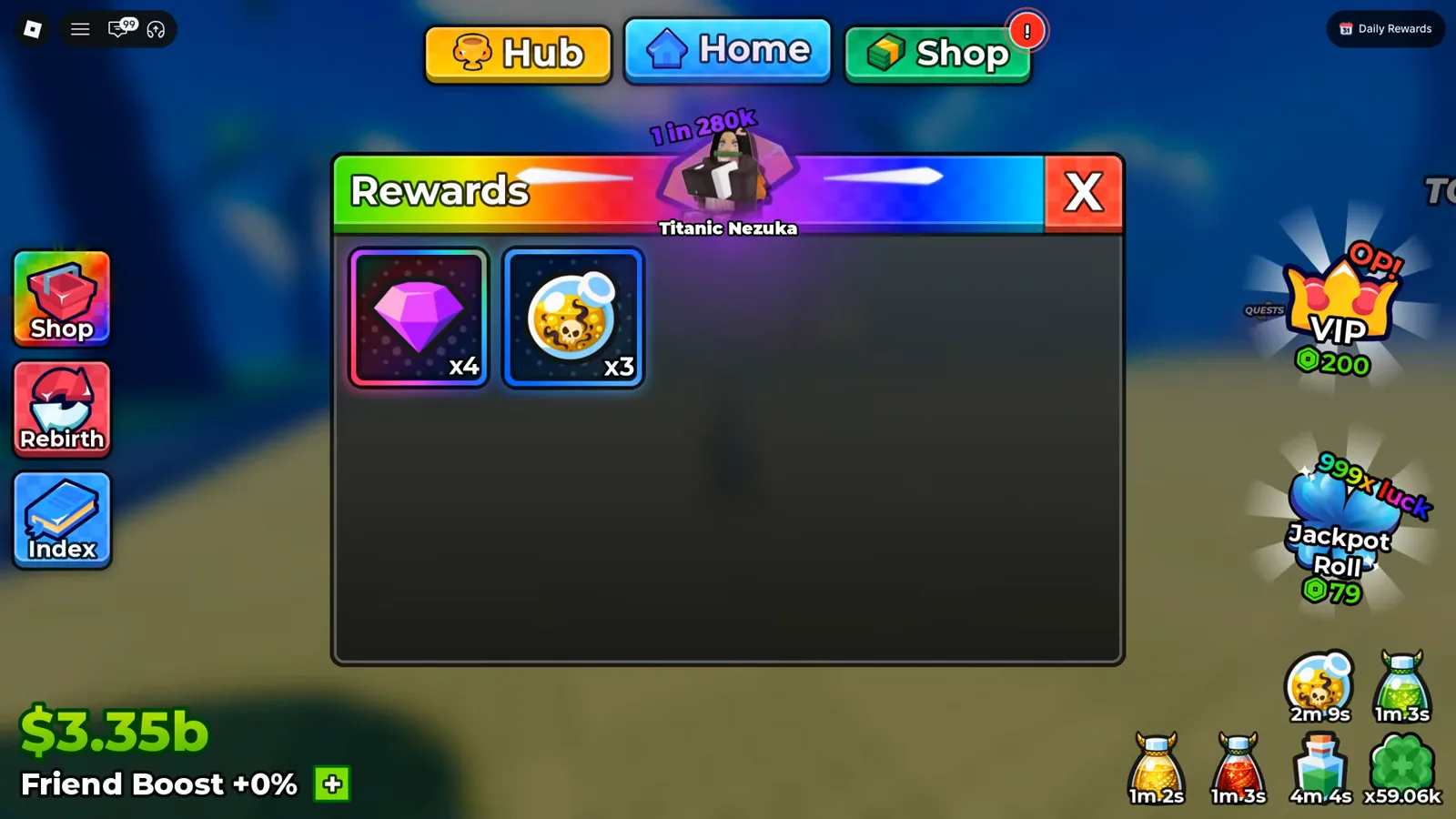
This is outcome, not odds — the number you actually got.
Watch the Rewards payout at 11:40
Not every run pays gems. The same panel in an earlier trip of the same session shows only two potions and no jewel at all, which is the honest shape of a drop table.
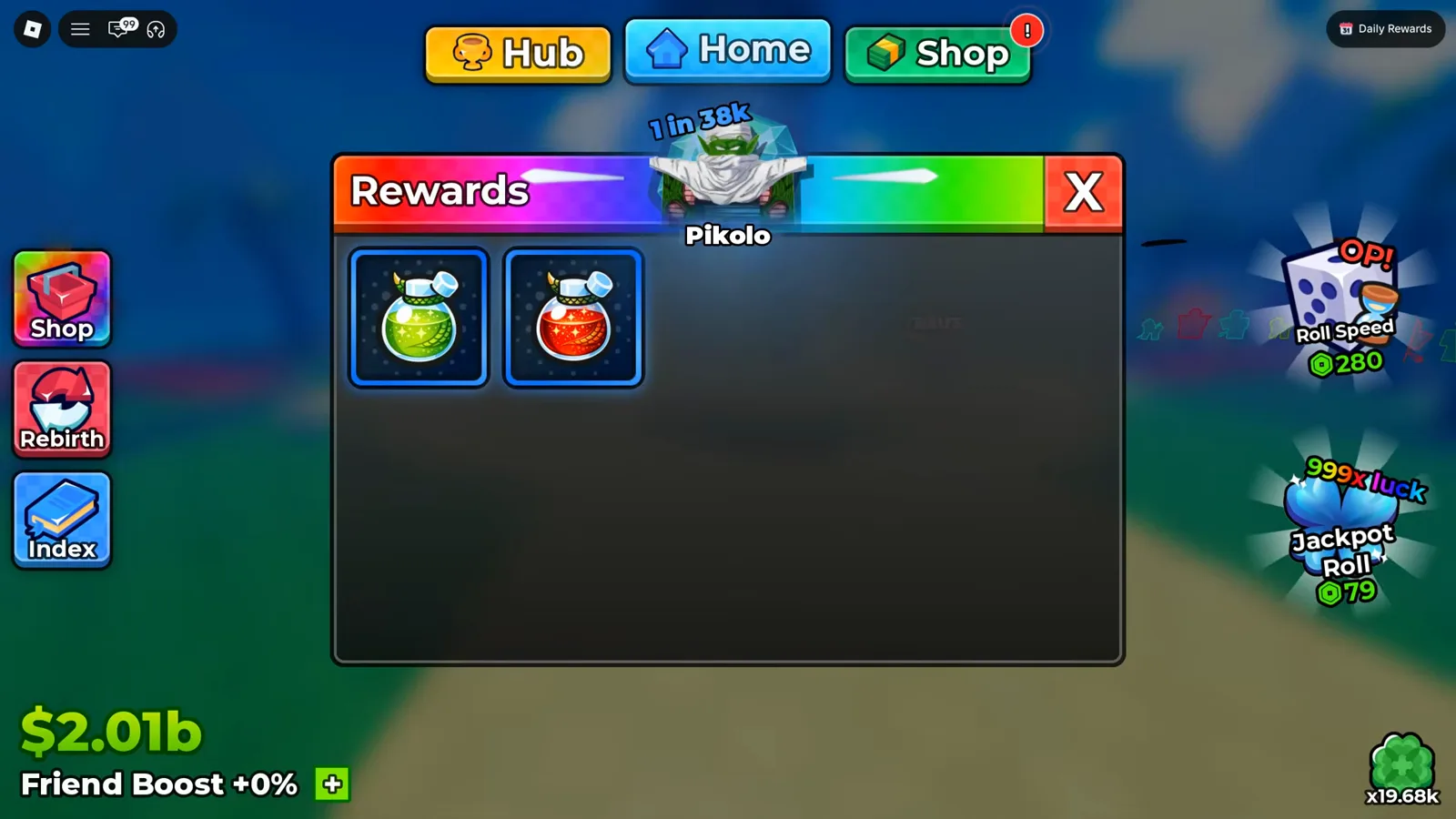
Two potions and no gem — the drop column percentages are chances for a reason.
Watch the potion-only payout at 10:40
3 — The ground. Rewards land as physical pickups you walk over, which is where the “+4 Gems” toast above comes from.
Both long-form players in our set describe the same behaviour, and one of them says it out loud while reading a finished run’s payout: “you do actually get tickets from the towers. It’s just very rare. We have a lot of trait rerolls and gems” — Superlex at 9:29. The deeper towers are the overnight currency farm because they feed potions, rerolls and gems at once. The mechanics of running one unattended — Auto, the backpack cap, auto-sell — are on the Infinity Tower guide and the AFK farming guide.
What Should You Spend Gems On First?
Since the only confirmed sink is grade rolls, the priority question is not what to buy but which unit gets the attempts.
- Only grade-roll units you are keeping. A grade multiplies that specific card’s income, so gems spent on a unit you plan to sell next roll are gone. The pattern our sources show on camera is exactly this and no more: pick a named unit, spend a gem, take whatever letter lands — one player targets a B-grade Krillin because “he is a B, so we will use it”, then reads the result as a miss (“what did we lose out on? 3x”). Gems are consumed per attempt with no guarantee attached.
- Push the high-rarity cards first. A grade multiplier on a Legendary is worth multiples of the same multiplier on a Rare, so the tier list decides where gems pay back: see the character tier list.
- Watch Auto Roll rather than trusting it. The toggle repeats rolls without your clicks but does not stop when a good tier lands — the caveat we documented in the AFK farming guide. If you cannot watch the screen, roll manually.
- Set traits before you sink more gems into the same card. Grade and trait are different fields on the same unit, and traits are the reroll-currency decision, not the gem one — the ordering is in the reroll priority guide and the traits guide.
What Should You Not Spend Gems On?
Anything that is not a grade roll — and in practice that means do not look for gem prices where the game uses other wallets. The frames below are the two places players most often assume a gem cost and find cash instead.
The unit level-up stalls on your plot are priced in dollars: the pad below reads $5.5k to take a unit from Lvl 7 → 8.
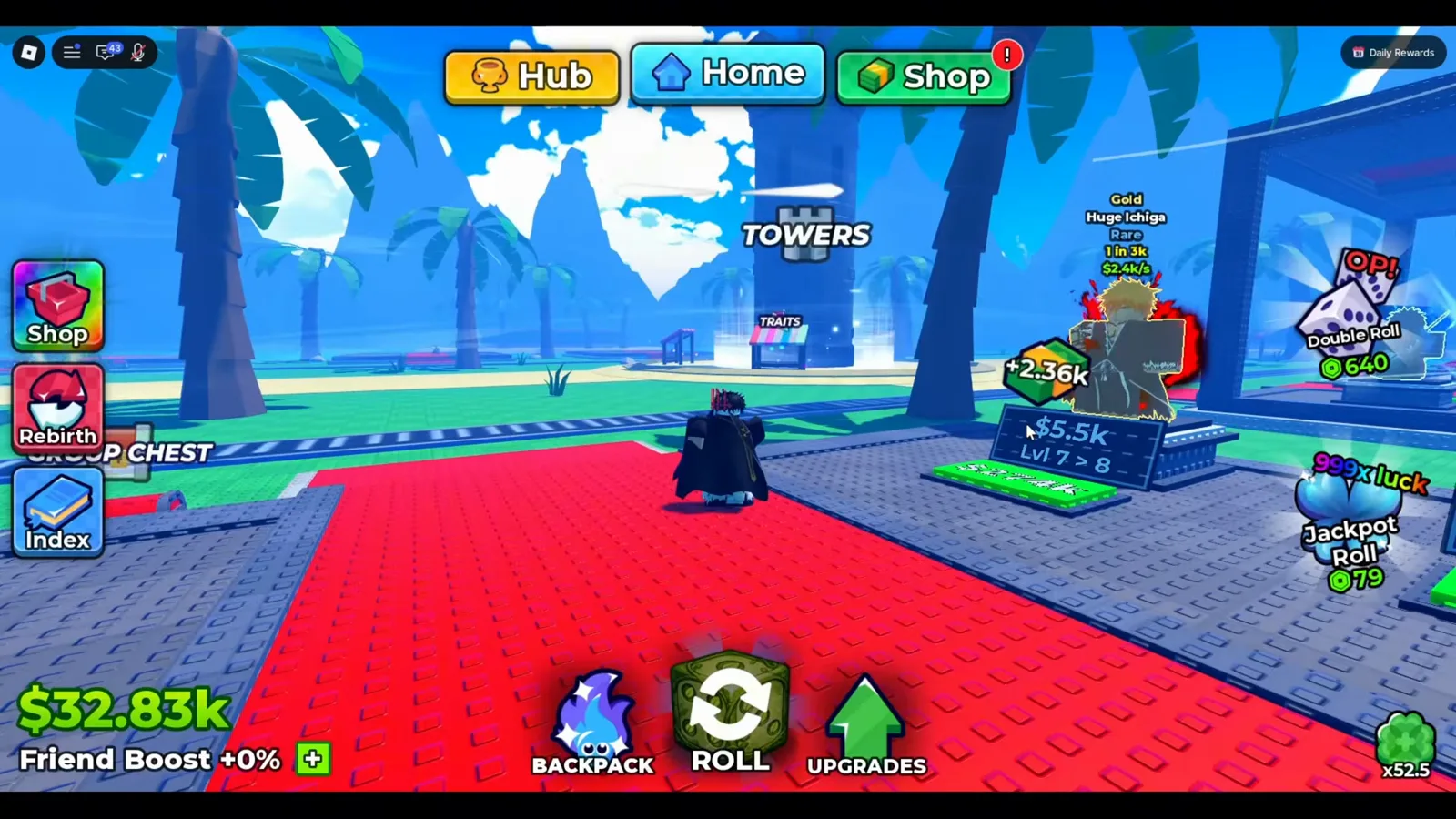
The green pads and the boards are dollars. Gems never appear on this screen.
Watch a level-up stall at 3:30
And when a stall is out of reach, the rejection is a cash check — the red line across the screen reads “You can’t afford to level this up!” while the boards around it price in the millions and billions of dollars.
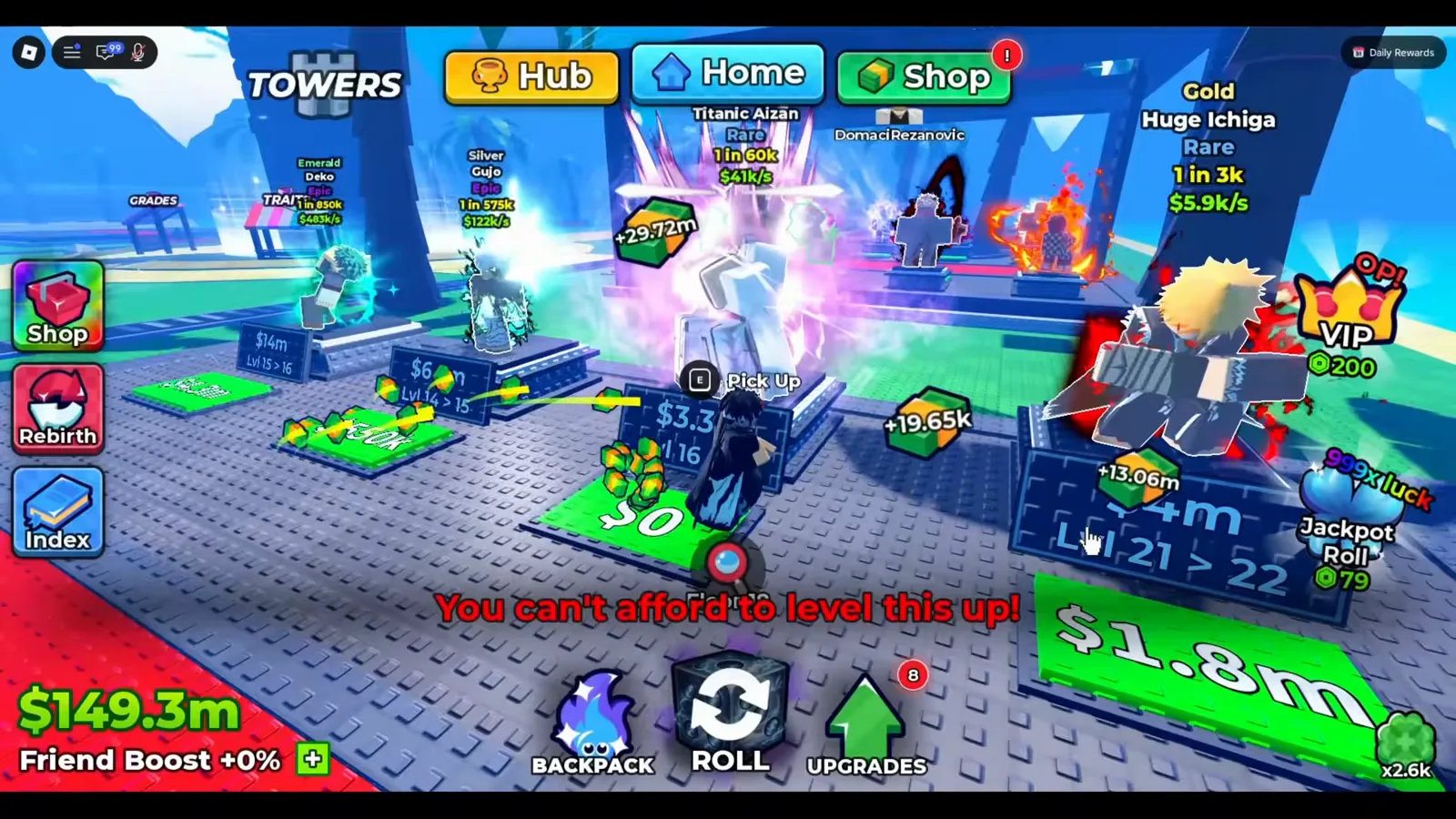
Cash-limited, not gem-limited — worth knowing before you hoard jewels for the wrong problem.
Watch the affordability warning at 5:40
The same split applies one layer up: the Upgrades hex tree — Money I, Luck I, Unit Storage I, Damage I — is priced in cash too, and the dice shop is dollars all the way through. The spending order for that wallet is on the block and dice upgrade priorities page, and the base-versus-slot decisions behind it on the beginner guide.
How Do Gems Differ From Lucky Spins and Trait Rerolls?
Three wallets, three jobs. Mixing them up is the single most common Anime Dice economy mistake, and the icons are the fastest way to keep them straight — the Backpack’s Items tab lays them out side by side in one row.
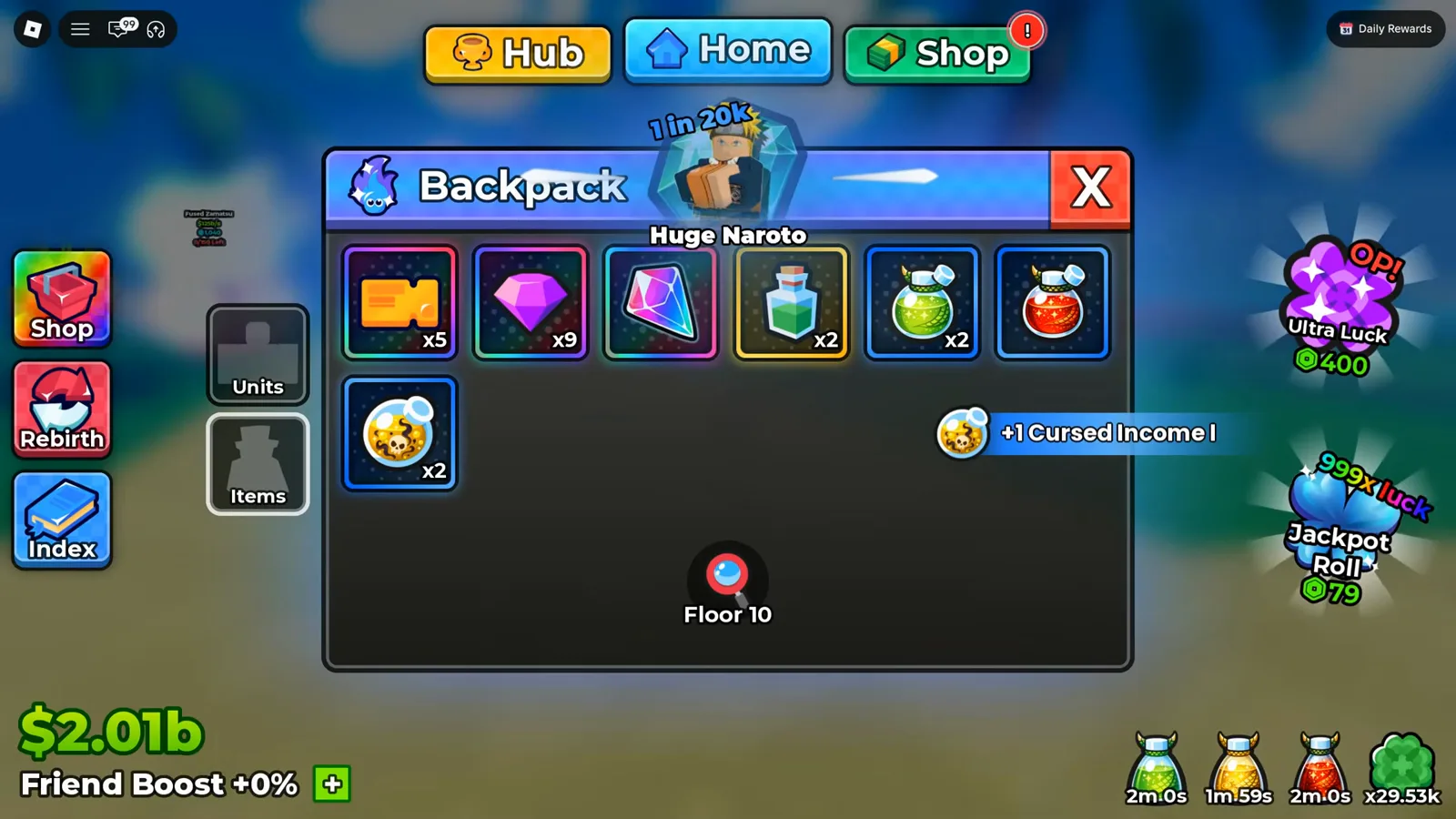
Three currencies, three icons — the stack that buys grade rolls is the purple one.
| Wallet | Icon you see | What it buys | Where it comes from |
|---|---|---|---|
| Gems | Purple faceted jewel | Grade rolls on a unit you own (income multiplier) | Tower drops and Rewards payouts |
| Trait Rerolls | Pink crystal, tooltip “Trait Reroll / Celestial” | A new roll of the traits on a unit you own | Tower drops, quests and codes |
| Lucky Spins | Spin counter in the shop | Additional rolls for new units | Codes, dailies, the spin counter |
| Cash ($) | Green bills, $ counter | Unit level-ups, the Upgrades tree, better dice | Your placed units, offline generation |
The practical consequence: if a unit’s income is the problem, gems and grade are the lever. If its trait line is the problem, the pink crystal is the lever, and spending gems will not move it. Which units deserve either is a tier-list question — start with the reroll priority guide, and top up the free side of all three wallets from live Anime Dice codes before you commit anything.
Related Articles
guides
Anime Dice Infinity Tower: Difficulty Tiers & Floor Rewards
Where the Infinity Tower is in Anime Dice, what each Towers difficulty tier means, how to set a team, and what floors drop — checked frame by frame on video.
guides
Anime Dice Offline Earnings: How Away Time Makes Cash
How offline earnings work in Anime Dice, what actually scales away-time cash, what the developer has not published, and a 4-step test to measure your own rate.
guides
Anime Dice Update History: UPD 1, 2, 3 Timeline (2026)
Anime Dice update timeline: launch, UPD 1, UPD 2, UPD 3 and the 12 September hotfix — each line split into official facts, community records and unverified claims.
Was this helpful?
Thanks for the feedback!