Anime Dice Potions: Effects, Durations and Tiers Read Off the Screen
What potions do in Anime Dice, read off the tooltips frame by frame: the name, rarity, multiplier and duration printed, where they drop, and the ticket question.
Preguntas frecuentes
What do potions do in Anime Dice?
How long do potions last in Anime Dice?
How many potions can you have running at once?
Can you buy potions with tickets?
Where do potions come from?
What Do Potions Do in Anime Dice?
A potion is a timed boost you own as an inventory item, and the game tells you exactly four things about it. Open the Backpack on its Items tab, hover a flask, and the tooltip prints a name (Pirate Luck III), a rarity (Mythical), a multiplier behind a four-leaf-clover glyph (x3), and one duration line — Lasts for 4m 0s. That is the entire contract the client offers, and it is the only place in either recording where a potion explains itself.
Notice what is missing from that list. The tooltip never says what x3 multiplies. It does not say whether the boost touches your roll luck, your income or your units’ damage — the name implies an effect family, and the clover glyph implies luck, but no screen spells the mechanic out. So on this page a multiplier is the item’s own printed claim, not a measured result, and we say so every time we use one.
Every screen here was opened and read frame by frame from two clean screen recordings:
Sources: the captures below are frames from two no-facecam, no-burned-caption screen recordings, checked frame by frame at full resolution on 2026-09-19 on the UPD 4-era client: RexonSIM’s I Spent ROBUX to 100% Complete Anime Dice Roblox! (20 minutes, an account that spends most of it with a full Boosts panel running) and RustScroll’s GOING NOOB 2 SECRET IN ROBLOX ANIME DICE (PART 1) (50 minutes, a from-zero run whose first potions arrive on the daily board). Spoken lines are quoted with timestamps. The developer publishes no potion list, no effect table and no duration table — everything below is what a screen showed.

RexonSIM's session — the Backpack, the Boosts panel and the tower drop tables all appear in its first four minutes
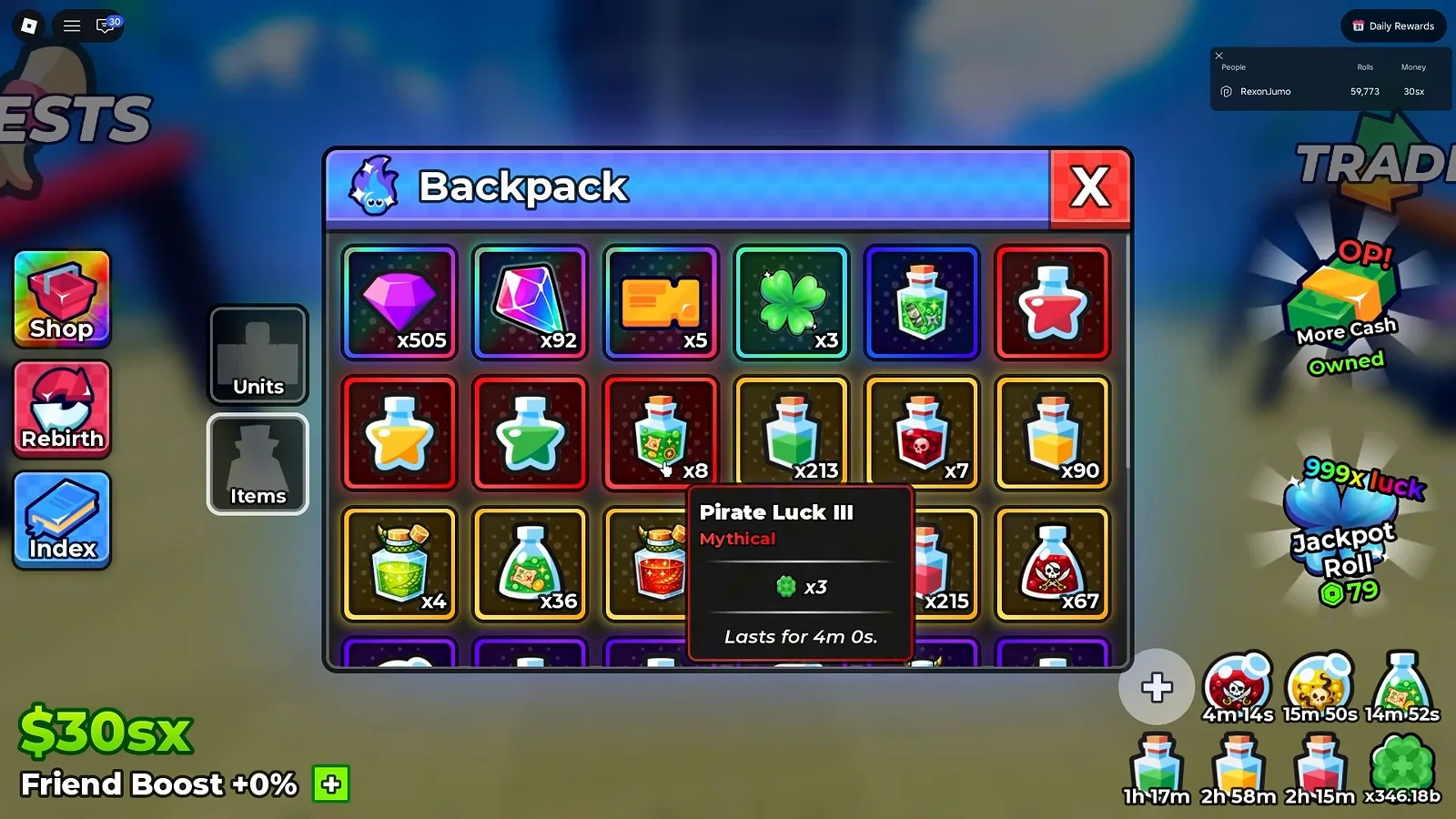
Read the tooltip top to bottom — nothing about potions lives anywhere else on screen.
Watch the potion tooltip at 2:42
Which Potions Did We Actually Read Off a Tooltip?
Four tooltips were legible at full resolution across the two recordings. We print them as a list of what exists, not as a table of what to chase — the families we could not read stay unlisted.
| Potion (tooltip, as printed) | Rarity line | Multiplier line | Duration line |
|---|---|---|---|
| Luck IV | Mythical | x4.25 | Lasts for 5m 0s |
| Pirate Luck III | Mythical | x3 | Lasts for 4m 0s |
| Cursed Luck III | Legendary | x2 | Lasts for 3m 0s |
| Cursed Luck III (Boosts-panel hover) | not shown in that tooltip style | x2 | not shown |
The first three come from the Backpack, where the tooltip carries all four lines; the fourth is the same potion hovered inside the Boosts panel at 19:20, where the tooltip style is shorter — name and multiplier only. Two details fall out of the table cleanly:
- The numeral and the rarity are separate dials.
Luck IVis Mythical at x4.25,Pirate Luck IIIis Mythical at x3, andCursed Luck IIIis Legendary at x2 — so the same numeral carries different rarities, and the onlyIVwe read did print the biggest multiplier. Three points is a direction, not a ladder: we extrapolate noLuck Iprice and noLuck Vduration from them. - The prefix tracks a tower name. We read
Pirate Luck IIIandCursed Luck IIIin the Backpack, and the Towers list those same sessions opens shows a Pirate Tower and a Cursed Tower as playable entries. That is a naming match, not a proven drop link — the floor-by-floor version of that question belongs to the Infinity Tower guide, which reads the drop tables themselves.
Outside the tooltips, potions announce themselves in green-and-purple pickup toasts, and those give us the effect families. Two we verified letter by letter: +1 Dragon Luck II at 15:25, printed beside a green gold-rimmed flask, and +1 Dragon Damage I at 15:45, beside a red one — so inside that one family the icon colour separates the Luck potion from the Damage potion. Two shorter toasts drop the tower prefix entirely and just print the effect: +1 Damage I crossing the Boosts panel at 3:30, and +1 Luck I crossing it at 19:20. Whether an Income family exists we cannot say: several toasts in the overview sheets look like they read +1 Income II, but none of them stayed legible when we opened the exact second, so the word does not appear on this page as a verified potion name.
How Many Potions Can Run at the Same Time?
The game keeps every active boost in one window called Boosts, and it is the most informative potions screen in either recording: one tile per running effect, each with its own countdown ticking independently.
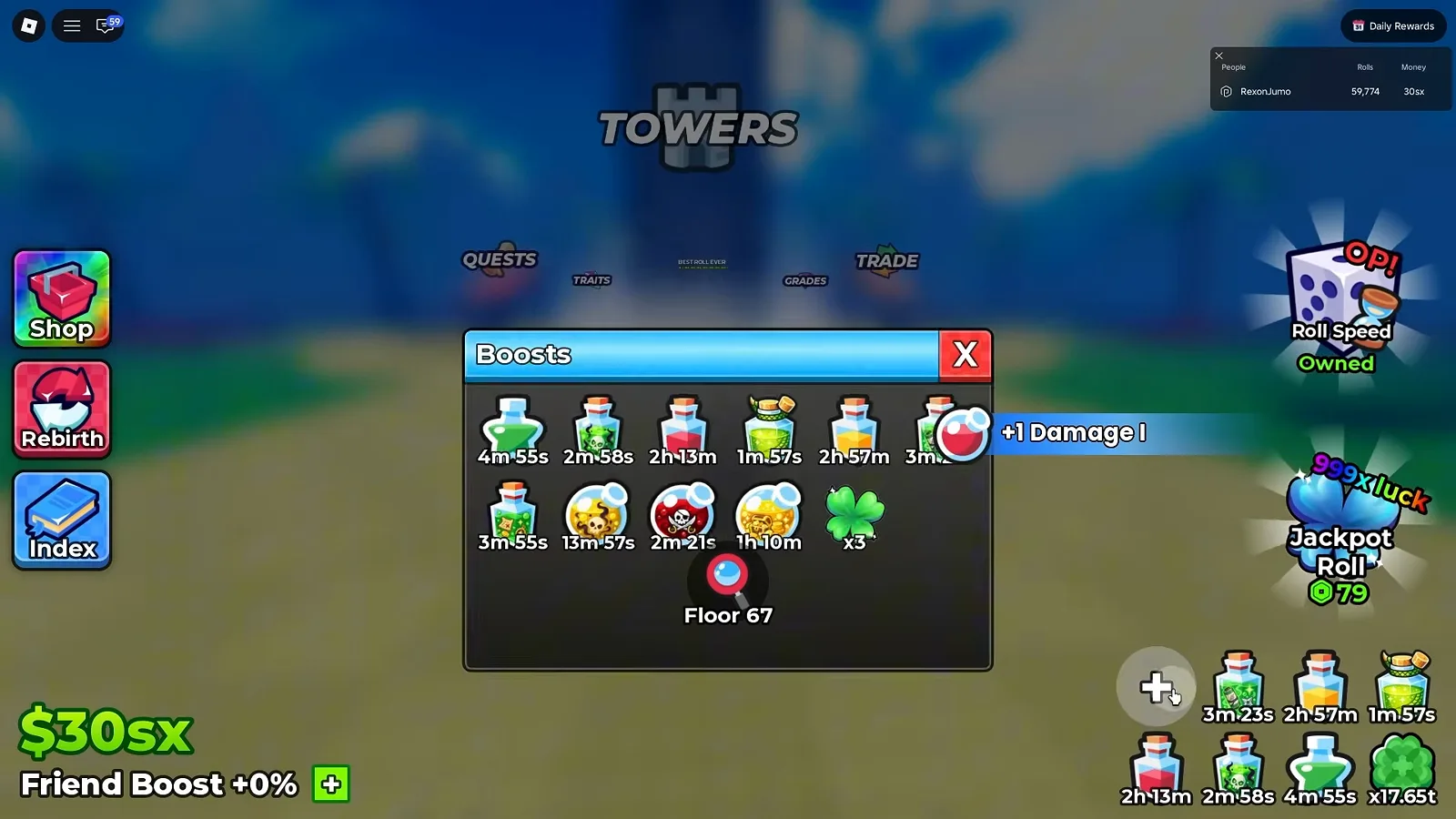
Eleven tiles open at 3:30: ten flasks each on their own countdown, and one clover tile that counts instead of timing down.
Watch the Boosts panel at 3:30
What the frame proves, and what it does not:
- Potions run concurrently. At 3:30 the panel holds eleven tiles. Ten carry countdowns —
4m 55s,2m 58s,2h 13m,1m 57s,2h 57m, one hidden behind the toast,3m 55s,13m 57s,2m 21s,1h 10m— and the eleventh is a four-leaf clover showingx3, a count rather than a timer, in the same glyph the Quests Shop tab uses for its Lucky Spin card. At 15:05 the same panel is open with nine tiles and every one of them is a flask:34m 44s,3h 39m,9m 53s,5m 52s,3m 51s,6m 55s,1h 6m,22m 31s,1h 52m. So nine or ten timed effects demonstrably run together; no screen prints a maximum, and we do not claim eleven is the ceiling. - The same row lives in the corner. Bottom-right of the HUD, the active boosts sit in a compact two-line strip — at 11:30 it reads
2m 10s,2m 9s,45s,1m 46s,3m 42s,3m 9sbefore a clover tile. That corner strip is how you check your stack without opening anything, and it is the row to watch when you are deciding whether to pop another flask before a spin. - Long timers exist, and we cannot name them. The corner strip and the Boosts panel both show tiles reading hours — at 14:00 one reads
1d 15h— while every named potion tooltip we read printed three to five minutes. Nothing on screen tells us which effect owns the hour-long tiles, so we print the observation and refuse to attach it to potions.
In the RustScroll recording the corner strip shows the same fixture on a completely different account at 48:10 — three timed tiles (38m 4s, 15m 56s, 15m 58s) beside the clover counter — which is why we treat the row as a permanent part of the HUD rather than an event-only widget.
RustScroll's from-zero run — the daily board pays the first potions, and the corner strip is running again by 48:10
Where Do Potions Come From?
Two faucets are printed on screen, and they are the two cheapest habits in the game.
1 — Tower runs. Every tower panel carries a Drops column, and potions sit inside it with percentages attached. The Infinity Tower’s panel is the clearest we captured: its Floor 25+ band lists a green potion, a red potion and a gold potion at 2% each, next to a purple gem at 2% and a reroll crystal below the fold.
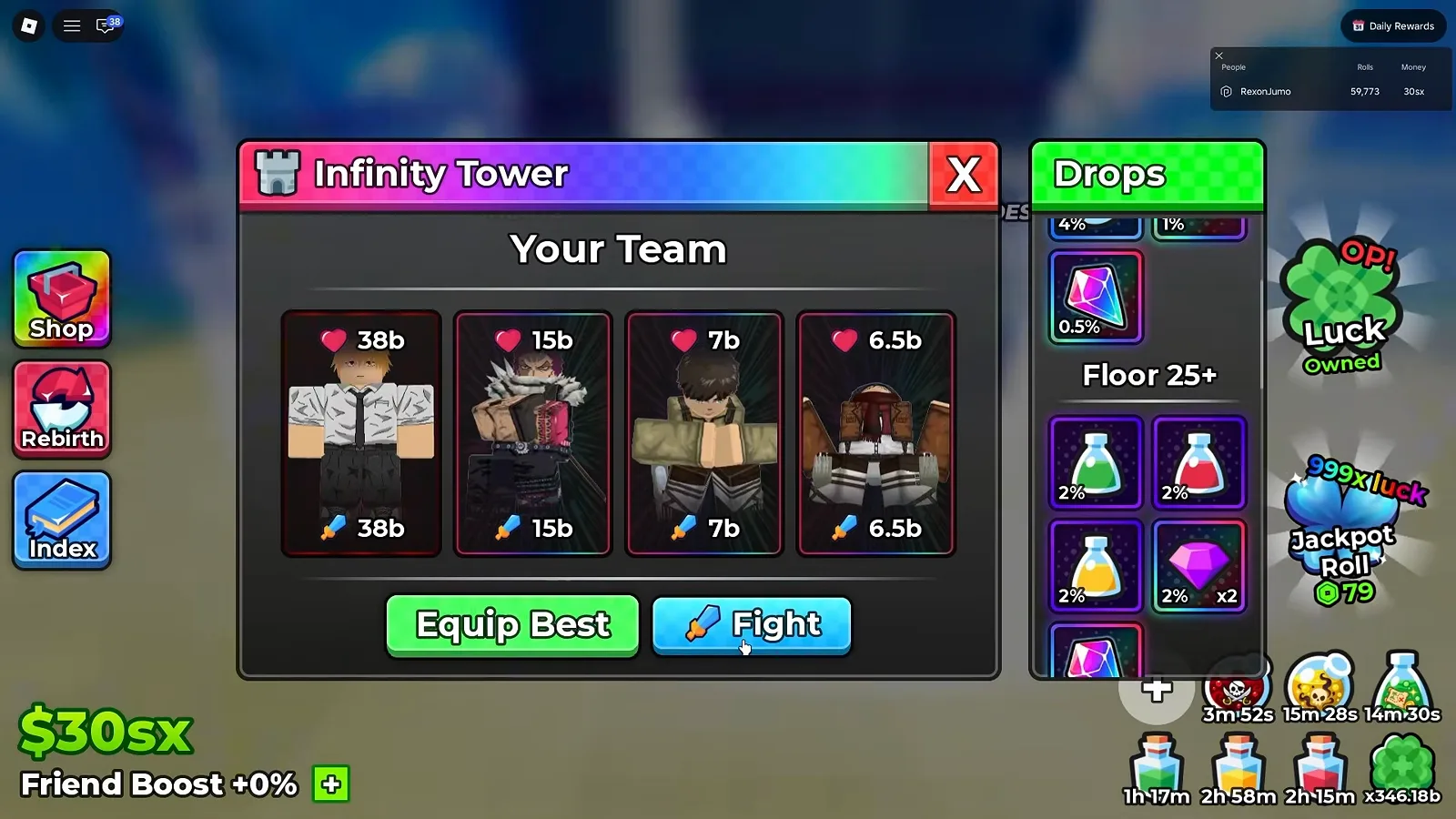
Percentages, not promises: 2% is a chance per settlement, and the top band is cut off in this frame.
Watch the Infinity Tower drop list at 3:00
Those are the odds offered, not collected — the post-run Rewards panel is where you see what a trip actually paid, and our Gems guide keeps two of those settlement frames, one of which returns potions and no gem at all. RustScroll describes the same farm by intent rather than by table at 45:25: “I’m doing the pirate tower to get what is it? Just to get overall potions and stuff.”
2 — The daily board. On a brand-new account in the RustScroll run, the Daily Rewards panel’s Day 1 tile is a green potion flask stamped x2, inside a green border with Reward Ready! printed under the grid. Day 3 pays 16 reroll crystals, Day 5 pays 32 gems, Day 7 pays a unit.
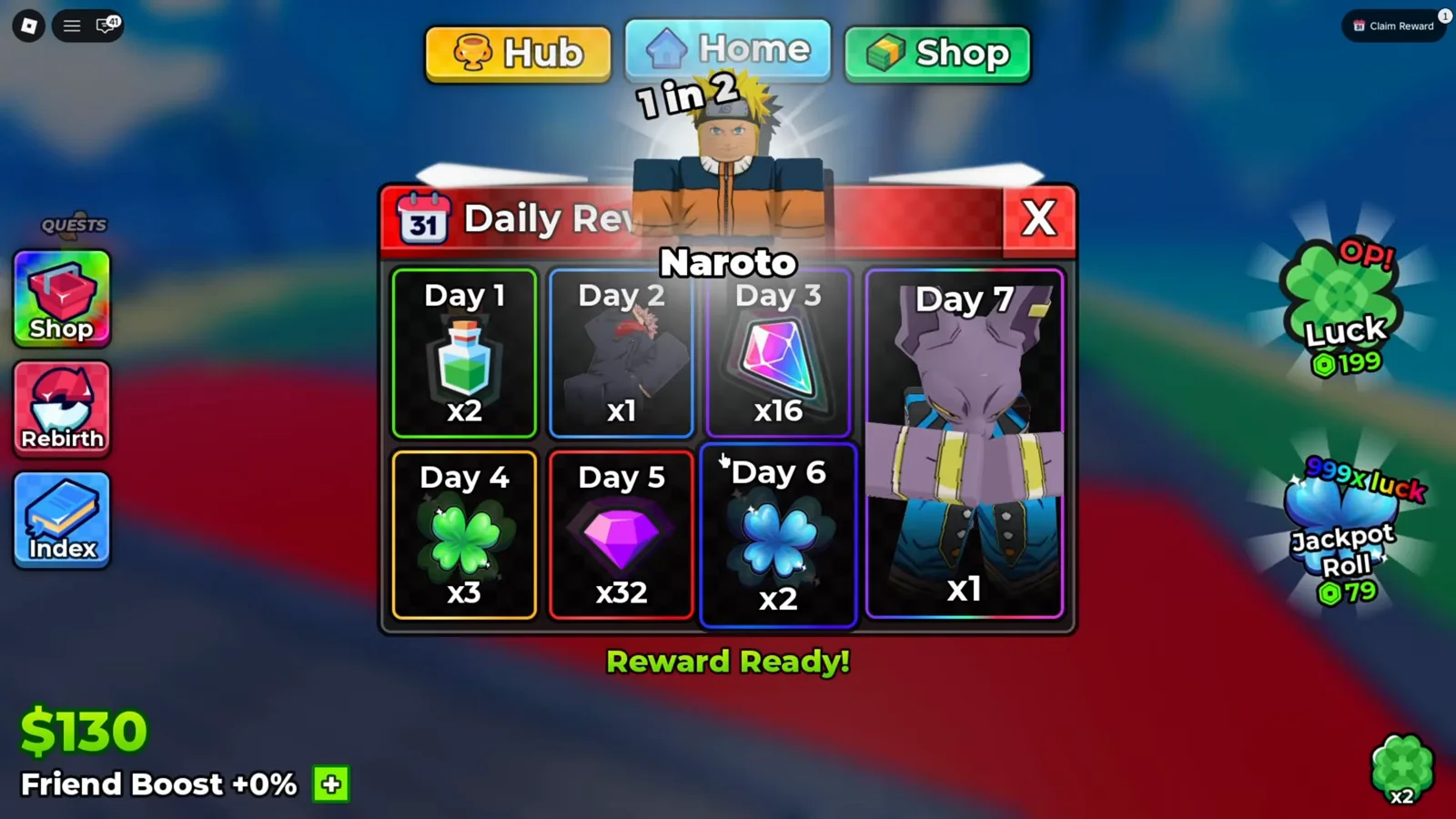
The one potion source that asks nothing of you but opening the panel.
Watch the daily rewards board at 2:05
A third source is implied by the frames but never shown as a shop: potions arrive in the same Rewards settlements as gems and reroll crystals after tower runs, and live codes are the other place players report free consumables landing. We checked every shop panel in both recordings for a potion price and found none — which is the next section.
Can You Buy Potions With Tickets?
No frame in either recording shows a potion for sale — not for tickets, not for cash, not for Robux. The place players expect it is the Shop tab inside the Quests panel, the one tab whose prices are paid in the orange ticket currency that the Daily and Weekly boards hand out. Here is that tab, whole:
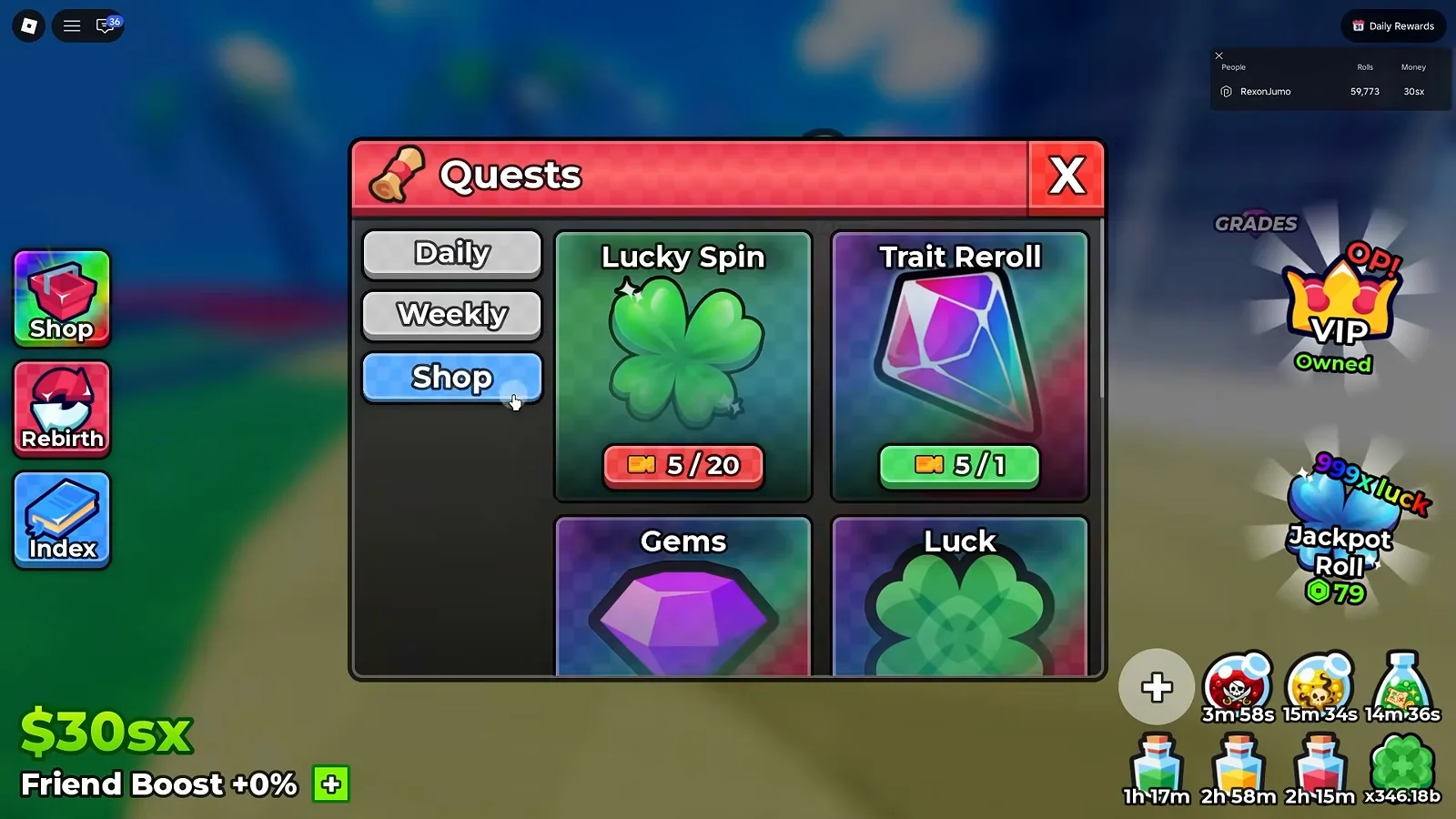
Four cards, two prices on screen, and no flask anywhere on the tab.
Watch the Quests Shop tab at 2:54
Four cards: Lucky Spin, Trait Reroll, Gems and Luck. None is labelled as a potion. Two honest notes fall out of the frame:
- The price pills read owned / cost. Lucky Spin carries a ticket icon with
5 / 20on a red pill; Trait Reroll carries5 / 1on a green one. Five is exactly the ticket stack in the same player’s Backpack seconds earlier and later (x5, third tile of the top row), and the red/green split matches “cannot afford / can afford”. Our quests and tickets guide left that pair of numbers unresolved on an UPD 3 account that showed60 / 20; this frame lines up with the same reading at a different balance. It is one account on one patch, so we call it strong evidence rather than a rule. - The
Luckcard is the one open question. Its art is the same four-leaf clover the Luck potions use, and its name is the effect those potions sell. But the panel prints no description, its price sits below the visible area in every frame we captured, and no frame in either recording shows anyone buying it. So we cannot tell you the ticket shop sells a potion, and we cannot tell you it does not.
How Do Players Actually Use Potions?
The recordings do not show a theory — they show a routine, and it is worth copying because it is the same one in both accounts:
- Buy the spins first, pop the potions second, roll last. The RexonSIM creator says the order out loud at 2:04: “I want to use these lucky spins with max luck. But I’m missing some luck potions.” He stops short of spending them for it — “Okay, you know, let’s just do this later” (2:04) — and the next time the Backpack is open, at 3:04, drinking is the first thing that happens in it.
- Use one of each, not one of everything. At 3:04 he works the Backpack tile by tile — “let’s use one of each… Is that everything? Is that all five? 1 2 3 4 5. Yep.” — and rolls immediately afterwards, at 3:34. The Boosts panel at 3:30 is what the habit leaves behind: ten countdowns and a spin counter in a single window. He counts to five the same way at 6:37, and again at 10:12 while a luck event is running.
- Double up when you are about to be away. At 5:06: “I could low key just spam a bunch of these potions and then overnight, which is what I’m going to do. But I’m just debating which one.” Doubling the stack is how you keep a boost alive across an AFK block — the away-time mechanics are on the AFK farming guide and the offline earnings guide.
- Re-check the corner strip before a big roll. At 18:54, mid-spending, he stops: “Wait, am I forgetting a potion?” — and the Boosts panel is how he answers it. The habit is the whole value of the item: a potion you let expire before your jackpot spins bought you nothing.
Where the payoff lands is a maths question we cannot answer honestly. Potions multiply something, rebirth multiplies Luck and Cash account-wide, and the upgrade tree nodes multiply income — but no screen in either recording prints the combined formula, and the update history page is blunt that no changelog exists to check it against. What we can tell you is which numbers are real: the four lines on the tooltip, the countdown in the corner, and the 2% in the drop column. Everything else on this page is a screenshot or a quote.
Artículos relacionados
traits
Anime Dice Best Traits Ranked: Every Panel Value We Could Verify
Every trait our frames could read on the Anime Dice Traits panel, ranked by printed value: Transcendent 15x at 0.006% down to Money I 1.2x at 25.4%.
guides
Anime Dice Hidden Leaf Tower: Extreme Difficulty & Leaf Potions
Where the Hidden Leaf Tower sits in the UPD 4 Towers menu, what its Extreme label prints, and which Leaf potions it drops — read off the panels frame by frame.
guides
Anime Dice Shop Guide: The Dice Ladder's Luck Multipliers and Prices
Every Anime Dice shop Luck value and cash price we could read on camera: Normal 2x to Cyber 62,500,000x, the buy-in-order dice ladder, and what Update 4 added.
¿Te resultó útil?
¡Gracias por tu opinión!