Anime Dice Upgrade Tree: Money, Luck, Damage & What to Buy First
How the Anime Dice Upgrades hex tree works: the Money, Luck, Damage and Unit Storage branches, what nodes cost, and what to buy first — read frame by frame.
Perguntas frequentes
How do you open the Upgrades tree in Anime Dice?
What branches does the Upgrades tree have?
What do the grey question-mark hexes mean?
How much does an upgrade node cost?
Which branch should you upgrade first?
What Is the Upgrades Tree, and Where Do You Open It?
The Upgrades tree is a honeycomb of floating hexagon nodes you buy with cash, and it lives behind the green UPGRADES button at the bottom-centre of the screen — the upward arrow wedged between BACKPACK and ROLL. Press it and the game does not pop up a flat menu; the nodes unfold in the world around a central Start hex, and a red Close button appears underneath.
Every screen on this page was opened and read frame by frame from one session:
Source: the captures and timestamps below are frames from Shensu’s I Went from NOOB to PRO in Roblox Anime Dice! (September 2026), the run that walks straight into the Upgrades tree around the two-minute mark, hovers individual nodes so their tooltips print, and keeps buying until the deeper tiers appear. A companion page, our Infinity Tower guide, screenshots the same video’s Towers menu — this page deliberately uses different frames and stays on the upgrade economy.

The session whose UPGRADES button, hex tree and node tooltips this guide is built from
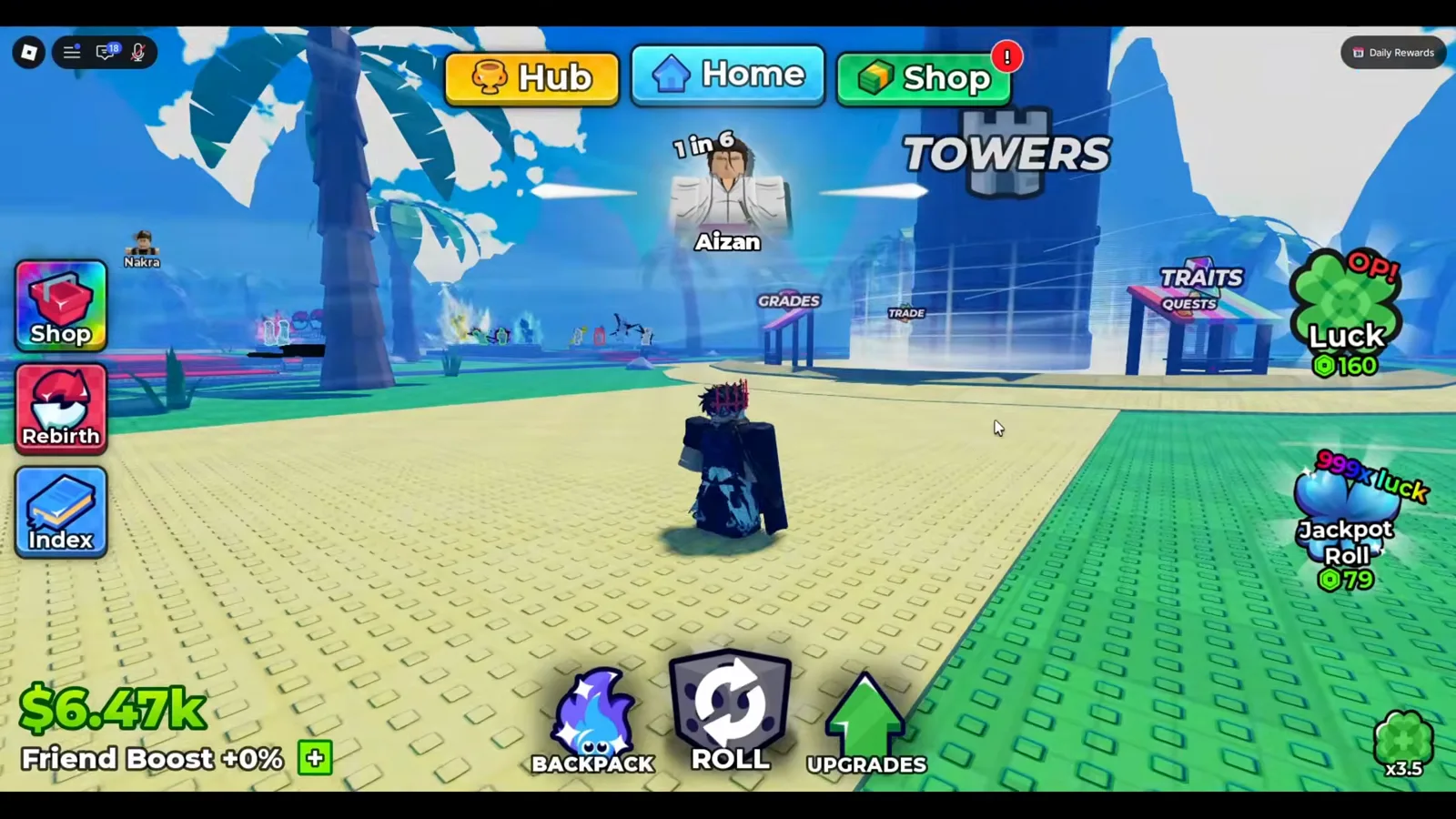
That arrow is the whole entry point; everything below is what opens behind it.
Watch the UPGRADES button at 2:06
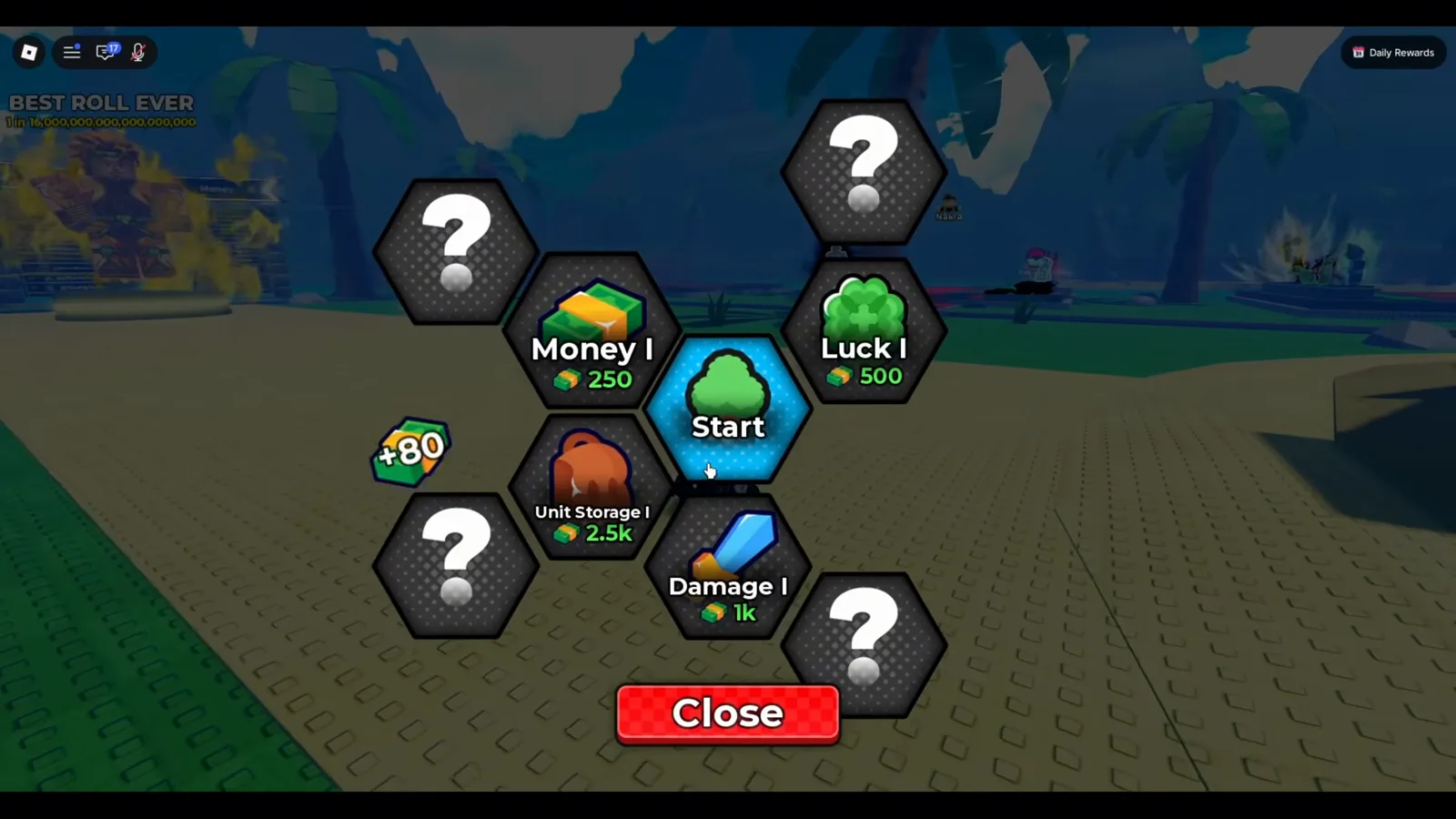
Four buyable branches, one Start node, and four grey ”?” hexes waiting to be unlocked.
Watch the freshly opened tree at 2:01
What Do the Money, Luck, Unit Storage and Damage Branches Do?
Reading the tier-I ring left to right, the game names four branches and gives each an icon that says what it touches. Hovering a node prints a small black tooltip with its effect — in the frame below the cursor is on Money I and the tooltip reads +25%.
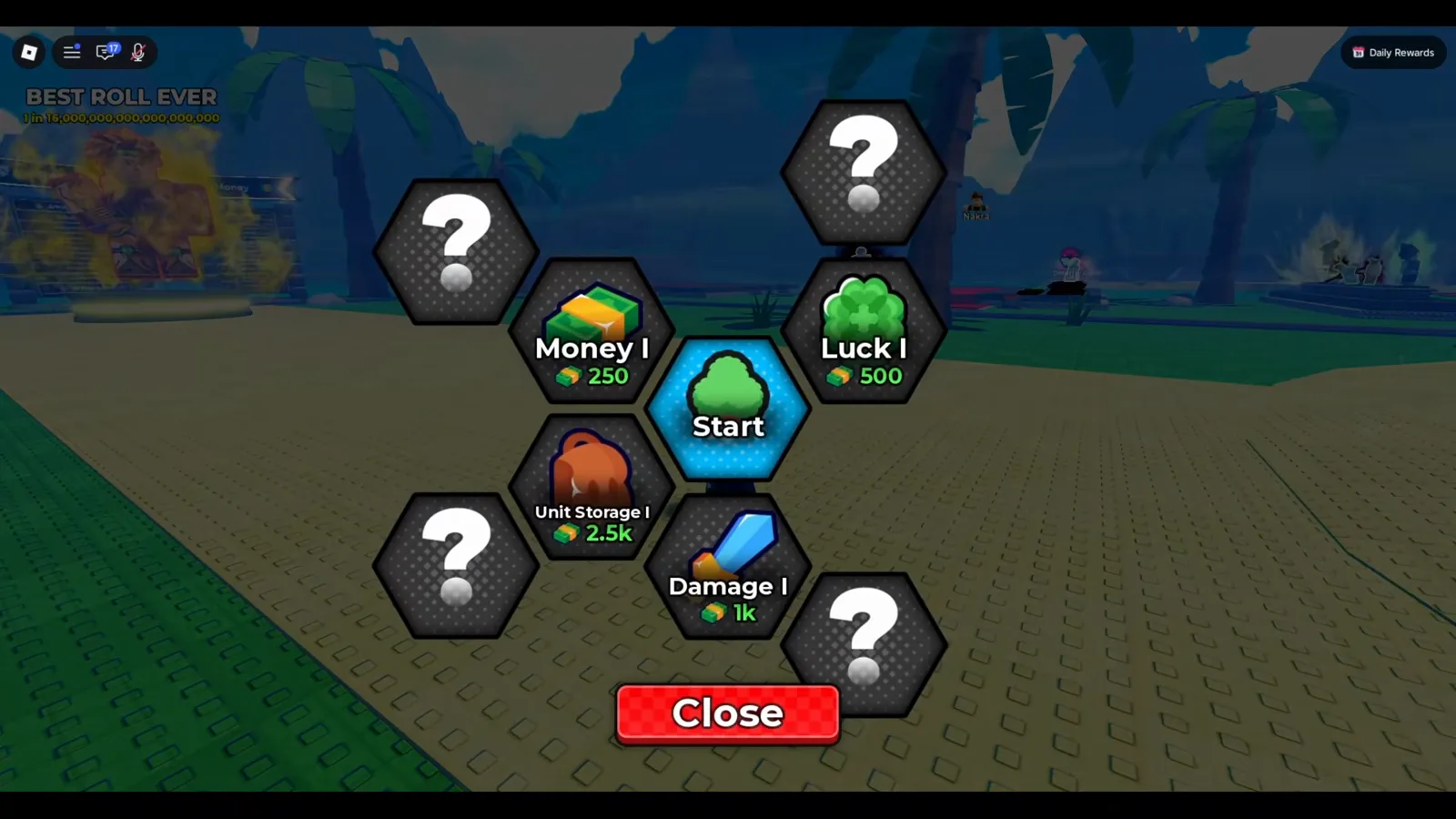
The four branches and their opening prices, straight off the screen.
Watch the four branches at 2:03
| Branch | Icon | What it raises | Tier-I cost (as shown) |
|---|---|---|---|
| Money | cash stack | cash generation — Money I tooltip reads +25% | $250 |
| Luck | four-leaf clover | roll luck (numeric effect not legible on screen) | $500 |
| Unit Storage | backpack | how many units you can carry (slot count not printed) | $2.5k |
| Damage | sword | unit damage — the branch tied to tower combat | $1k |
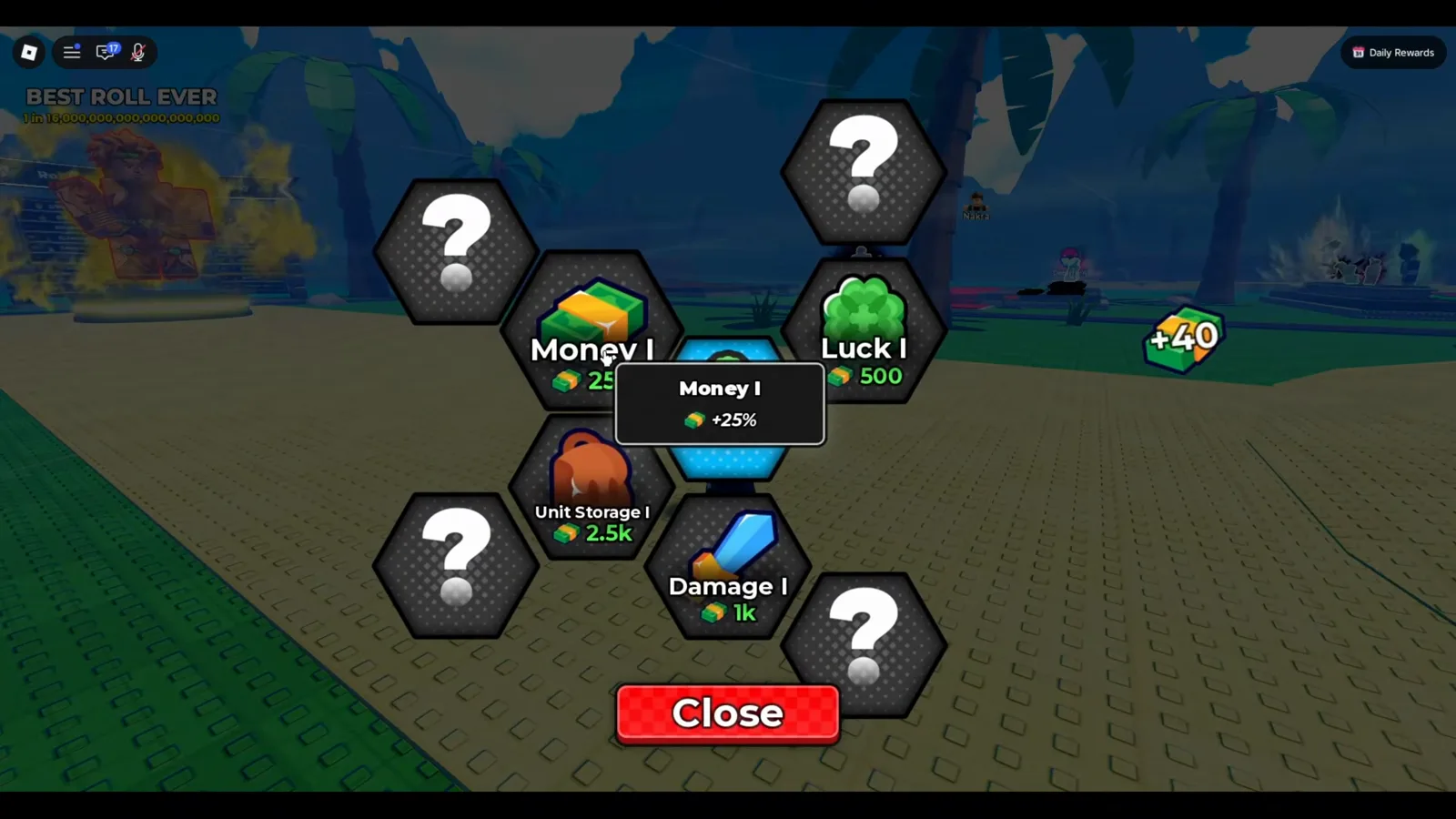
Money I is a +25% raise to your cash rate — the only node effect we could read at tier I.
Watch the Money I tooltip at 2:04
What Do the Grey ”?” Hexes Mean, and How Does the Tree Grow?
The outer ring of the freshly opened tree is grey hexes stamped with a ”?”. Those are nodes you cannot buy yet — the game only reveals a hex once the node in front of it has been purchased. Watch the same tree a few seconds later, after the walkthrough has spent cash on the tier-I nodes:
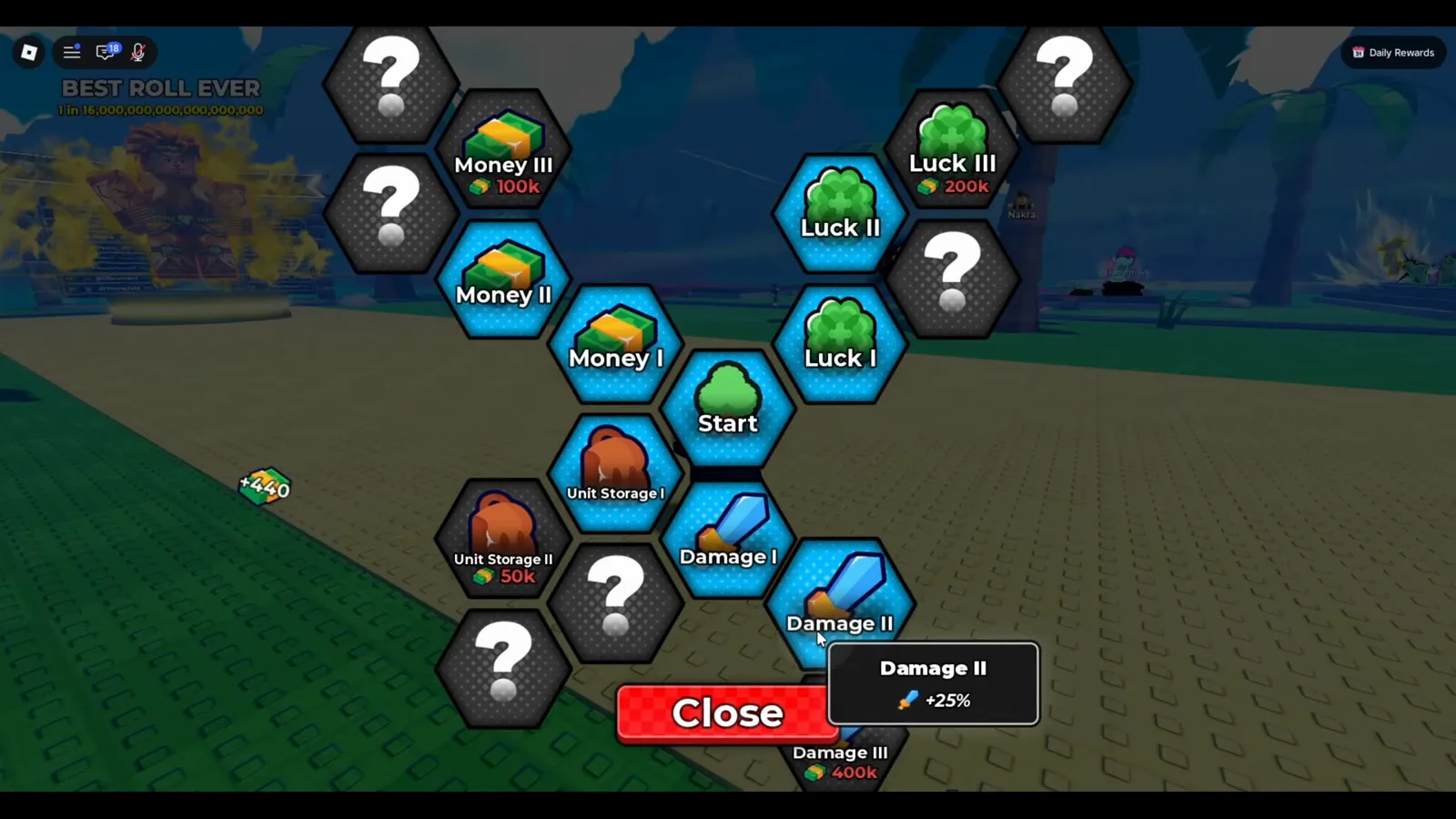
The ”?” positions are now real nodes: Money III $100k, Luck III $200k, Unit Storage II $50k, Damage III $400k — and Damage II reads +25%.
Watch the unlocked tiers at 2:05
Two things fall out of comparing that frame with the first one. First, the tree genuinely grows outward — the ”?” hexes that ringed the tier-I nodes become named II and III nodes once you buy the tier before them, while new outermost hexes stay ”?”. Second, the price curve is steep: the same branch that opens at $250 (Money I) is asking $100k by Money III. The block and dice upgrade priorities cover the parallel cash-vs-luck spending question on the plot side; the tree is the other half of the same wallet.
What Should You Upgrade First?
The tree never states a recommended order, so this is the sequence the screens and the surrounding economy support — not a leaked spreadsheet:
- Money, early and often. Every node on this tree is priced in cash, and Money I is a flat +25% to your cash rate (tooltip, above). Raising income first is what makes the $2.5k, $50k and $100k nodes reachable at all; the fuller spending order lives in block and dice upgrades.
- Luck, next. The clover branch is what weights rolls toward the rare, high-multiplier units — which is the whole point of rolling. See which units are worth pulling in the character tier list, and how to spend the pulls in the Traits guide.
- Damage, only when a tower stops you. The sword branch is the one the walkthrough ties to tower combat (“there’s also damage as well — I think it’s for the tower”), and Damage II confirms it with a +25% tooltip. If you are not pushing floors yet, leave it; the Infinity Tower guide covers exactly when the Damage branch starts paying for itself.
- Unit Storage, as a fix. Buy it when your backpack fills mid-session, not on a timer — the deeper tiers jump fast ($2.5k to $50k by Unit Storage II).
Two free-to-play levers sit outside the tree but feed the same wallet: redeeming live Anime Dice codes funds spins and rerolls before you spend a dollar on a node, and the Gems usage guide explains the separate currency the tree deliberately does not charge in — every node here is cash.
Artigos relacionados
guides
Anime Dice Grades: The Income Tier Ladder and Gem Cost
What Grades do in Anime Dice: a per-unit income multiplier you reroll with Gems, read off the on-screen tier ladder frame by frame.
guides
Anime Dice Quests and Tickets: Daily, Weekly and Shop Tabs
Where the Quests board is in Anime Dice, what the Daily, Weekly and Shop tabs actually pay, and what Tickets buy — read off frames, one screen at a time.
guides
Anime Dice Gems: What to Spend Them On and What to Skip
What Gems do in Anime Dice, read off the screen: the Grades roll cost, tower drop tables, the Trait Reroll crystal, and what is actually priced in cash instead.
Isso foi útil?
Obrigado pelo feedback!