Anime Dice Unit Levels: How to Level Up and What Each Level Costs
Anime Dice unit levels read frame by frame: the level sign on your plot, the cash the next level takes, a seven-step price ladder and the level cap nobody prints.
常見問題
How do you level up a unit in Anime Dice?
How much does one level cost in Anime Dice?
Why does Anime Dice say You can't afford to level this up?
What is the max level in Anime Dice?
Is the level on the sign the unit's level or the plot's?
Do gems, traits or grades level a unit up?
How Do You Level Up a Unit in Anime Dice?
Every unit standing on a plot in your home area is signed. In front of the plot there is a dark blue board, and that board carries two lines in a fixed order: a cash figure, and a level line the client writes as Lvl A > B. That board is not decoration — it is the purchase.
We caught the whole thing happening in one unbroken two-second run. Inside that window the same stall advanced six times, once per purchase, and each purchase did two things: the number in the level line went up by exactly one, and the balance in the bottom-left corner fell by the figure the sign had just printed. Through the run the cursor rests on the sign itself, not on the green pad below it. Seven prices, six levels bought, no cuts between them:
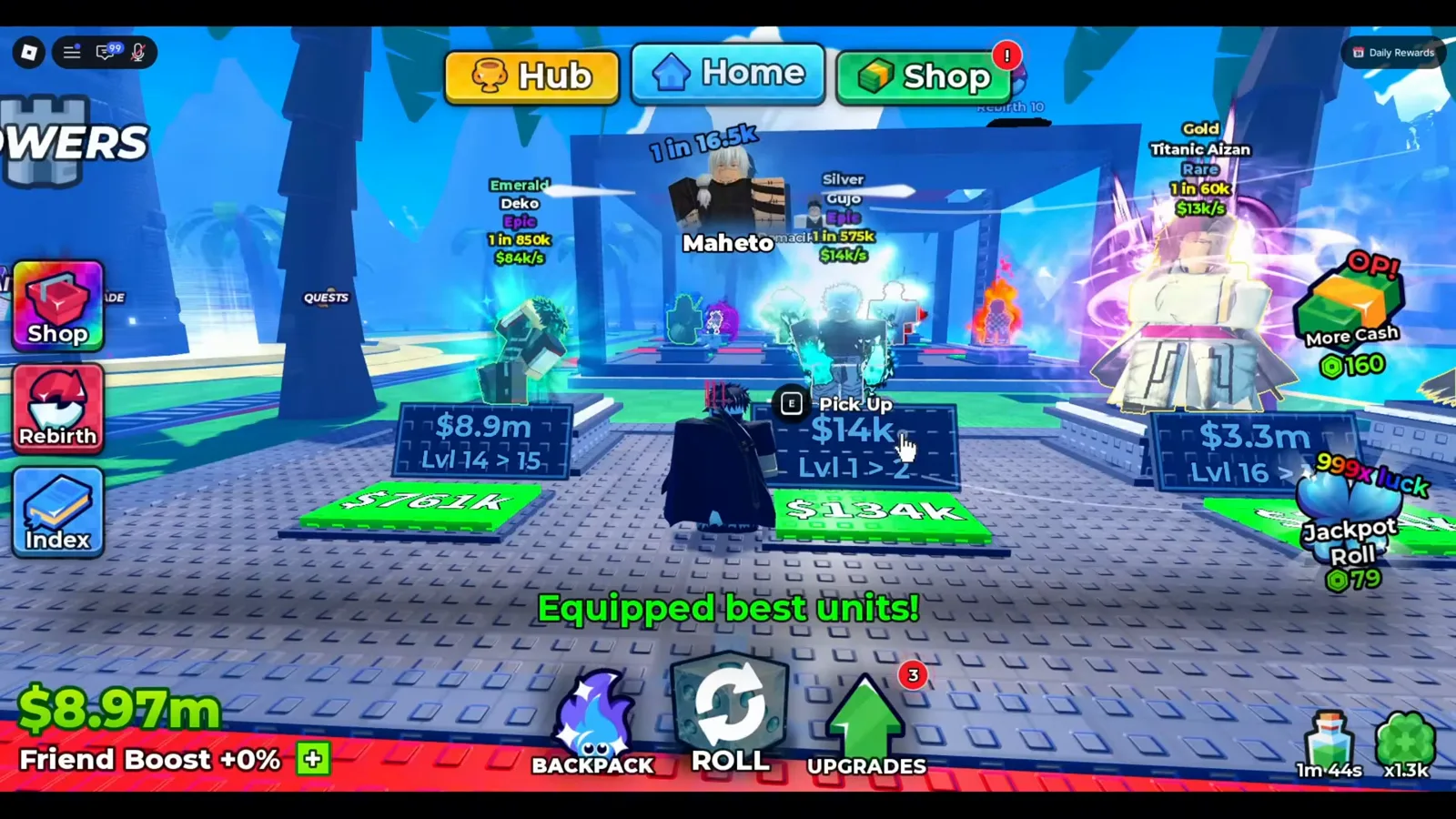
The first purchase of the run, read at native resolution at 4:20.0. $14k over Lvl 1 > 2, a $134k pad underneath, and a $8.97m balance.
Watch the Lvl 1 > 2 sign at 4:20
One second later the same sign is a different sign, because a level has been bought:
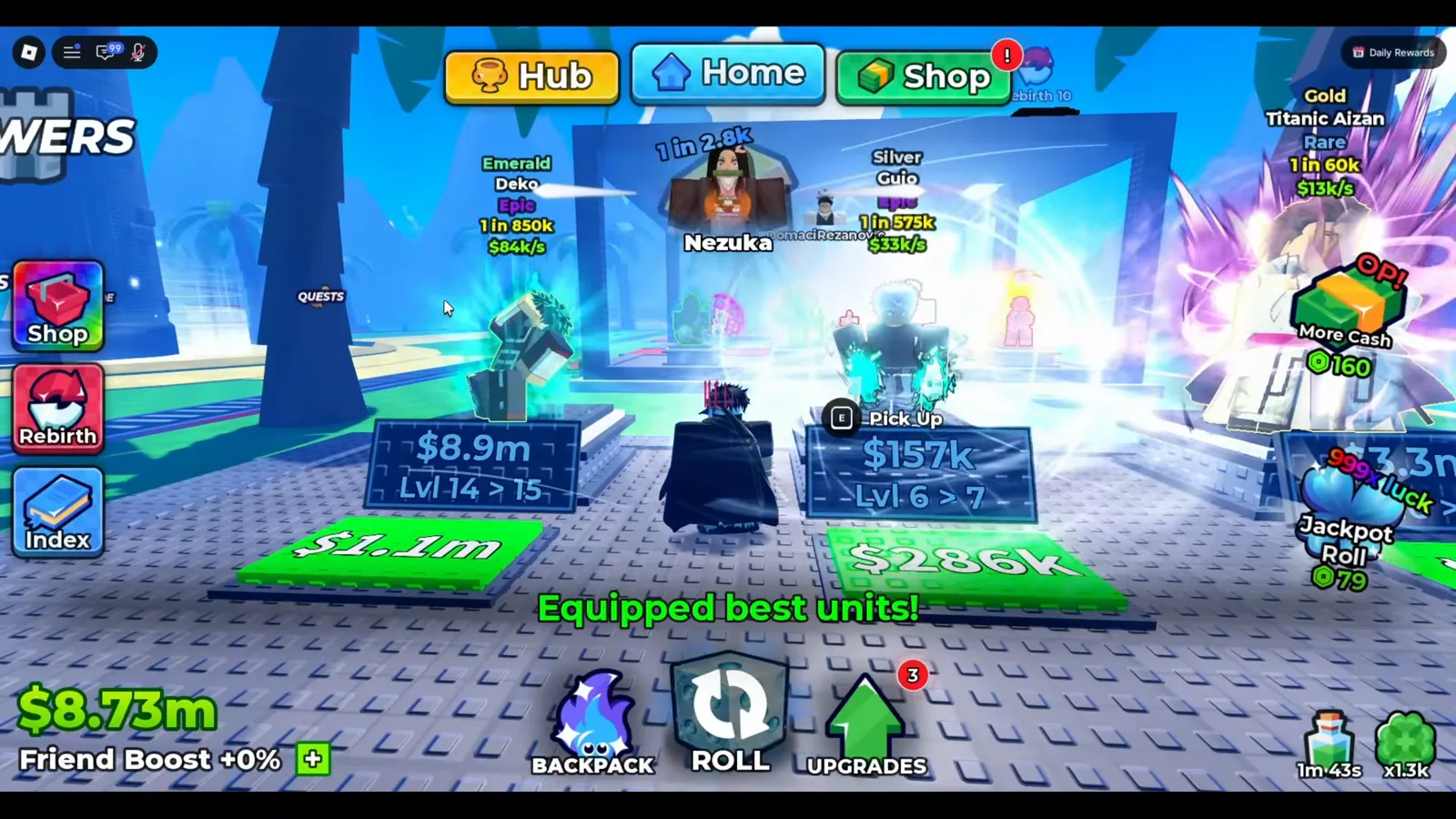
$157k over Lvl 6 > 7 at 4:21.0, with the balance at $8.73m. The pad under this plot now reads $286k, up from $134k at 4:20.0 — so the pad moves during the run, and it still is not the price on the sign.
Watch the Lvl 6 > 7 sign at 4:21
Sources: every figure on this page except the four plates at 9:04 was re-read at native 1920×1080 on 2 October 2026 from Shensu’s I Went from NOOB to PRO in Roblox Anime Dice! (10 minutes 19 seconds, uploaded 11 September 2026) — a recording with no facecam, no burned-in captions and no channel furniture, checked across 62 contact-sheet cells spanning the whole video before a single frame was used. The seven-rung ladder, the two pad readings and both spoken quotes above were then re-pinned from the same recording at native resolution before publication, and that re-pin corrected this page’s earlier claim that the green pad sits still — the pad moves, but it still is not the price. The four-plate still in the price section comes from Cx’s 24-minute Anime Dice session (uploaded 18 September 2026) at 9:04, re-read natively here as well. Each image deep-links to the second it was taken from. That first recording predates UPD 5 (around 19 September) and UPD 6 (27–29 September), so the ladder below is what a pre-UPD 5 build printed; the developer ships no patch notes and no level table, and we have not re-pinned these prices inside a UPD 6 session. The only number on this page we take from another page instead of our own frames is the
Level 35card on the character tier list.
Which Number on the Sign Is the Price?
The top line. The client labels neither line, so we did not take that on faith: we checked it against the wallet. The balance is printed to two decimals in millions, which puts a floor on how precisely it can be read, but every deduction we measured lands inside the window that contains the price printed on the sign immediately before it. In the table, the “before” figure is the last frame ahead of the purchase and the “after” figure the first frame behind it:
| Price printed on the sign | Level it bought | Balance just before → just after | Second of the purchase |
|---|---|---|---|
$14k | Lvl 1 > 2 | $8.97m → $8.95m | 4:20.1 |
$23k | Lvl 2 > 3 | $8.95m → $8.93m | 4:20.2 |
$38k | Lvl 3 > 4 | $8.93m → $8.89m | 4:20.4 |
$61k | Lvl 4 > 5 | $8.89m → $8.83m | 4:20.5 |
$98k | Lvl 5 > 6 | $8.83m → $8.73m | 4:20.9 |
$157k | Lvl 6 > 7 | $8.73m → $8.57m | 4:21.9 |
$251k | Lvl 7 > 8 | next price, not bought inside the window | 4:21.9 |
The second line is not decoration either. It is the current level and the level the money buys, in the client’s own format, and it moves in lockstep with the price: you never see Lvl 6 > 7 sitting above $14k.
How Does the Price Scale With the Level?
On one stall the ladder climbs by roughly 1.6x per level, and it does so with almost no wobble. Divide each price in the table above by the one before it: 23/14 is 1.64, 38/23 is 1.65, 61/38 is 1.61, 98/61 is 1.61, 157/98 is 1.60 and 251/157 is 1.60. Seven rungs, six ratios, all in a band of five hundredths.
That is the shape of a single stall. It is not a price list for the game, and the frames are blunt about it. At 7:05 two signs stood on the same deck in the same second: $12b over Lvl 25 > 26 and $10b over Lvl 29 > 30 — the deeper level asking the smaller figure. At 8:40 the same inversion repeats, four times larger: $274b over Lvl 28 > 29 beside $1.2t over Lvl 26 > 27.
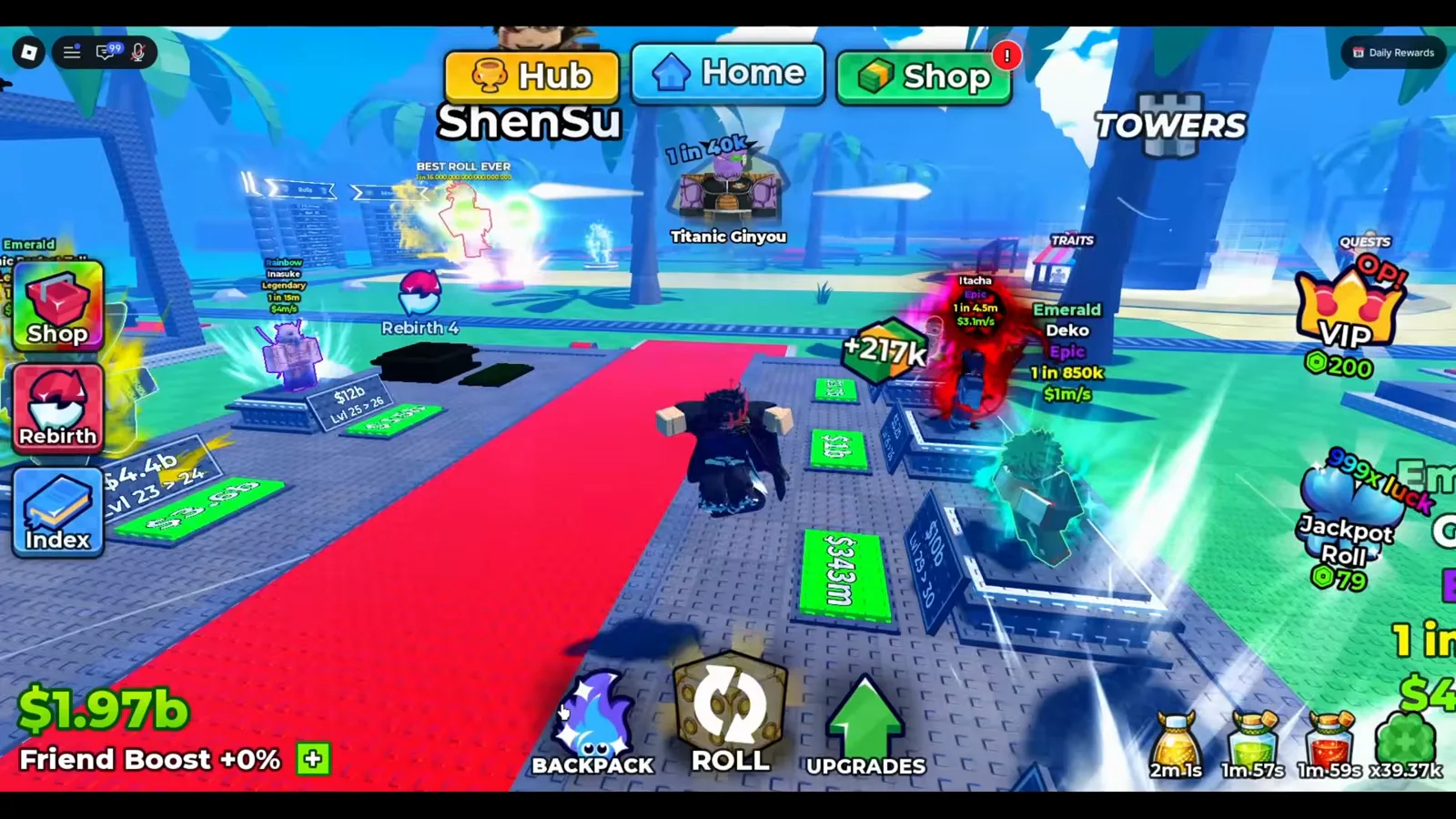
7:05. $4.4b over Lvl 23 > 24, $12b over Lvl 25 > 26, $10b over Lvl 29 > 30. Reading them left to right is enough to kill the idea of one global ladder.
Watch the billion-price signs at 7:05
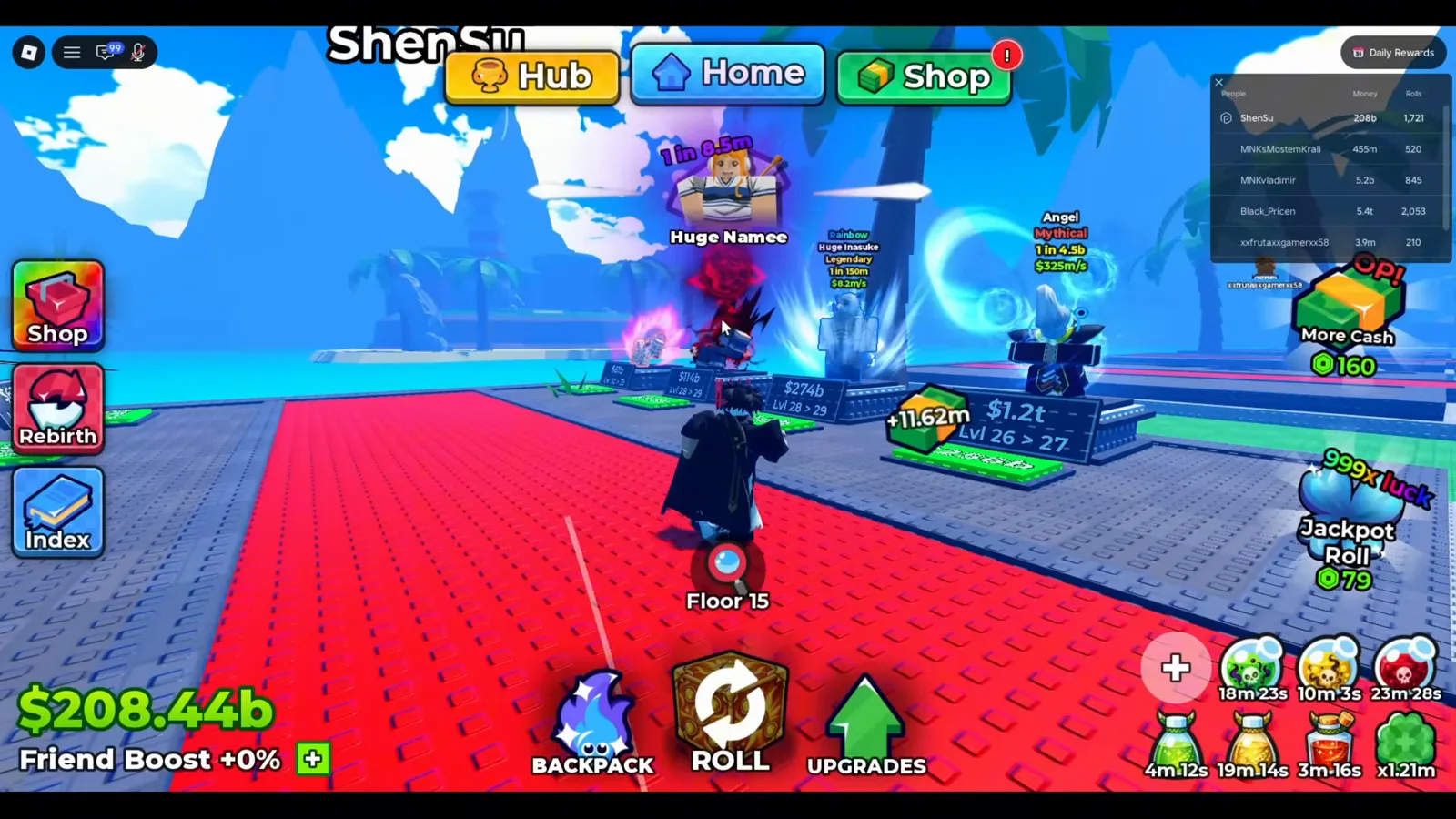
8:40. $274b for Lvl 28 > 29 next to $1.2t for Lvl 26 > 27. Same account, same second, same deck — and the deeper sign is the cheaper one again, this time by more than 4x.
Watch the trillion-price signs at 8:40
What the price follows is the stall rather than the level number — and a stall is a unit standing somewhere. That is why the same line can print three different figures in three parts of one recording: Lvl 14 > 15 reads $8.9m at 4:20, $3.9m at 4:23 and $6.7m at 5:39, on three different plots. Which property of the unit sets the base price is not printed anywhere, so this page does not claim one.
A second recording pushes the same point harder, and it is the cleanest single frame we have for it. In Cx’s session four signs stand side by side, and all four read Lvl 1 > 2 — the very first rung — while printing four different prices:
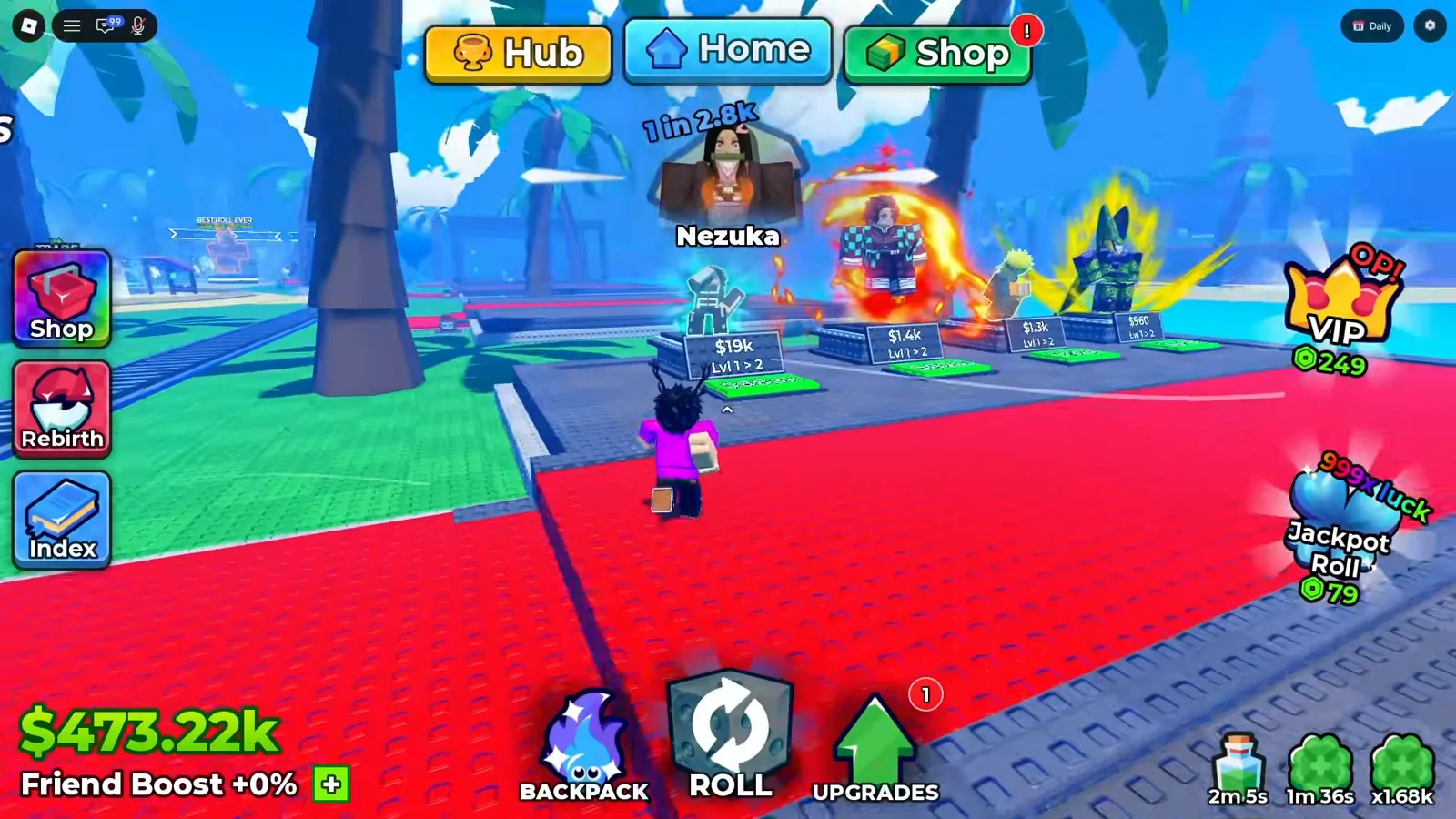
$19k, $1.4k, $1.3k and $960, all four over Lvl 1 > 2, read at 9:04 of a different account’s session. A global price table for a given level cannot produce this frame.
Watch the four Lvl 1 > 2 plates at 9:04
Here is every level point we could read, with the second it came from:
| Sign, as printed | Second | Note |
|---|---|---|
$765 over Lvl 1 > 2 | 3:55 | the unit above it printed $765/s on its nameplate |
$960 over Lvl 1 > 2 | 9:04 (Cx) | one of four Lvl 1 > 2 plates in a single frame |
$1.3k over Lvl 1 > 2 | 9:04 (Cx) | the second of the four |
$1.4k over Lvl 1 > 2 | 9:04 (Cx) | the third of the four |
$19k over Lvl 1 > 2 | 9:04 (Cx) | the dearest of the four, on the same level line |
$5.5k over Lvl 7 > 8 | 3:30 | the frame the gems guide also uses |
$4.2m over Lvl 13 > 14 | 4:23 | one of three signs in the rejected frame |
$3.9m over Lvl 14 > 15 | 4:23 | a different stall from the 4:20 one |
$8.9m over Lvl 14 > 15 | 4:20 | same line, same recording, more than double the 4:23 figure |
$6.7m over Lvl 14 > 15 | 5:39 | a third stall, a third price |
$14m over Lvl 15 > 16 | 5:39 | the sign the rejected purchase was aimed at |
$3.3m over Lvl 16 > 17 | 4:23 and 5:39 | unchanged across 76 seconds |
$4.4b over Lvl 23 > 24 | 7:05 | |
$12b over Lvl 25 > 26 | 7:05 | |
$274b over Lvl 28 > 29 | 8:40 | |
$10b over Lvl 29 > 30 | 7:05 | the deepest line this page can verify |
$1.2t over Lvl 26 > 27 | 8:40 | the largest price we read |
What Happens When You Cannot Afford a Level?
The client answers with a red line printed straight across the middle of the screen: “You can’t afford to level this up!” It is a cash check and nothing else — no gem glyph, no timer, no required level.
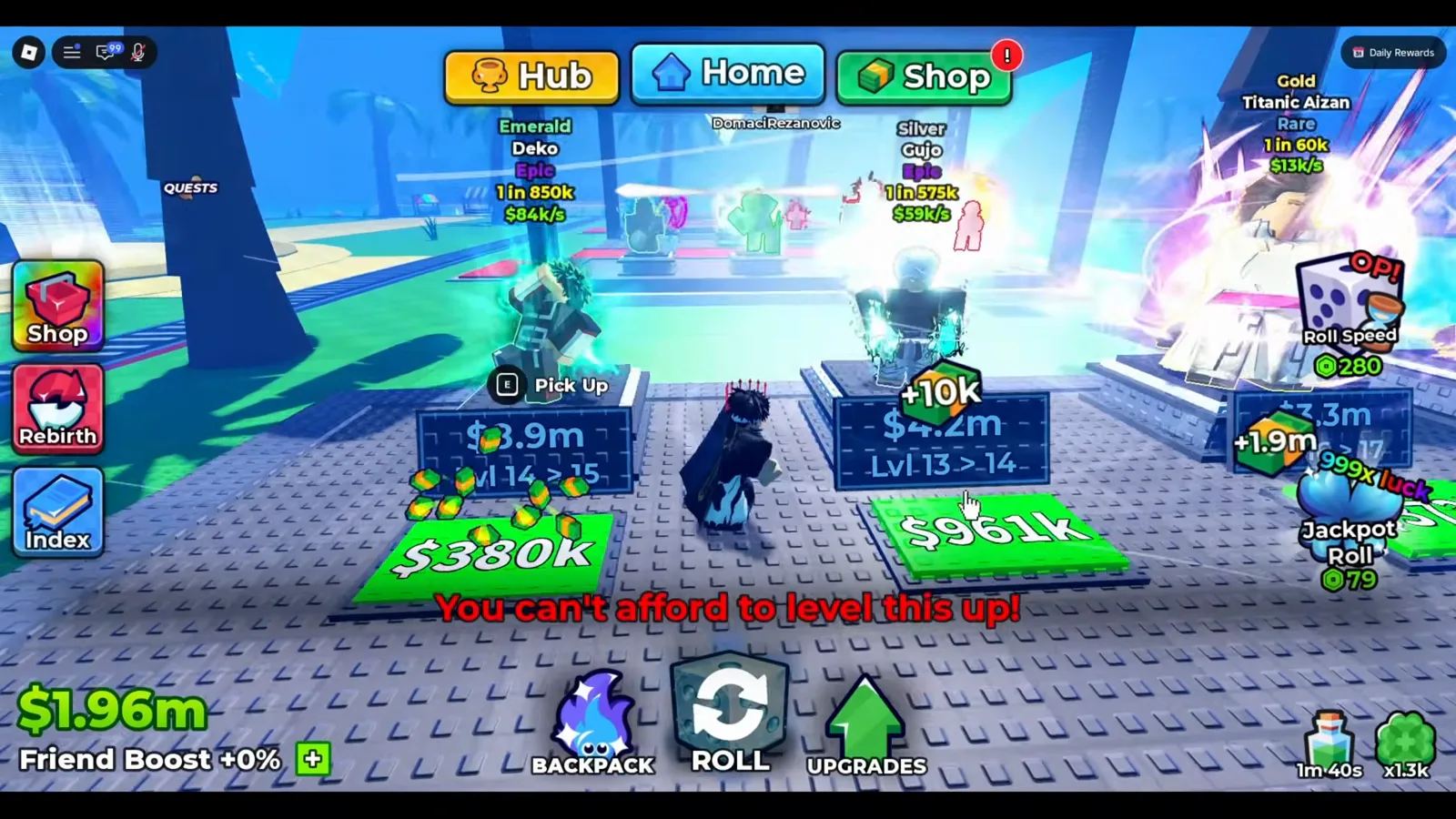
4:23, balance $1.96m. Every sign in shot is dearer than the wallet: $3.9m, $4.2m and $3.3m against a balance that cannot cover any of them.
Watch the rejected purchase at 4:23
The message scales with the account like everything else here. Two minutes of video later the same player is holding $10.54m and the red line is back, because the signs around the deck have grown to $3.3m, $6.7m and $14m:
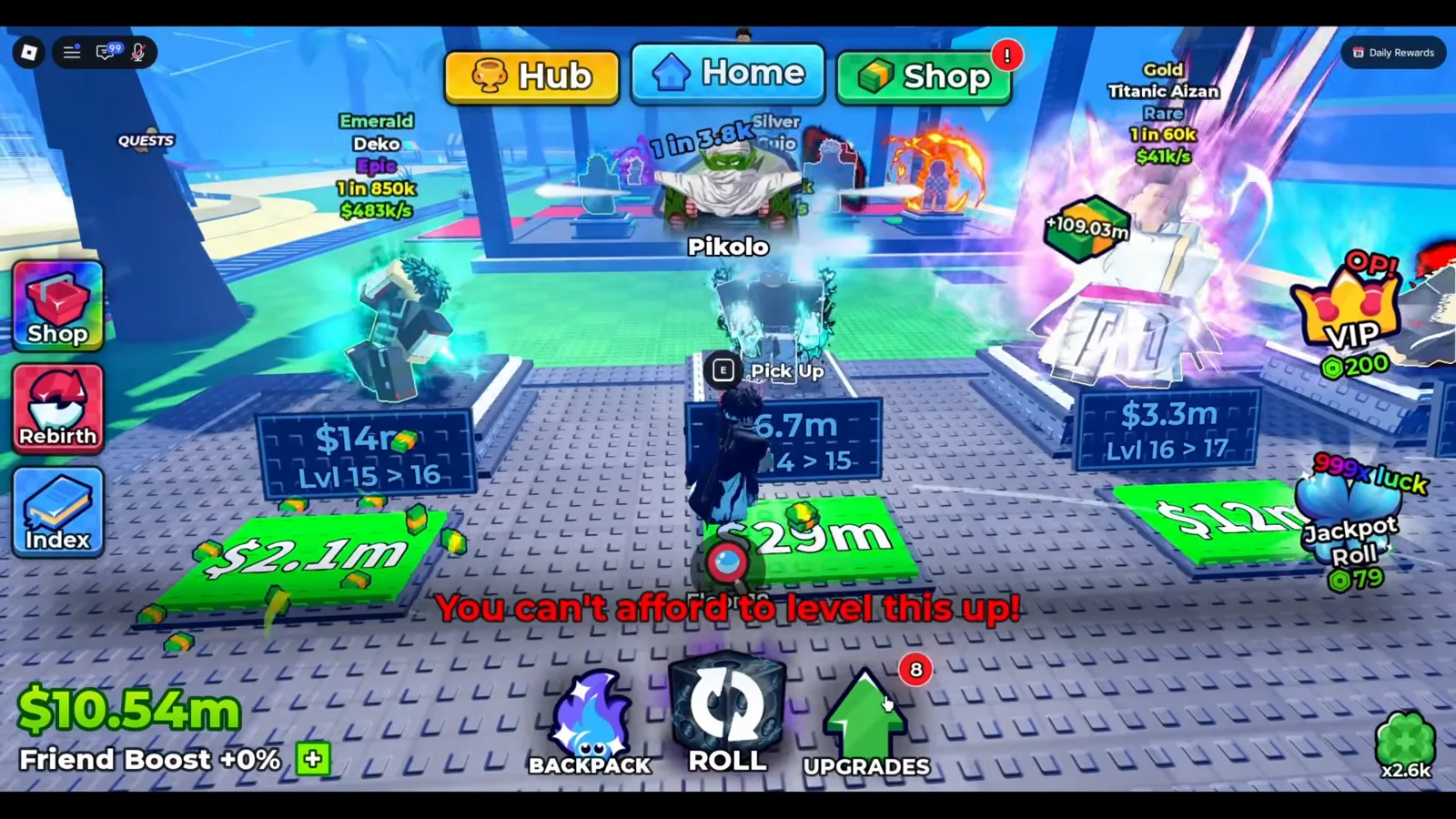
5:39, balance $10.54m, with $14m on the left-hand sign. The cheque the game wants has grown faster than the wallet.
Watch the second rejected purchase at 5:39

The whole level ladder — the sign, the purchase run at 4:20 and both rejected attempts — is inside this noob-to-pro recording
Is There a Max Level in Anime Dice?
No frame prints one. In ten minutes of footage that reaches a $208b balance and level lines well into the twenties we found no cap, no MAX tile, no ceiling marker and no message telling the player they had finished. The ladder simply keeps asking for more: $10b at Lvl 29 > 30, $274b at Lvl 28 > 29, $1.2t at Lvl 26 > 27.
Two things are worth being precise about, because the keyword invites a number.
The deepest level line this page re-pinned at native resolution is Lvl 29 > 30, read at 7:05. Beyond that we are quoting another page of ours rather than a frame of this recording: the character tier list keeps a card that prints Level 35 in its own tooltip, which proves the ladder reaches at least 35 — it does not prove the ladder stops there.
The creator says “let’s max this guy out” at 7:25 and “let’s max him out” at 3:57. Those are his words about his own clicking, not a number the client prints, and the recording contains no moment where the game refuses a purchase for any reason except money.
What Could Not Be Verified About Unit Levels
Stated plainly, so that nothing below gets quoted back as settled:
- Whether the level belongs to the unit or to the plot. The world sign prints
Lvl A > Band never says what owns it; the Backpack prints a separateLevel Non unit cards; the plot slots page reads the same sign format from the plot side and reaches a different conclusion about ownership. We buy levels, we watch them rise, and we refuse to name the owner. - What sets a stall’s base price. Two stalls two levels apart printed
$12band$10bin one second, and the sameLvl 14 > 15line printed$8.9m,$3.9mand$6.7min three frames. The price clearly travels with the stall, but no screen states whether it is derived from the unit’s rarity, its roll odds, its income or the plot’s own history. - What the green pad’s figure is. It is a cash figure, it is not the price, and it does not move with the ladder. Beyond that: three readings, three different relationships to the sign, and no label.
- Whether UPD 5 or UPD 6 changed the prices. Our frames come from a recording uploaded on 11 September 2026, before UPD 5 went live around 19 September and before UPD 6 landed on 27–29 September. Nobody publishes a changelog, so a silent rebalance would leave no trace; every figure here is a pre-UPD 5 build’s.
- The exact deduction, to the dollar. The balance is printed to two decimals in millions, so a
$14kpurchase can only be located inside a$10k-wide window. The printed price fits every window we measured, but the counter is not precise enough to prove the arithmetic to the unit. - Whether the ladder has a top. See the section above: the deepest printed line on this page is
Lvl 29 > 30, and the level-count keeps climbing in later frames. No cap, no statement, no evidence either way. - How two units on one plot interact.
Pick Upreturns a unit to the Backpack, and the plot slots page documents that prompt. Whether a replacement unit inherits the level already paid for on that plot is not shown in any frame we captured.
If your client prints a cap, a level-100 sign, or a tooltip that names what owns the level, a dated screenshot through the contact page settles it and gets credited here.
Which Units Are Worth the Cash?
Leveling is the cheapest lever on a card and the only one priced in the currency you generate by playing, which is why the question is never whether to level but what to level. Three things the frames make clear:
- Level a unit you are keeping. Each level is a cash purchase on that stall, and the price compounds at roughly 1.6x, so money spent on a card you sell tomorrow is spent twice. The character tier list is where the card-by-card call belongs.
- Push the rungs your income can carry. The rejected frames are instructive:
$1.96magainst$3.9mis a stop, and$10.54magainst$14mis the same stop several magnitudes of income later. The AFK farming guide and the beginner guide are where the income side of that race is set up. - Remember level is one field of several. Grade, trait and mutation sit on the same card, and grade rolls are paid in gems rather than cash — see the grades guide and the gems guide. A card’s income line can move for reasons that have nothing to do with the number on the sign, which is why the sign is the honest place to read your level and the nameplate is not.
What Should You Read Next?
- Plot slots — the same sign read from the plot side, plus the Backpack counter and Unit Storage
- Gems — the wallet that does not pay for levels, and the proof that this screen is dollars
- Block and dice upgrade priorities — where the cash you spend on levels should come from
- Upgrades tree — the hex map that spends the same wallet on multipliers instead of levels
- Grades — the letter field on the same card, paid in gems rather than cash
- Character tier list — which units are worth the ladder at all, including the
Level 35card - Beginner guide — the order to spend in when everything on the deck is affordable
- AFK farming — the income setup that decides how far up the ladder you can climb
相關文章
guides
Anime Dice Calculator: Cash per Luck and the Next-Dice Wait
Every Anime Dice dice price re-read at native resolution, turned into cash-per-Luck arithmetic from the 42x rung to 5,000,000,000x, plus the wait formula.
guides
Anime Dice How to Trade: the Two-Column Trade Window, Frame by Frame
Anime Dice trading read frame by frame: a two-player window with Ready per side, then Accept, Confirming, Saving and a Completed toast. No prices, no value list.
guides
Anime Dice Gears: Rarities, Bonuses and Where They Drop
Anime Dice gears are UPD 6 tower-drop equipment worn in the Backpack's Gears tab. We read six of them frame by frame: name, rarity word and bonus row.
這篇對你有幫助嗎?
感謝你的回饋!